

Last Updated on August 18, 2026
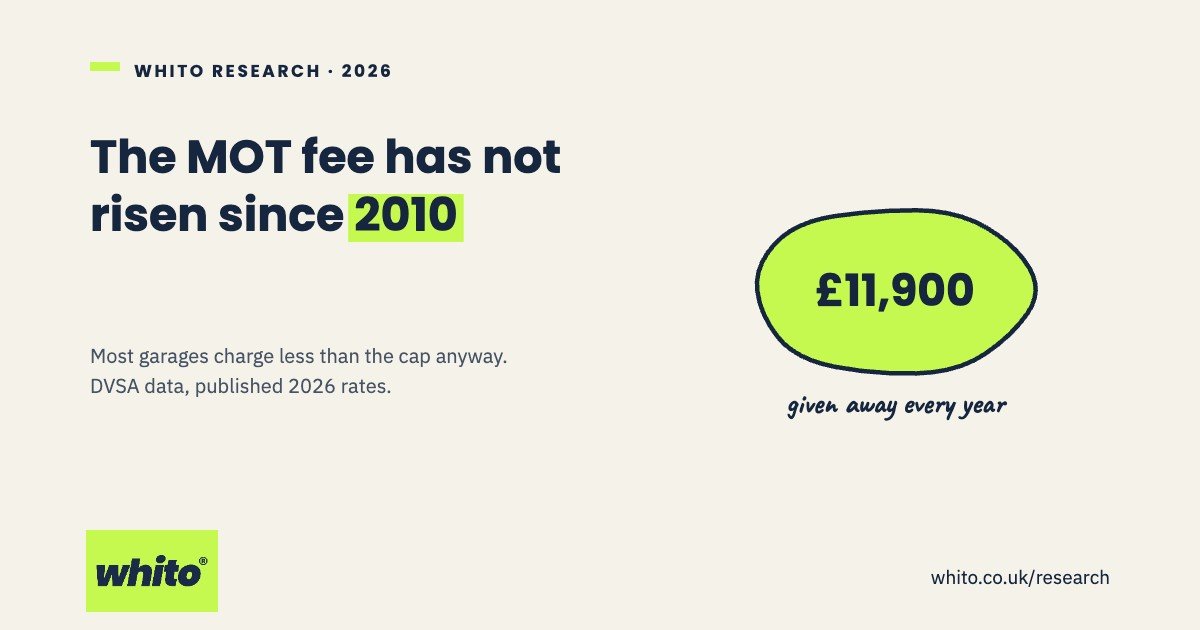
The question this answers: how much money is a typical UK independent garage giving away every year? Our answer, priced from official data and published rates: about £11,900. The largest line is not something a garage is overpaying for. It is something it is undercharging for, and the law would already let it charge more.
The maximum a garage may charge for a class 4 MOT is £54.85.
That figure was set on 6 April 2010. It has not moved since. Sixteen years, four months, and the statutory price of the most common job in the aftermarket has not changed by a penny.
Here is the part that should sting. The government’s own consultation document says most garages do not even charge the cap. Its words: MOT testing is a highly competitive market and many testing stations charge less than the maximum, “often in the £35-45 price range”.
So the sector spent sixteen years unable to raise a price, and spent them discounting below it anyway.
That is the difference between a garage and the other businesses we have audited in this series. A cafe leaks money through its bills. A salon leaks it through its diary. A garage leaks it through the price of an hour.
Who this applies to
There were 23,316 MOT test stations in Great Britain in 2024-25 and 66,423 nominated testers, according to DVSA. Station numbers have been flat for a decade and are now at their lowest since 2015-16.
Those stations carried out 33,128,617 class 3 and 4 MOT tests between them. Divide one by the other and the average station does 1,421 car and light van tests a year, which is about 27 a week. That division is ours, not DVSA’s, and it averages a one-bay independent against a national fast-fit chain, so treat it as a yardstick rather than a description of your workshop.
Our model garage is a two bay independent test station doing that average 1,421 tests, taking £200,000 a year on card, using 20,000 kWh of electricity and sitting on a rateable value of £22,000. Every one of those is a stated assumption.
Leak 1: the MOT price you are not charging. Exposure £21,100. Banked: £7,100
At the £54.85 cap, 1,421 tests is £77,934 of test fee revenue. At the £40 midpoint of the government’s stated range it is £56,834. The gap is £21,100 a year.
We are not banking £21,100, because you cannot jump straight to the cap in a market where the garage down the road advertises £29.99. What we are banking is five pounds.
£5 more per test, across 1,421 tests, is £7,104 a year. That is one leak, one decision, and no new customers.
Two things make the case. First, inflation. DfT calculated in 2023 that if the maximum fee had tracked CPI from 2010 it would already have been £73.50 by July 2022, and that was four years ago. Second, the trade’s own position: as of August 2026 the Independent Garage Association and the IMI are jointly asking government to raise the cap to £95.
And the honest counter-argument, which came from a former MOT tester quoted in the same coverage: nearly every garage offers a discount on an MOT, so where is the argument for a cost rise if they are able to do that? It is a fair hit. The discounting is voluntary.
Leak 2: business rates, and a rule that changed in April. Saving: £1,100
This is the finding most garage owners will not know, because the answer used to be no.
From 1 April 2026 England has two permanently lower business rates multipliers for qualifying retail, hospitality and leisure properties. The small business RHL multiplier is 38.2p against the standard small business multiplier of 43.2p. Five pence in the pound.
Under the old retail relief schemes, garages were simply not on the eligible list. The 2023-24 and 2025-26 guidance named hairdressers, shoe repairers, dry cleaners and appliance repairers. Vehicle repair and MOT appeared nowhere.
The new guidance is different. The qualifying list for services provided to visiting members of the public now reads: “Funeral directors, Launderettes, Hair and beauty salons…, Tattooists, Garages, Shoe repairers, Key cutters…”
Garages are on the list. On a rateable value of £22,000 that 5p difference is £1,100 a year.
Councils are supposed to identify eligible properties themselves, so this may already be on your bill. It may also not be, particularly if your premises has been coded the same way for fifteen years. Find the multiplier printed on your 2026-27 bill. If it says 43.2p, ring the billing authority and point at the guidance.
Two limits worth knowing. If your rateable value is £12,000 or less you already pay nothing under Small Business Rate Relief, so the multiplier is worth nothing to you. And this is England only.
Leak 3: out-of-contract energy. Saving: £1,766
A garage is a heavy electricity user with compressors, lifts, lighting and increasingly EV charging. When a fixed contract lapses without a replacement, the supplier moves you to out-of-contract rates automatically.
Across fifteen suppliers’ published out-of-contract rates in 2026, business electricity averaged 35.63p per kWh, ranging from 25.14p to 47.50p. A one year fixed rate for a small business user was quoted at 26.8p in August 2026. Both figures are broker aggregations rather than official statistics.
At 20,000 kWh a year the gap is £1,766, before standing charges, which run considerably higher out of contract.
The spread matters more than the average here. A garage sitting on the cheapest supplier’s out-of-contract rate is barely losing anything. A garage on the dearest is losing three times our figure. Look up your own supplier’s published rate rather than trusting the average, including ours.
Leak 4: card processing. Saving: £1,292
Garages have high average transaction values, which makes the percentage matter more than it does in a cafe. On £200,000 taken on card, at rates published on the providers’ own sites and checked on 18 August 2026:
| Provider | Rate | Monthly fee | Annual cost |
|---|---|---|---|
| Square, Zettle | 1.75% | £0 | £3,500 |
| SumUp pay as you go | 1.69% | £0 | £3,380 |
| SumUp Payments Plus | 0.99% | £19 | £2,208 |
The £19 a month pays for itself once card turnover passes roughly £30,000 a year, so for a garage this is not a judgement call.
The bigger problem is the garages this table does not describe. A traditional merchant acquirer contract with interchange plus pricing, PCI fees, a minimum monthly service charge, terminal rental and an exit penalty does not publish rates at all. If that is you, the saving is almost certainly larger than £1,292, and the only way to find out is to ask for a full fee breakdown in writing.
Leak 5: the subscription you have outgrown or never audited. Saving: £636
Technical data is the one bill in a garage that goes up on its own.
Autodata publishes its UK pricing, which puts it in a minority. Its Diagnostics and Repair tier starts at £127 a month and its Service and Maintenance tier at £74, both excluding VAT. A garage paying for the full diagnostic tier while only ever opening service schedules and torque figures is spending £636 a year on data it does not use.
Watch the entry offer as well. Autodata’s £9.99 first month converts automatically into an annual subscription unless you cancel. That is disclosed, and it is also exactly the kind of thing that quietly becomes a permanent line on a card statement.
The wider point is what we could not price. Snap-on publishes no UK software prices. HaynesPro publishes none. TecRMI publishes none. TOPDON publishes a £3,670 tablet price but not the renewal cost after the included updates run out, so a buyer cannot see year three at the point of sale. Hella Gutmann gives a starting price including one year of software and no renewal figure.
The total
| Leak | What changes | Annual saving |
|---|---|---|
| MOT pricing | £5 more per test | £7,104 |
| Business rates multiplier | Check the bill says 38.2p | £1,100 |
| Energy | Agree a contract before the old one lapses | £1,766 |
| Card processing | Re-quote against published rates | £1,292 |
| Technical data subscription | Pay for the tier you actually open | £636 |
| Total | £11,898 |
The MOT is not the product
There is a reason the discounting happens, and it is worth stating plainly rather than pretending garages are simply bad at pricing.
In 2024-25, 28.08 percent of class 3 and 4 MOTs failed at first test. A further 1,793,797 tests passed only after rectification at the testing station. Per station that is roughly 399 initial failures a year, about eight a week, and 77 jobs fixed during the test itself.
So the cheap MOT is a loss leader that works. It buys diagnostic access to a vehicle, and roughly three in ten of those vehicles need something doing. DVSA said as much in its own impact assessment: MOTs are sometimes sold at a loss to attract custom or sell other products and services.
That is a legitimate strategy. It stops being one when nobody has checked whether the repair work actually covers the discount. DfT’s own assessment admits there is insufficient evidence on how far garage revenue depends on MOTs, and no one has measured it since.
You can measure it in your own workshop in a month. Take every MOT, record the discount against the cap, and record the repair value that came out of it. If the average repair value per discounted test exceeds the discount, the loss leader is working. If it does not, you are simply cheap.
The bigger money we could not price
Unrecovered labour. This is almost certainly larger than everything above combined, and there is no reliable UK data on it. The best published evidence is a 2017 worked example from one consultant, Andy Savva, whose own garage charged £90 an hour and recovered £82, with technicians selling around four hours from a seven hour day. He has also said that of the thousands of garages he worked with, two had fully calculated their overheads and were charging a profitable rate. Both figures are one person’s experience. Nobody in the UK publishes measured productivity or labour recovery benchmarks for independent garages, which is a remarkable gap in a sector that sells hours.
Your hourly rate against your cost to operate. The most recent labour rate survey with a stated method found a national independent average of £76 an hour across 279 garages, ranging from £141 in south west London to £47 in Huddersfield. That was 2023. In the same coverage the cost to operate a typical garage was put at around £60 an hour. At the bottom of that range the labour line loses money before anyone counts recovery. Worth knowing: the IGA’s own survey of 3,338 garages found rates rose by £5.88 between 2012 and 2020, which it calculated as 6.7 percentage points behind inflation.
The Employment Allowance. Up to £10,500 against employer National Insurance in 2026-27. It is claimed through payroll each tax year rather than applied automatically, and it can be backdated four years. Employer NI is 15 percent on everything above £5,000 per employee.
Annual tester compliance. Every nominated tester must complete at least three hours of training and pass an annual assessment by 31 March or be suspended automatically. There is no DVSA price for this; it is an open market, and commercial providers were advertising the 2026-27 assessment from £34 plus VAT per tester. Worth re-quoting rather than renewing on autopilot.
Why this is a Start problem
Whito’s framework runs Start, then Build, then Scale. A pricing decision is the most Start thing there is. It needs no budget, no agency and no new channel, and it changes the economics of every job that follows it.
There is a specific trap here. Garage marketing advice almost always points at volume: more MOT bookings, more reminders, more local search. Volume is the wrong lever when the unit price is below cost. Every extra test you win at £35 makes the problem larger, not smaller. Fix the price of the hour, then go and fill the bay.
Method, and what we did not claim
Test volumes, station counts and failure rates come from DVSA’s MOT testing data for Great Britain, 2024-25, which DVSA states is not an official statistic. Great Britain, not the UK: Northern Ireland MOTs are done by DVA at state test centres, not commercial garages. The per station figures are our own division of DVSA totals and are averages across every station type. The model garage is a stated assumption throughout.
We have not claimed the government is reviewing the car MOT fee. Trade press has reported it, but we found no ministerial statement or published consultation, and the only DVSA consultation that concluded in 2026 covered HGV, bus and trailer testing charges. We have not quoted a total MOT revenue figure for the sector, because so many garages discount below the cap that no such figure can be established. We have not given a split of independent garages versus chains, because DVSA does not publish one. We have not used a national average garage labour rate for 2026, because no survey with a stated method exists for this year. We have not priced unrecovered labour, despite believing it is the biggest number in the sector, because the UK data does not exist. Corrections to hello@whito.co.uk.
Common questions
What is the maximum MOT fee in 2026?
£54.85 for a class 4 vehicle, which covers most cars. The figure was set on 6 April 2010 and has not changed since. Class 7 vans up to 3,500kg are £58.60 and motorcycles £29.65. VAT is not charged on the test fee itself.
Do garages get the lower business rates multiplier?
Yes, in England, from 1 April 2026. “Garages” appears in the government’s list of qualifying retail, hospitality and leisure properties, which means an eligible garage should be billed at 38.2p rather than 43.2p where the rateable value is under £51,000. This is a change: garages were not on the eligible list under the older retail relief schemes. Check which multiplier is printed on your bill.
How many MOTs does an average test station do?
Great Britain had 23,316 MOT test stations and 33,128,617 class 3 and 4 tests in 2024-25, which averages 1,421 car and van tests per station per year, or about 27 a week. That is our calculation from DVSA totals and it averages small independents with large chains.
What proportion of MOTs fail?
28.08 percent of class 3 and 4 tests failed at first presentation in 2024-25, and 22.67 percent failed finally. Vans in class 7 are worse at 35.31 percent. A further 1,793,797 tests passed only after the fault was rectified at the test station.
Should a garage charge the full MOT cap?
That is a commercial decision and it depends on whether the discount pays for itself in repair work, which most garages have never measured. Record the discount against the cap and the repair value generated for one month. Note that garages cannot lawfully agree prices with each other.
The sharp takeaway
The statutory price of an MOT has not moved since 2010, and most garages charge less than it anyway. Five pounds a test is worth £7,100 a year to an average station, which is more than the energy, card fees and software savings in this article combined. Before you spend anything on winning more work, find out what the work you already do is actually priced at.
Want to know where your business is leaking money and visibility?
The same audit for cafes: £7,400 a year without selling one more coffee
The same audit for hair salons: five leaks, £4,600 a year
What UK garages actually spend on marketing
The best payment processors for UK businesses
What dollar-priced software really costs a UK business
How many UK businesses have a website?
The structural checks behind this research run on any website in about twenty seconds. Enter yours and read the full result on the page. Free, and we do not ask for your email.
Check your business freeIf your business is named here and you think we have a fact wrong, email hello@whito.co.uk and we will check it and correct it. If you want to respond, send us a statement and we will publish it alongside. Full detail: Corrections, right of reply and removals.