

Last Updated on August 18, 2026
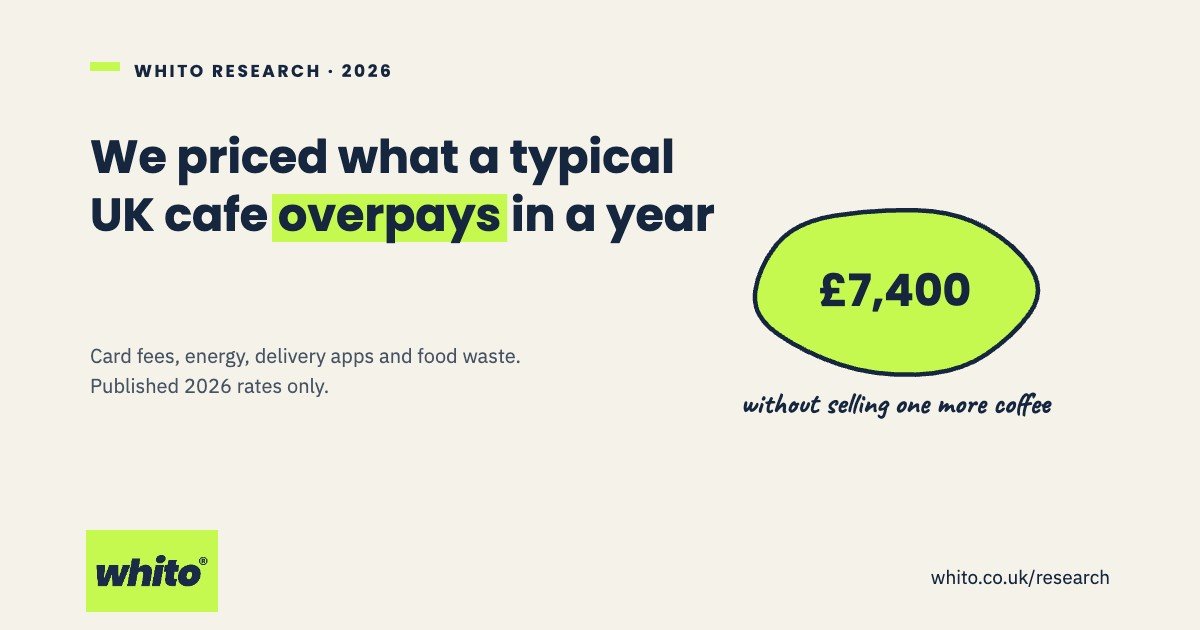
The question this answers: how much money is a typical UK independent cafe giving away every year on card fees, energy, delivery commission and food waste? Our answer, priced from published rates in August 2026: about £7,400 a year, before you count business rates relief or marketing waste. None of it requires selling one more coffee.
Ask a cafe owner how to make more money and most will talk about getting more customers through the door. New signage. A loyalty app. Maybe paid ads.
Here is the problem with that answer. The average independent coffee shop already hands over thousands of pounds a year in fees and waste that it does not need to pay. Winning new customers costs money. Stopping leaks does not.
So we priced the leaks. We took a model cafe, a single site independent taking £150,000 a year on card, and worked through four cost lines using published rates and primary sources. Not estimates. Not “industry averages” from a sales page. Published numbers, checked in August 2026, with the source named for every figure.
The four lines came to £7,412 a year. Call it £7,400.
Who this applies to
There are 13,211 independent coffee shops in the UK, and the independent sector turned over £5.1 billion last year (World Coffee Portal, The Independents Report UK 2026). Add the 12,313 branded outlets and the country has roughly 25,500 coffee shops competing for the same footfall.
Margins are tight across hospitality, and UKHospitality called margin, not demand, the sector’s biggest challenge in July 2026. When margins are thin, a pound saved is worth far more than a pound of new revenue. £7,400 saved is £7,400 of profit. £7,400 of new sales is not.
Leak 1: card fees. Saving: £912 a year
Card processing is the cost most cafes never revisit. The Payment Systems Regulator found in 2021 that small merchants “do not regularly search, consider switching provider, or negotiate”, despite evidence they could get a better deal by doing so. Since then it has only got worse. The PSR’s March 2025 market review found Mastercard and Visa raised their core scheme and processing fees to acquirers by at least 25 percent since 2017, costing businesses at least £170 million extra a year.
Here is what the main pay-as-you-go providers publish for in-person payments, checked on their own pricing pages on 18 August 2026.
| Provider | In-person rate | Monthly fee | Cost on £150,000 of card sales |
|---|---|---|---|
| SumUp (pay as you go) | 1.69% | £0 | £2,535 |
| SumUp (Payments Plus) | 0.99% | £19 | £1,713 |
| Square (free plan) | 1.75% | £0 | £2,625 |
| Zettle by PayPal | 1.75% | £0 | £2,625 |
Read that middle row again. Two providers with published rates, same £150,000 of card sales, and the difference between the cheapest and the dearest is £912 a year. That is the gap between providers who publish their prices. Older acquirer contracts, with blended rates, terminal rental, authorisation fees and PCI charges, sit above all of these, which is exactly why the regulator found their pricing “opaque”. If you signed your card deal more than three years ago and have never re-quoted it, this line is probably bigger for you, not smaller.
Leak 2: out-of-contract energy. Saving: about £2,300 a year
When a fixed business energy deal ends and nothing is agreed, the supplier moves you to out-of-contract rates. Ofgem confirms this also happens automatically when you move into a premises. Nobody chooses these rates. You land on them by not acting.
The gap is large. Across sixteen suppliers’ published out-of-contract rates in 2025-26, electricity averaged 35.63p per kWh against typical fixed offers around 26p, and gas averaged 9.22p against fixed offers of roughly 6.5-8.2p (Purely Energy and EnergyCosts, both broker aggregations of supplier-published rates, dated 2025-2026).
A food and beverage business uses around 17,330 kWh of electricity and 35,471 kWh of gas a year (Bionic customer data, updated January 2026). On those volumes the unit-rate gap alone is worth about £2,330 a year. Out-of-contract standing charges, which run two to four times fixed levels on some suppliers’ published tariffs, add more on top. We have used £2,300 as the conservative figure.
Leak 3: delivery commission. Saving: £1,700 a year
Uber Eats publishes its UK pricing: a 30 percent delivery fee per order when their couriers deliver, against a 13 percent pickup fee when the customer collects, both excluding VAT. Deliveroo and Just Eat publish no UK commission rates on their merchant pages at all, which tells its own story.
Our cafe marketing costs research found delivery commission running at 25-35 percent of every order, which makes it the biggest marketing cost most cafes never count as marketing.
The saving here is not “leave the platforms”. For some cafes they bring orders that would not otherwise exist. The saving is moving your regulars to direct channels. Take a cafe doing £10,000 a year through delivery apps. At Uber Eats’ published 30 percent, that is £3,000 in commission. Move those same orders to click and collect at the published 13 percent and it is £1,300. Same customers, same food, £1,700 kept.
A sticker on the box, a card by the till and a collection discount that undercuts the app price by less than the commission you save. That is the whole tactic.
Leak 4: food waste. Saving: £2,500 a year
Food waste costs the UK hospitality and food service sector £3.2 billion every year, which WRAP puts at around £10,000 per outlet per year (WRAP, sector figures current as of 2026, per-outlet average across all outlet types). Three quarters of what gets thrown away could have been eaten.
WRAP’s November 2024 analysis found businesses got a £14 return for every £1 invested in reducing food waste. You do not need to be heroic about it. Cut a quarter of a £10,000 average waste bill through portioning, prep planning and a simple waste log, and that is £2,500 a year. WRAP’s own worked example has a pub doing 1,000 covers a week saving over £9,000 a year at a 50 percent reduction, so a quarter is not an ambitious target.
The total
| Cost line | What changes | Annual saving |
|---|---|---|
| Card fees | Re-quote against published rates | £912 |
| Energy | Get off out-of-contract rates | £2,300 |
| Delivery commission | Move regulars to collection and direct | £1,700 |
| Food waste | Cut a quarter of the average waste bill | £2,500 |
| Total | £7,412 |
The savings that depend on your circumstances
Business rates. Small Business Rate Relief is not automatic in England. You have to apply to your council. A cafe whose only premises has a rateable value of £12,000 or less pays nothing at all with SBRR, which at the new 2026-27 small retail, hospitality and leisure multiplier of 38.2p would otherwise be £4,584 a year at a £12,000 rateable value. Relief tapers up to £15,000. Separately, the old 40 percent retail relief ended in April 2026 and was replaced by permanently lower RHL multipliers, so check your bill reflects the 38.2p rate, not the standard 43.2p (GOV.UK, current guidance and Budget 2025 factsheet).
Water. Most businesses in England can switch water retailer and most never have. Ofwat found only about 10 percent of eligible customers had made an active choice in the market’s first year, with small businesses engaging least. Retailers claim savings of up to 20 percent on bills, though those are their marketing claims, not regulator figures.
Insurance. A 2025 survey of 250 small business owners found 81 percent shop around at renewal but only 52 percent actually switch (Consumer Intelligence, March 2025). Getting quotes and not acting on them is the worst of both.
Dollar-priced software. Our audit of 24 business tools found dollar-priced software costs UK businesses around 3.2-3.4 percent above the mid-market exchange rate, and the big four banks add a 2.75 percent non-sterling card fee on top. Small line, but it never stops.
Why this is a Start problem, not a Scale problem
Everything above is structure. None of it is growth. That is deliberate.
Whito’s framework runs Start, then Build, then Scale. A cost audit sits right at the Start: it needs no budget, no agency and no new channel, and it funds everything that comes after it. A cafe that finds £7,400 a year in its own cost base has just built itself a proper marketing budget, roughly £600 a month, without borrowing a penny. Spending on ads while paying 1.75 percent on cards and out-of-contract rates on electricity is scaling a leaky bucket.
Method, and what we did not claim
All rates were checked on 18 August 2026 on the source named. The model cafe, £150,000 of annual card turnover and £10,000 of delivery app sales, is a stated modelling choice, not a measured average. Broker-collated energy figures are labelled as such throughout; Ofgem publishes no deemed-versus-fixed price comparison and we have not attributed one to it. We have not quoted a Deliveroo or Just Eat commission rate because neither publishes one in the UK. We have not quoted an average net margin for independent cafes because no primary source publishes one. WRAP’s per-outlet waste figure is a sector-wide average with older underlying data, still used on WRAP’s live pages, and is labelled as an average, not a cafe-specific measurement. Corrections to hello@whito.co.uk.
Common questions
How much can a UK cafe save on card fees?
On £150,000 of annual card sales, the gap between the cheapest and dearest published pay-as-you-go rates is £912 a year (0.99 percent plus £19 a month versus 1.75 percent, August 2026 published pricing). Cafes on older unpublished acquirer contracts typically stand to save more.
Do cafes qualify for small business rates relief in 2026?
In England, yes, if the cafe is your only premises and its rateable value is £12,000 or under you pay no business rates at all, tapering to zero relief at £15,000. It is not automatic. You must apply to your council. From April 2026 qualifying hospitality premises also get a lower multiplier of 38.2p.
What commission do delivery apps charge UK cafes?
Uber Eats publishes a 30 percent delivery fee and a 13 percent pickup fee, excluding VAT. Deliveroo and Just Eat publish no UK commission rates on their merchant pages, so exact costs depend on your agreement.
How much does food waste cost a cafe?
WRAP puts food waste at around £10,000 per hospitality outlet per year on average, with three quarters of it avoidable, and found a £14 return for every £1 invested in reducing it.
What should a cafe cut first?
Start with the costs that need no behaviour change: re-quote your card processing and get an energy contract agreed before your current one expires. Then work on delivery commission and waste, which need habits, not spend.
The sharp takeaway
Most cafes do not have a revenue problem. They have a leak problem. The typical independent can recover about £7,400 a year from card fees, energy, delivery commission and food waste using nothing but published rates and a waste log, and every pound of it lands as profit. Audit the leaks before you buy the growth.
Want to know where your business is leaking money and visibility?
The same audit for car garages: the MOT fee has not risen since 2010
The same audit for hair salons: five leaks, £4,600 a year
What UK cafes actually spend on marketing
Free marketing for cafes: the two best channels cost nothing
EPOS and till system costs in the UK
The best payment processors for UK businesses
What dollar-priced software really costs a UK business
How many UK businesses have a website?
The structural checks behind this research run on any website in about twenty seconds. Enter yours and read the full result on the page. Free, and we do not ask for your email.
Check your business freeIf your business is named here and you think we have a fact wrong, email hello@whito.co.uk and we will check it and correct it. If you want to respond, send us a statement and we will publish it alongside. Full detail: Corrections, right of reply and removals.