

Last Updated on August 18, 2026
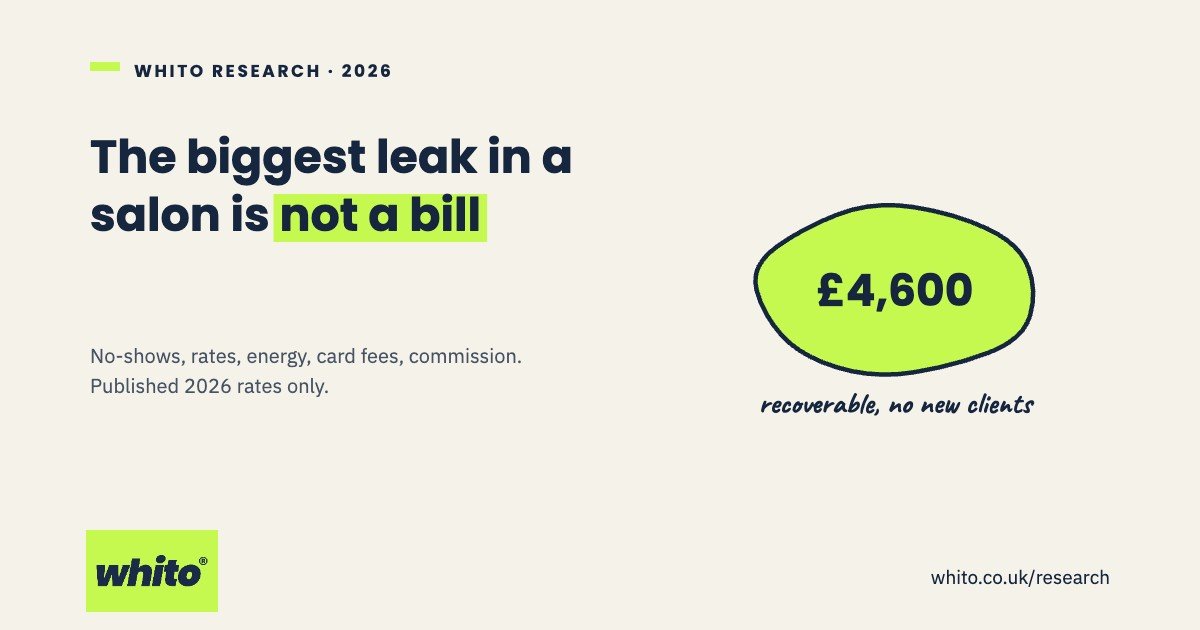
The question this answers: how much money is a typical UK hair salon losing every year, and how much of it can actually be got back? Our answer, priced from published 2026 rates: about £4,600 a year across five leaks. The largest one is not a bill. It is revenue that walked out of the door.
Most salon cost advice tells you to shop around for cheaper colour and switch your card machine. Fine advice. Small money.
The biggest number in this article is not a cost at all. It is the revenue a salon books, staffs, heats and lights, and then never collects, because the client did not turn up.
That is the difference between a salon and a shop. A shop that loses a sale still has the stock. A salon that loses an appointment has already paid for the hour. The chair was there. The stylist was there. The lights were on.
So we priced five leaks for a model salon, three chairs, £120,000 a year, using published rates and primary sources checked in August 2026. They came to £4,616.
Who this applies to
The National Hair and Beauty Federation puts the sector at around 50,000 businesses employing 220,000 people, contributing £5.8 billion to the economy. Its State of the Sector survey presented in March 2026 found 20 percent of hair and beauty businesses operating at a loss, and described nearly three quarters as running on razor thin margins.
One statistic explains why this sector feels every cost increase more sharply than most. In 2025, 43.3 percent of jobs in hair and beauty were paid at or within pennies of the statutory minimum, the highest coverage rate of any occupational group in the country (NHBF, July 2026). There is no absorption room. Every wage uprating lands on the bill in full.
Which is exactly why the money already inside the business matters more here than a new marketing channel.
Leak 1: no-shows and late cancellations. Exposure £8,400. Banked: £2,100
A survey of over 200 UK beauty and wellness businesses in December 2025 found they lose almost 7 percent of monthly revenue to no-shows and late cancellations. Twenty nine percent of businesses reported losing between 5 and 10 percent, and 15 percent reported losing 11 to 20 percent (Fresha, published February 2026).
On our model salon that is £8,400 a year. It is by some distance the largest number in this article.
Now the honest part. We are not banking £8,400, and neither should you.
That survey was funded by a booking platform, the businesses self-reported rather than being measured, and the figure combines no-shows with late cancellations, which are not the same problem. Fresha’s own analysis of three million actual bookings in 2024 put the measured no-show rate for hair salons at 3.16 percent, well below what owners report losing.
The fixes have the same problem. Treatwell reported that salons requiring prepayment cut no-shows by half. Fresha claims cancellation policies reduce them by up to 90 percent. Every one of those numbers comes from a company selling the feature, and not one publishes a sample size, a method or a control group. The trade body does not measure no-shows at all.
So we bank a quarter. £2,100. If deposits and reminders work even half as well as the people selling them say, the real figure is higher. We would rather be wrong in that direction.
Leak 2: the wrong business rates multiplier. Saving: £900
This one is free money and it is sitting on a bill you already receive.
From April 2026 there are two permanently lower business rates multipliers for qualifying retail, hospitality and leisure properties in England, both 5p in the pound below the national equivalents. The small business RHL multiplier is 38.2p against the standard small business multiplier of 43.2p (GOV.UK, published November 2025).
Hair and beauty qualifies. The eligibility guidance names “hair and beauty salons (for instance, hairdressers, nail bars, beauty salons, tanning shops…)” among qualifying properties, provided the premises is occupied, wholly or mainly used for that purpose, and open to visiting members of the public.
On a rateable value of £18,000, the difference between 43.2p and 38.2p is £900 a year. On £30,000 it is £1,500.
Qualifying is not the same as receiving. Councils apply the multiplier, and a salon that has been coded as a general shop for years will not necessarily have been moved. Look at your bill, find the multiplier, and if it says 43.2p rather than 38.2p, ring the council.
Leak 3: out-of-contract energy. Saving: £674
Salons are electricity businesses that happen to cut hair. When a fixed contract ends and nothing is agreed, the supplier moves you to out-of-contract rates automatically, and the same happens when you take on a premises without arranging a supply.
Across sixteen suppliers’ published out-of-contract rates in 2026, electricity averaged 35.63p per kWh (Purely Energy). Fixed one year business electricity for a small user was quoted at 26.8p in August 2026 (AquaSwitch). Both are broker aggregations, not official statistics, and we are treating them as such.
A three chair salon uses roughly 7,000 kWh of electricity a year on one broker’s estimate (Selectra). At a 9.63p gap that is £674 a year on unit rates alone, before standing charges, which run considerably higher out of contract.
Leak 4: card processing. Saving: £532
On £100,000 taken on card, at published rates checked 18 August 2026:
| Provider | Rate | Monthly fee | Annual cost |
|---|---|---|---|
| Square, Zettle | 1.75% | £0 | £1,750 |
| SumUp pay as you go | 1.69% | £0 | £1,690 |
| SumUp Payments Plus | 0.99% | £19 | £1,218 |
£532 between the top row and the bottom, on identical takings. The monthly fee earns its keep above roughly £3,000 a month on card, which most three chair salons clear comfortably.
One warning. If your booking software also processes your payments, the card rate and the software are a bundle, and you cannot change one without the other. Price the whole bundle, not the headline percentage.
Leak 5: commission on clients who never came back. Saving: £410
Treatwell charges 35 percent commission on the first booking of a new client it sends you, plus VAT, and nothing on repeat bookings. On a £50 first appointment that is £21. Booksy charges 30 percent on a Boost client’s first visit with a £5 minimum. Fresha charges a 20 percent one time fee, though it publishes its rates only in dollars.
Nobody should object to a finder’s fee. That is what it is, and for a new salon it can be the difference between a full column and an empty one.
The problem is what happens next. First visit retention across the sector runs at around 35 percent. So of sixty marketplace clients a year, roughly thirty nine never return. At £21 each, that is £819 a year of commission spent on people who came once.
You cannot fix that with a better platform deal. You fix it at the basin, by rebooking the client before they put their coat on, while they can still see what you have just done. Convert half of those one time visits into second appointments and you recover about £410 of wasted commission, and considerably more in the revenue those clients then bring.
The total
| Leak | What changes | Annual saving |
|---|---|---|
| No-shows and late cancellations | Deposits, reminders, a policy you enforce | £2,100 |
| Business rates multiplier | Check the bill says 38.2p | £900 |
| Energy | Agree a contract before the old one ends | £674 |
| Card processing | Re-quote against published rates | £532 |
| Wasted new client commission | Rebook at the basin, not by email | £410 |
| Total | £4,616 |
The bigger money, if it applies to you
The Employment Allowance. Worth up to £10,500 against your employer National Insurance bill in 2026-27, and it is not automatic. You claim it through payroll each tax year. It can be backdated four years. Employer NI is now 15 percent on everything above £5,000 a year per employee, down from a £9,100 threshold before April 2025, so the allowance is doing far more work than it used to. If you are not sure whether you are claiming it, that is the single most valuable ten minutes in this article.
Apprenticeships. For an apprentice aged 16 to 24 at a non-levy employer, which is essentially every salon, the government funds 100 percent of training. The hairdressing professional standard carries a funding band of £11,000 and the barbering standard £9,000. From 1 October 2026 there is also a hiring payment of up to £2,000. The apprentice rate is £8.00 an hour against a National Living Wage of £12.71. In the NHBF’s most recent survey, 388 of 423 businesses said they were unlikely to take on an apprentice. Some of those businesses have not run these numbers.
The VAT flat rate trap. The flat rate percentage for hairdressing and other beauty treatment services is 13 percent. But if your spend on goods is under 2 percent of turnover or under £1,000 a year, you are a limited cost business and the rate becomes 16.5 percent, which is worse. A service heavy barbershop with low product spend can be on the flat rate scheme and losing money by being on it.
Small business rates relief. If the salon is your only premises and its rateable value is £12,000 or less, you pay no business rates at all. It tapers to nothing at £15,000. You have to apply to your council. It is not applied for you.
Chair rental, if you use it. HMRC published guidance in May 2025 setting out eight factors for whether a chair renter is genuinely self employed, covering who sets the hours, who provides the clients, who sets the prices and who they answer to. Getting this wrong is not a saving, it is a bill with interest on it. If your renters work your hours, your prices and your clients, check it properly.
Why this is a Start problem
Whito’s framework runs Start, then Build, then Scale. Everything above sits at the Start, because none of it requires a budget, an agency or a new channel.
There is a particular reason this matters in a salon. You cannot advertise your way out of an empty chair that was booked. If a client no-showed at eleven, spending money to find a different client for that same eleven o’clock slot is buying back something you already had. The cheapest client in any salon is the one already sitting in the chair, and the second cheapest is the one who rebooked before they left.
Fix the retention and the no-shows first. Then spend on getting found.
Method, and what we did not claim
All rates were checked on 18 August 2026 at the source named. The model salon, three chairs, £120,000 turnover, £100,000 taken on card, 7,000 kWh of electricity and a rateable value of £18,000, is a stated modelling choice, not a measured average. Whito’s own salon marketing research puts a two to three chair salon at £100,000 to £180,000 of turnover, which is where the £120,000 comes from.
We have not quoted an average salon turnover or net margin, because no primary source publishes one. Dividing sector turnover by business count mixes sole traders with multi site groups and produces a number that describes nobody. We have not repeated the widely quoted claim that the average salon bins £15,000 of colour a year, because it originates with a colour management software vendor and has no published method, and we would rather leave a leak out than price it badly. We have not quoted a Fresha price in pounds, because Fresha publishes in dollars. No-show figures are labelled as platform-funded throughout, because all of them are. Energy figures are broker aggregations and are labelled as such. Corrections to hello@whito.co.uk.
Common questions
How much do no-shows cost a UK salon?
UK hair and beauty businesses report losing almost 7 percent of monthly revenue to no-shows and late cancellations, which is £8,400 a year on a £120,000 salon (Fresha survey of over 200 UK businesses, December 2025). Measured booking data puts the actual no-show rate for hair salons lower, at 3.16 percent of appointments, so treat the self-reported figure as an upper bound.
Do hair salons get the lower business rates multiplier?
Yes. Hair and beauty salons are named in the government’s qualifying retail, hospitality and leisure guidance, so from April 2026 an eligible salon should be billed at the RHL small business multiplier of 38.2p rather than 43.2p, provided the rateable value is under £51,000. Check your bill, because qualifying and being billed correctly are two different things.
What commission does Treatwell charge?
Treatwell publishes 35 percent commission on the first booking from a new client it introduces through its marketplace, plus VAT, and 0 percent on repeat bookings, plus a 2.5 percent processing fee on online prepayments. On a £50 first appointment the commission is £21.
Can a salon claim the Employment Allowance?
Most can. It is worth up to £10,500 against employer National Insurance in 2026-27, must be claimed through payroll each tax year rather than applied automatically, and can be backdated four years. It cannot be claimed if the only person paid above the secondary threshold is a director.
What should a salon fix first?
Check the business rates multiplier and whether you are claiming the Employment Allowance, because both are paperwork rather than behaviour change. Then work on rebooking and no-shows, which are worth the most but take a change of habit at the chair.
The sharp takeaway
A cafe leaks money through its bills. A salon leaks it through its diary. The bills are worth about £2,100 a year on a three chair salon and they are worth fixing, but the appointment that never happened is worth four times that, and no advertising budget will get it back. Count your missed appointments for one month before you spend another pound on finding new clients.
Want to know where your business is leaking money and visibility?
The same audit for car garages: the MOT fee has not risen since 2010
The same audit for cafes: £7,400 a year without selling one more coffee
What UK salons actually spend on marketing
Free marketing for hairdressers and barbers
The best payment processors for UK businesses
EPOS and till system costs in the UK
How many UK businesses have a website?
The structural checks behind this research run on any website in about twenty seconds. Enter yours and read the full result on the page. Free, and we do not ask for your email.
Check your business freeIf your business is named here and you think we have a fact wrong, email hello@whito.co.uk and we will check it and correct it. If you want to respond, send us a statement and we will publish it alongside. Full detail: Corrections, right of reply and removals.