

Last Updated on August 10, 2026
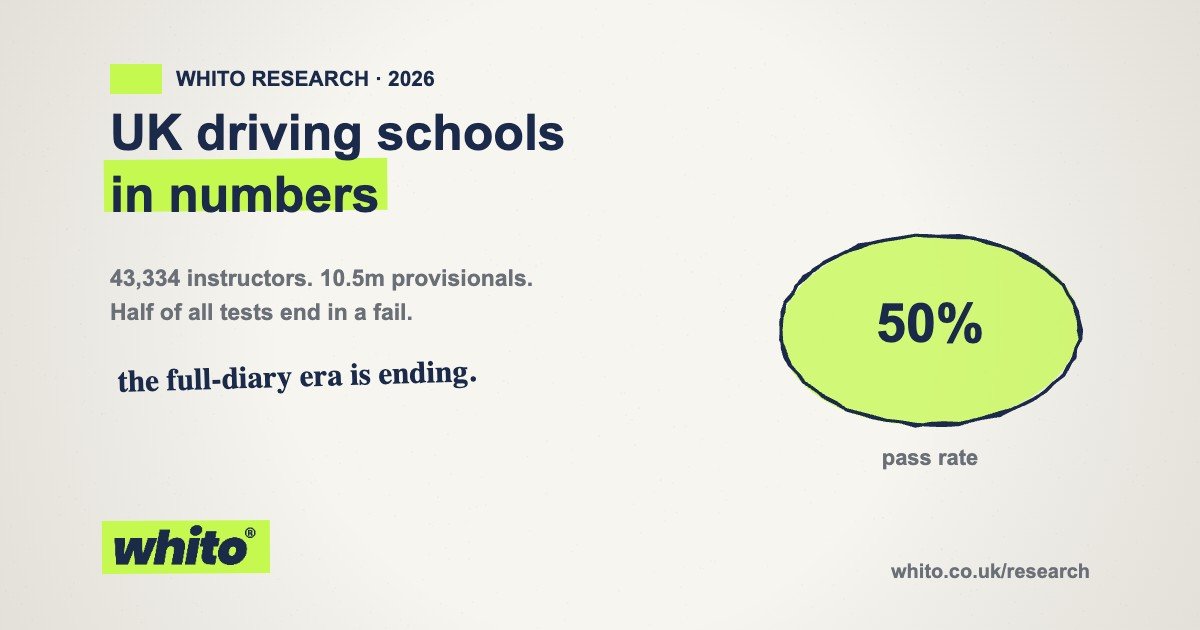
2026 Data Report. Published by Whito, 10 August 2026. Independent research. No sales pitch.
Executive summary
There are 43,334 approved driving instructors on the DVSA register, teaching from a pool of 10.5 million provisional licence holders. For the past four years, most of them have not needed to market themselves at all. The driving test backlog kept every diary full.
That era is ending. This page breaks down the numbers behind the UK driving school market in 2026: instructor supply, learner demand, prices, pass rates and what it all means for finding pupils. No upsell. Just the data.
Key takeaways
- The instructor register is growing again: from a low of around 39,200 in late 2023 to 43,334 by October 2025, with 5,500 trainees in the pipeline and more than 20,000 new applications in 2025 to 2026.
- Test waiting times are falling. DVSA’s median wait was 9.7 weeks in May 2026, examiner numbers are at their highest since 2018, and the target is a 7 week wait by November 2027.
- 45.4 per cent of instructors now have availability for new pupils, up 8.8 points in a year. The share running a waiting list fell from 56.4 to 47.3 per cent. Marketing is about to matter again.
- The most common lesson price is £36 to £40 an hour, charged by half of all instructors. Learning to drive costs a typical learner around £2,500 all in.
- Only half of practical tests are passed. 17 year olds pass at 60.8 per cent; over 45s at 36.4 per cent.
- Driving schools are the most price-transparent small business trade Whito has measured: 85 per cent publish lesson prices on their websites.
How to read this page
This is a reference page, not a blog post. Jump to the section that matters to you. All figures are in GBP and reflect UK data as of August 2026. Every external figure is from an official or named source, listed in the methodology.
Market size and structure
The DVSA register held 43,334 approved driving instructors (ADIs) in October 2025. The recent history matters: the register peaked at just over 47,000 in 2011, sank to roughly 39,200 in late 2023, then recovered to 40,984 by March 2024 and 43,334 by October 2025. Another 5,500 trainee instructors hold a training licence, and DVSA received more than 20,000 applications to join the profession in 2025 to 2026.
Getting in is hard. The three qualifying exams pass at 37.0 per cent (theory), 55.3 per cent (driving ability) and 27.8 per cent (instructional ability) respectively. Even so, the direction is clear: supply is rising.
Structurally this is a sole trader industry. Most instructors are one person and one car, either fully independent or paying a weekly fee to teach under a national franchise brand. A minority operate multi-instructor local schools.
| Register over time | ADIs |
|---|---|
| April 2011 (peak) | 47,074 |
| Late 2023 (low) | ~39,200 |
| March 2024 | 40,984 |
| October 2025 | 43,334 |
Source: DVSA register data and DVSA instructor surveys. The 2023 figure is from published analysis of DVSA monthly register data.
The learner pipeline
Demand is enormous and measurable.
10,530,739 people held a provisional licence in May 2026. Around 1.74 million practical tests were booked ahead at the start of 2025, up 12.3 per cent on the year before. And the National Audit Office found roughly 680,000 people who had passed the theory test but not yet booked a practical: a queue behind the queue.
One demand stream worth knowing about: provisional licence applications from overseas licence holders more than tripled between 2018 and 2024, from 98,000 to 339,000 a year. Learners who already drive but need a UK licence are a growing pupil segment with different needs: fewer hours, test-focused preparation.
The waiting list is shrinking, and that changes marketing
The backlog story is turning. At its worst, September 2025, the average wait for a practical test was 22 weeks, against roughly 5 weeks before the pandemic, and 70 per cent of test centres were at the maximum measurable wait.
Since then: examiner numbers reached 1,604 full time equivalents by April 2026, the highest since 2018. DVSA’s new median measure put the national wait at 9.7 weeks in May 2026, ranging from 24.3 weeks in Banbury to 6.7 in Darlington. Booking rules tightened through 2026: a two-change limit from 31 March, learners must book and manage their own tests from 8 April, and swaps are restricted to your three nearest centres from 9 June. The official target is a 7 week average wait by November 2027.
Why this is a marketing page’s business: DVSA’s own instructor survey shows 45.4 per cent of instructors now have availability for new pupils, up 8.8 points in a year, and the share holding a waiting list fell from 56.4 to 47.3 per cent. For four years, a full diary was the default and marketing felt optional. As tests speed up, pupils cycle through faster, diaries open, and the instructors who can be found will fill them first.
What lessons cost
DVSA’s 2025 instructor survey found £36 to £40 an hour is the most common price band, charged by 50.3 per cent of instructors. The RAC puts the typical range at £35 to £50, with London frequently above £50. Automatic lessons usually carry a £2 to £5 premium.
| Cost to learn (typical) | Amount |
|---|---|
| Provisional licence (online) | £34 |
| Theory test | £23 |
| 45 hours of lessons at £50 | £2,250 |
| Practical test (weekday) | £62 |
| Instructor’s car for the test | £50 to £90 |
| Typical total | ~£2,500 |
RAC breakdown, July 2026. The 45 hours of lessons plus 22 hours of private practice guideline is DVSA’s long-standing guidance, as cited by the RAC.
Two commercial implications. First, a pupil is not a £40 sale: at 30 to 45 hours, a single new pupil is worth £1,000 to £1,800 in lifetime lesson revenue. Every marketing decision should be priced against that number, not one lesson. Second, from Whito’s own August 2026 research across 200 small business websites, driving schools are the most price-transparent trade in Britain: 85 per cent publish their prices, against 0 per cent of plumbers. Your prices are being compared whether you publish them or not.
Pass rates that shape expectations
Half of all practical tests end in a fail: the 2025 to 2026 pass rate was exactly 50.0 per cent, from just under two million tests. Age is the strongest predictor in the published data: 17 year olds pass 60.8 per cent of tests, while learners over 45 pass 36.4 per cent. Location matters too: centre pass rates in 2024 to 2025 ran from 66.7 per cent in Dorchester to 33.4 per cent in Wolverhampton. The theory test passes at 44.8 per cent.
The marketing lesson is about claims. Almost every driving school website advertises a high first-time pass rate. Learners can now see the official averages, and DVSA’s Ready to Pass research shows 89 per cent of learners treat their instructor as the biggest influence on whether they are ready. Verifiable honesty (your real rate, your real reviews) beats an unverifiable boast.
How learners choose an instructor
Honest answer first: there is no robust published study on how UK learners split between word of mouth, search and social when choosing an instructor. Anyone quoting a percentage for that is guessing. What the evidence does support:
- Recommendation carries huge weight in a trust purchase like this, and reviews are recommendation at scale. A Google Business Profile with steady reviews is the closest thing to a published word-of-mouth record.
- Price comparison is real because prices are published. In a trade where 85 per cent show their rates, the school with no price list is the odd one out.
- AI assistants are entering the funnel. When a parent asks ChatGPT to recommend an instructor, the answer comes from the public record: profile, reviews, clear service pages. We tested this for driving schools specifically: Will AI recommend your driving school?
- Availability is a conversion factor the industry underuses. As waiting lists shorten, “spaces this month in [area]” is a more persuasive line than any slogan.
Red flags and common mistakes
- Treating a full diary as a marketing strategy. Full diaries were a backlog subsidy. The DVSA numbers say that subsidy is being withdrawn.
- Unverifiable pass-rate claims. “95 per cent first-time pass rate” with no basis reads as noise next to a 50 per cent national average. Use real numbers or none.
- No published availability. Learners ring four instructors and go with whoever answers with a start date.
- Ignoring the Google Business Profile because you have no premises. Car-based instructors can register as a service-area business. Most have not.
- Paying for followers instead of reviews. A thousand Instagram followers convert worse than thirty local Google reviews.
- Competing only on price. Cutting £5 an hour costs £225 over a 45 hour pupil. A visible review base earns more than a £2 discount.
The minimum viable marketing stack: a Google Business Profile set up for your service area, a steady review request habit, a one-page site with prices and areas covered, a WhatsApp or booking link, and a referral thank-you for existing pupils.
Cite this research. Whito Research (2026). UK Driving School Marketing in Numbers: 2026 Data Report. https://whito.co.uk/for/driving-schools/uk-driving-school-marketing-data/ Key finding: 43,334 approved driving instructors on the DVSA register (October 2025), with waiting lists shortening and 45.4 per cent of instructors open to new pupils. You are welcome to reuse these figures with a link to this page as the source.
Methodology
Figures compiled 10 August 2026 from official and named sources: DVSA Working as a driving instructor surveys (2024 and 2025 results), DVSA driving test statistics (DRT tables, 2025 to 2026), DVSA instructor register data, the National Audit Office investigation into car driving test waiting times (December 2025), DVLA licence data via the RAC Foundation, the RAC cost of learning to drive guide (July 2026), and Driving Instructors Association analysis of the DVSA annual report 2025 to 2026. Price transparency figures are Whito’s own August 2026 study of 200 UK small business websites. Contains public sector information licensed under the Open Government Licence v3.0. Whito’s analysis and interpretation are our own, not the source bodies’. Figures are the latest published at the time of writing and will be revised as new data lands. This page is information, not business or financial advice.
About Whito
Whito publishes independent research and practical marketing guidance for UK small businesses. We are not an agency, we do not run campaigns for driving schools, and nothing on this page is selling a service to fix. Structure before scale.
Want to know how your driving school compares?
The free Whito Scorecard checks your marketing foundations in ten minutes and shows you what to fix first.
Common questions
How many driving instructors are there in the UK? 43,334 approved driving instructors were on the DVSA register in October 2025, up from roughly 39,200 in late 2023, with around 5,500 trainee instructors in the pipeline.
Is the driving test backlog over? Not over, but easing fast. DVSA’s median waiting time was 9.7 weeks in May 2026, examiner numbers are the highest since 2018, and the official target is a 7 week average wait by November 2027.
What should driving schools do about these numbers? Prepare for the end of the full-diary era: set up a service-area Google Business Profile, build a steady review habit, publish prices and availability, and check whether AI assistants can find and recommend you.
Related Whito research: Will AI recommend your driving school?, UK driving school marketing costs 2026, and the UK price transparency study.
The structural checks behind this research run on any website in about twenty seconds. Enter yours and read the full result on the page. Free, and we do not ask for your email.
Check your business free