
Finding
Fewer than half, 45.5 per cent, of 200 independent UK small business websites across ten trades and ten cities publish any price at all, and 0 of 20 plumbers publish a single figure, Whito's August 2026 price transparency study found.
Source: Whito, whito.co.uk/research/uk-price-transparency-study, August 2026. Free to quote with a link to this page.
Last Updated on September 11, 2026
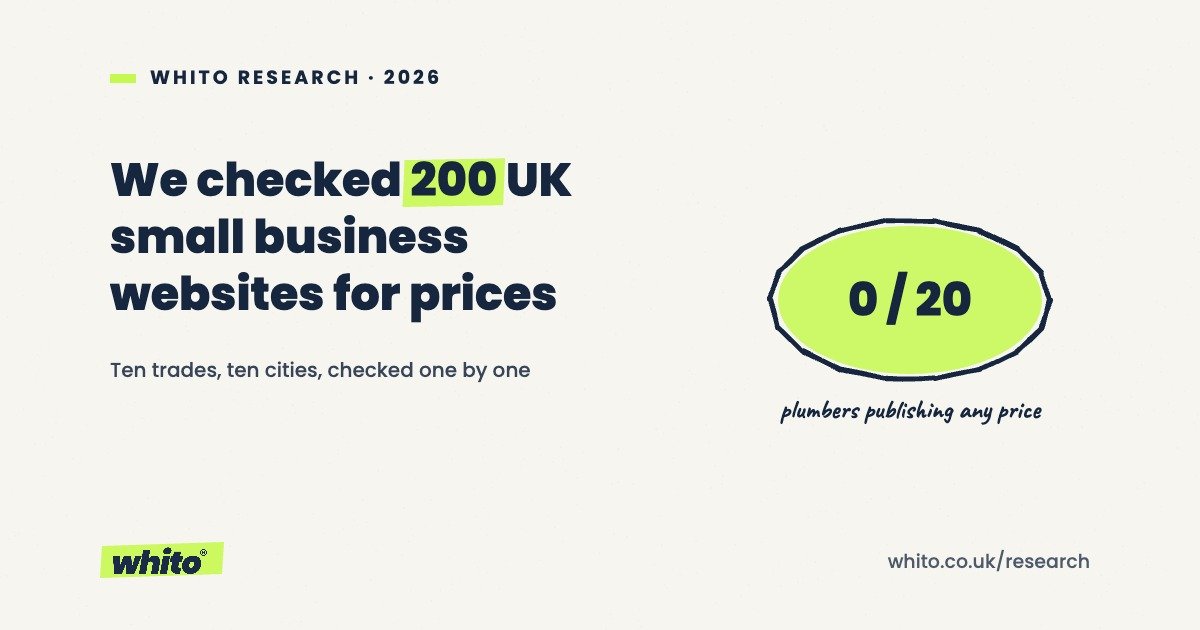
Whito Research, August 2026. We checked 200 independent UK small business websites across ten trades and ten cities for one thing: is any price published at all? Aggregates only. No business is named.
Ask a tradesperson why there are no prices on their website and you will hear the same answer. Every job is different.
It sounds reasonable. It is also, on the evidence, an excuse. Wedding photographers quote jobs that vary as much as any boiler repair, and almost all of them publish prices. Plumbers publish none. Not few. None.
We checked 200 independent small business websites, 20 per trade across Manchester, Leeds, Birmingham, Bristol, Sheffield, Norwich, Cardiff, Glasgow, Nottingham and Southampton. We counted a business as publishing a price if any concrete figure in pounds appeared anywhere on its site: an hourly rate, a callout fee, a from-price, a package, a price list. “Free quote” does not count. A number counts.
- Fewer than half of the 200 businesses (45.5 per cent) publish any price at all.
- 0 of 20 plumbers and 0 of 20 gardeners publish a single figure. Electricians: 2 of 20.
- Across the five home service trades combined, 16 per cent publish anything. Across salons, physios, driving schools and photographers, 87.5 per cent do.
- 15 of the 200 sites promise “fixed prices” or “transparent pricing” without publishing a single number.
- 6 sites have a pricing page with no prices on it.
The league table
Share of businesses publishing any price on their own website, by trade. 20 independent businesses checked per trade.
| Trade | Publish any price | Share |
|---|---|---|
| Photographers | 19 of 20 | 95% |
| Physiotherapists | 18 of 20 | 90% |
| Driving schools | 17 of 20 | 85% |
| Hair and beauty salons | 16 of 20 | 80% |
| Cleaning companies | 8 of 20 | 40% |
| Independent garages | 6 of 20 | 30% |
| Accountants | 5 of 20 | 25% |
| Electricians | 2 of 20 | 10% |
| Plumbers | 0 of 20 | 0% |
| Gardeners and landscapers | 0 of 20 | 0% |
The divide is not about the work. It is about habit.
The businesses that publish prices are not the ones with simple, predictable jobs. A wedding costs anywhere from a few hundred pounds to several thousand, and 19 of the 20 photographers we checked publish their numbers anyway. Physiotherapists publish assessment and follow-up fees as standard. Driving schools print an hourly rate on the homepage.
The businesses that publish nothing are the quote trades. Plumbing, gardening, electrical work, most garages, most accountants. The work varies, but no more than a wedding does. What actually differs is the industry norm. In some trades, publishing prices is what everyone does. In others, nobody does it, so nobody has to.
That norm survives because it feels safe. If you publish nothing, you cannot be undercut on a webpage, and you get to price each job after seeing it. What that logic misses is the customer who never calls.
The empty pricing page
The strangest pattern in the data is the site that gestures at transparency without committing to it.
Fifteen of the 200 sites promise “fixed prices”, “transparent pricing” or “no hidden charges” while publishing no number of any kind. Six go further and maintain an actual pricing page with no prices on it: a packages page with three named tiers and no figures, a Prices page that says please call for the latest prices, a Pricing menu link that quietly points back at the homepage.
The garages produced our favourite detail. Most publish nothing, and among those that do publish something, the price you are most likely to find is the MOT. The one service where the price is capped by the government.
Why hiding prices costs money
Three commercial reasons, no theory required.
First, buyers filter on price before they ever contact you. A visitor who cannot find a number does not think “premium”. They think “expensive”, or they simply keep scrolling to a competitor who answers the question. You never see these people in your enquiries, which is exactly why the no-prices habit feels costless. The cost is invisible by design.
Second, the enquiries you do get are worse. Publishing even a from-price filters out the buyer who was never going to pay your rate, before they cost you a site visit and a written quote. The trades most worried about tyre kickers are running the exact policy that produces them.
Third, the price questions are being answered anyway. Just not by you. “How much does a plumber cost”, “hair colour prices”, “physio session cost”: these are some of the most-asked questions in every service category, and search engines and AI assistants now answer them directly. If your site carries no numbers, the answer comes from national averages, directories and whichever competitor did publish. Whito’s own cost guides exist because businesses leave this question unanswered at scale. When a customer asks an AI what things cost and then rings you, the anchor price in their head was set by someone else.
What to publish when every job really is different
Nobody is asking you to price an unseen job. Structure the information instead.
- Start with one number. An hourly rate, a callout fee, or a minimum charge. One figure moves you from the 55 per cent who publish nothing into the minority who answer the question.
- Use from-prices for the common jobs. “Boiler service from £90. Garden tidy from £120. Self assessment return from £200.” Three lines. They set your anchor, filter your enquiries and give search engines and AI something true to quote about you.
- Show a worked example. “A recent rewire of a three-bed semi came to £4,200 including materials.” Real jobs with real numbers beat any pricing table for trust, and no competitor can copy them.
This is a Start stage fix. It needs no budget, no tools and one honest hour with your own job history.
Methodology
We checked 200 businesses on 10 August 2026: ten trades (plumbers, electricians, gardeners and landscapers, independent garages, cleaning companies, accountants, hair and beauty salons, physiotherapists, driving schools, photographers), two independent businesses per trade in each of ten cities (Manchester, Leeds, Birmingham, Bristol, Sheffield, Norwich, Cardiff, Glasgow, Nottingham, Southampton).
Businesses were drawn from page-one organic search results for standard queries such as “plumber Manchester”. National chains, franchises, directories, marketplaces and lead generation platforms were excluded; every business checked is an independent local firm with its own website. For each we reviewed the homepage plus any pricing page linked in the site’s navigation. “Publishes a price” means any concrete figure in pounds for the business’s own services appears on the site. Statements such as “free quote”, “competitive prices” or “fixed fees” without a number were counted as not publishing.
Two honest caveats. Sampling from page-one search results skews the panel towards better-marketed businesses, so the true share publishing prices across all UK small businesses is likely lower than our figures. And for four towns in the photography sample the search query included the word “prices”, which may flatter that trade’s 95 per cent; treat it as the top end. A handful of sites blocked automated checking and were substituted with the next qualifying business in the same town.
We have deliberately named no businesses. The finding is the pattern, not the people, and every business in the sample is doing what its industry considers normal.
Questions this study answers
Should a small business publish prices on its website? On this evidence, most of your competitors will not, which is precisely the opportunity. In the home service trades, publishing even a from-price puts you in roughly the 16 per cent that answer the customer’s first question.
Do published prices attract price shoppers? They do the opposite. Hidden prices attract enquiries from people who have no idea what you charge, some of whom were never going to pay it. A published from-price filters before the phone rings, not after the site visit.
What if my prices genuinely depend on the job? Publish the structure instead: a callout fee, an hourly rate, from-prices for your three most common jobs, or a worked example of a real recent job. Every trade in our sample that publishes well does one of these. None of them price unseen work.
The takeaway
Whole trades have agreed, without ever discussing it, not to answer the first question every customer asks. That is not a pricing strategy. It is a habit wearing one as a disguise. The businesses that break it get the enquiry, set the anchor and feed the machines that now answer cost questions on their behalf. The rest are quoted for by strangers.
Not sure what else your website is failing to answer?
The free Whito Visibility Check checks your marketing foundations in ten minutes and shows you what to fix first.
Related Whito research: what marketing really costs UK businesses, UK business survival rates by industry, and what UK business websites tell AI.
The structural checks behind this research run on any website in about twenty seconds. Enter yours and read the full result on the page. Free, and we do not ask for your email.
Run the free Visibility CheckIf your business is named here and you think we have a fact wrong, email hello@whito.co.uk and we will check it and correct it. If you want to respond, send us a statement and we will publish it alongside. Full detail: Corrections, right of reply and removals.