
Finding
38.4% of the 363,825 UK businesses started in 2019 were still trading five years later, according to ONS Business Demography data published in November 2025, with survival ranging from 56.1% in health to 20.5% in transport and storage. Only 5.4% closed within the first year.
Source: Whito, whito.co.uk/research/uk-business-survival-rates-by-industry, November 2025. Free to quote with a link to this page.
Last Updated on September 17, 2026
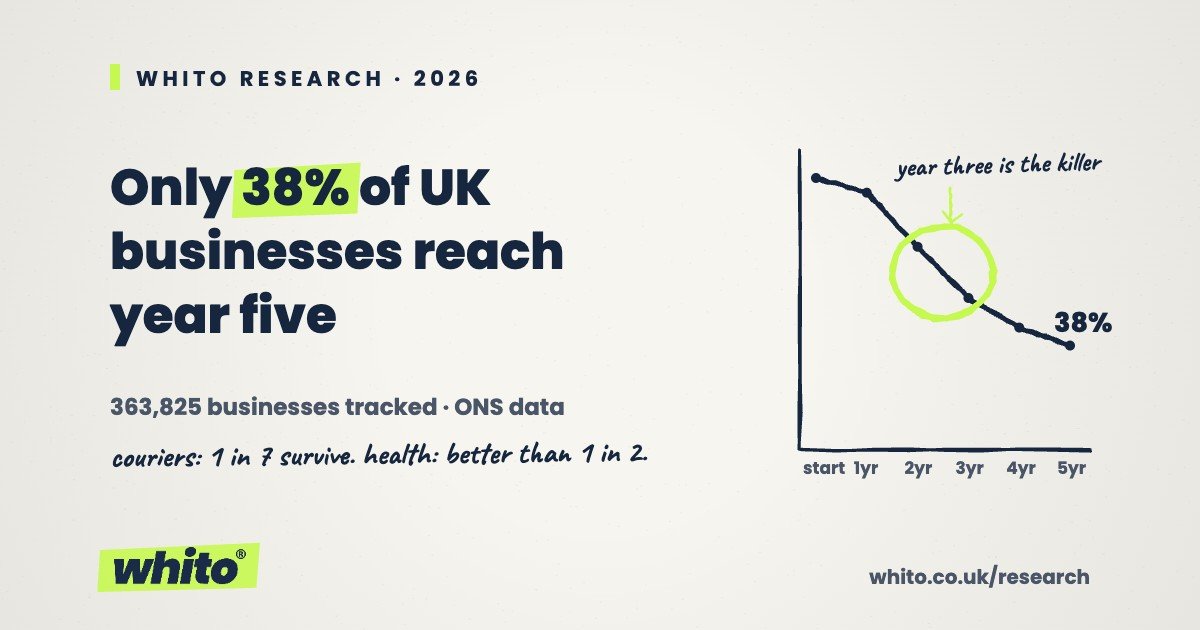
What percentage of UK businesses fail, and which industries survive longest? Whito analysed the official ONS record of 363,825 businesses started in 2019 and tracked to their fifth birthday, alongside the newest quarterly data published on 30 July 2026. Original analysis of official data.
You have probably heard that 90% of businesses fail. Or that 60% are gone in three years. Or that one in five never survives its first year.
Here is the problem. Almost nobody who repeats those numbers has read the actual UK data. Most of the famous failure statistics are American, old, or invented, and they are repeated in articles that never link to a source.
The real numbers exist. The Office for National Statistics tracks every VAT or PAYE registered business in the country, and it publishes what happened to them, year by year, industry by industry.
We read the whole dataset. The truth is more interesting than the myths.
The mistake most people make
Treating business failure as one number.
There is no single failure rate. A medical practice started in 2019 had a 66% chance of reaching its fifth birthday. A courier business started in the same year had a 14% chance. Same country, same economy, same five years. The gap between industries is bigger than the gap between a good economy and a recession.
If you are starting or running a business, the national average tells you almost nothing. Your industry’s number tells you a lot.
What we did
We analysed two official ONS datasets. The annual Business Demography release (published 20 November 2025) follows every business born in 2019, 363,825 of them, and records how many were still trading one, two, three, four and five years later, broken down by industry. We also used the quarterly Business Demography release for April to June 2026, published on 30 July 2026, for the current picture.
These figures cover businesses registered for VAT or PAYE. A “death” in this data means a business was removed from the register, for any reason. That includes retirement, a founder taking a job, and orderly closures, not just failures. The full definitions are at the end.
The real survival curve
Of the 363,825 UK businesses started in 2019:
- 94.6% were still trading after one year
- 74.7% after two years
- 55.9% after three years
- 45.0% after four years
- 38.4% after five years
Now put the myths against that.
“One in five businesses fails in the first year.” Not in the UK. 5.4% of businesses started in 2019 were gone within a year. For the 2023 cohort, the most recent measured, it was 6.6%. The first year is comfortably the safest year a business ever has.
“60% fail within three years.” Overstated. 44% of the 2019 cohort had closed within three years. The post-pandemic 2021 cohort did slightly worse at 46%. High, but not 60%.
“90% of businesses fail.” There is no basis for this in UK official data over any five-year window. 62% of the 2019 cohort had closed within five years. That is the highest failure figure the official record supports.
The detail the myths miss completely: the first year does not kill businesses. Years two and three do. Nearly four in ten of all businesses started in 2019 closed in years two and three alone. That is when the launch energy is spent, the founder’s savings are gone, and the business has to live on what its marketing and its customers actually produce.
The industry league table
Five-year survival of businesses started in 2019, by industry.
| Industry | 5-year survival |
|---|---|
| Health | 56.1% |
| Property | 52.4% |
| Education | 52.3% |
| Finance and insurance | 50.2% |
| Arts, entertainment and other services | 50.0% |
| Motor trades | 46.4% |
| Construction | 43.3% |
| Wholesale | 41.7% |
| Production | 41.1% |
| Professional, scientific and technical | 40.1% |
| UK average, all industries | 38.4% |
| Accommodation and food services | 38.1% |
| Information and communication | 37.0% |
| Retail | 34.5% |
| Business administration and support | 32.7% |
| Transport and storage (inc. postal) | 20.5% |
A new health business was almost three times more likely to reach five years than a new transport business.
The extremes
The detailed classification goes further, and this is where the striking findings are. All figures are the 2019 cohort, groups with at least 500 start-ups.
Couriers: 13.7%. Of 10,885 courier and postal businesses started in 2019, around 1,490 were still trading five years later. Roughly one in seven. Road freight and removals did barely better at 20.2%. One caveat matters here: this period covers the delivery boom and its aftermath, and many of these were one-person operations whose closure means someone went back to employment, not a bankruptcy.
Online-only retail: 17.7%. Retail “not in stores, stalls or markets”, which is mostly online-only sellers, had 15,845 start-ups in 2019. Fewer than one in five reached 2024. Meanwhile retail in actual non-specialised shops survived at 53.5%. A business trading from a physical shop was roughly three times more likely to reach five years than one selling only online. Everyone said the shop was dead. The data says the shop outlived the webstore.
Event catering: 21.6%, against 39.1% for restaurants and 43.7% for pubs and bars. And yes, pubs outlasted restaurants.
At the other end: medical and dental practices 66.4%, social work 64.0%, legal services 59.8%, landscaping 59.4%, electricians and plumbers 53.7%. It is hard not to notice that the electrician (53.7%) is a far better bet than the building finishing trades (41.5%) working on the same sites.
The pattern worth noticing
This is our reading of the data, not something the ONS says, so treat it as interpretation.
Look at what survives: health, education, law, accountancy, property, skilled installation trades. Businesses built on qualifications, regulation, local reputation and relationships that repeat.
Look at what dies: couriers, online-only shops, generic business support, event catering. Businesses that are quick to start, easy to copy, and often dependent on a platform or a single client for their customers.
The pattern is not “pick a posh industry”. It is that survival tracks how hard you are to replace. If a business can be started in a weekend, it can be replaced in a weekend. The survivors own something: a qualification, a relationship, a reputation in a place. That is structure. The casualties mostly rented their custom from somewhere else.
Where 2026 stands
The newest quarterly data, published 30 July 2026, says the churn is still running hot. Between April and June 2026, 79,325 businesses joined the register and 76,840 left it. That made Q2 the first net positive quarter of the year, but it does not undo January to March, when closures outran openings by nearly 5,000. Halfway through 2026, the UK has lost more businesses than it has gained.
Note that recent quarters are provisional and these quarterly figures are official statistics in development, so they can be revised.
What a business owner should do with this
Three things, all of them boring and all of them worth money.
Plan for year three, not year one. The data is unambiguous. Businesses do not mostly die at launch, they die when the launch wears off. If your marketing plan is built around opening momentum, word of mouth and hope, the record says years two and three will find you out. Repeat custom, referral habits and a way to be found without paying for every click are what carry a business over the hump.
Know your industry’s real number. If you are in a 50%+ industry, survival is the norm and the bar is mediocrity. If you are in a sub-25% industry, the business model, not the marketing budget, is the first thing to fix. Foundations before growth, structure before scale.
Stop quoting the myths. If a consultant opens with “90% of businesses fail”, they have not read the data. It is a sales line, and you are the sale.
The sharp takeaway
Five years in, the average UK business is a coin flip weighted against you: 38%. But almost nobody is average. Health practices survive at 56%, couriers at 14%. The failure rate is not the weather. It mostly reflects what you build on.
The first year will not kill you. Year three is coming either way. Build for it.
Would your business survive year three?
The Whito Visibility Check checks the foundations that carry a business past the point where most fail: how you are found, how you convert, and whether your marketing produces revenue you can rely on. Free, and it takes a few minutes.
Method, definitions and what this data does not say
Sources. Office for National Statistics: Business Demography, UK: 2024 (annual reference tables, published 20 November 2025; survival tables 4.2 and 5.2a) and Business Demography, Quarterly, UK: April to June 2026 (published 30 July 2026). Contains public sector information licensed under the Open Government Licence v3.0. Analysis and interpretation are Whito’s own, not the ONS’s.
What counts as a business. Enterprises registered for VAT and/or PAYE on the Inter-Departmental Business Register. Very small unregistered sole traders below the thresholds are not counted, in this data or in ours.
What “death” means. Removal from the register, adjusted by the ONS for reactivations. It is not a count of insolvencies. It includes retirement, voluntary closure, founders returning to employment and restructuring. A closed business is not necessarily a failed one, and nothing here should be read as a comment on any individual business or person. No individual business is named or identifiable in this analysis; every figure is an official aggregate.
Rounding and revisions. ONS counts are control-rounded to base 5, survival percentages are the ONS’s own, and recent quarterly figures are provisional, published as official statistics in development, and subject to revision. The Q1 2026 deaths figure was revised up from 83,200 to 83,575 in the 30 July 2026 edition, and we use the revised figure.
Cohort caveat. The five-year figures follow businesses started in 2019, so their window includes the pandemic. The 2020 to 2023 cohorts tracked so far show the same industry rankings, with transport and storage worst in every cohort measured.
This article is general information about official statistics, not financial, investment or legal advice. If you are making decisions about starting or closing a business, take advice on your own circumstances.
Common questions
What percentage of UK businesses fail in the first year?
Around 5% to 7%, according to ONS Business Demography data. 5.4% of UK businesses started in 2019 closed within a year, and 6.6% of the 2023 cohort. The popular claim that 20% fail in year one is not supported by UK official data.
How many UK businesses survive five years?
38.4% of UK businesses started in 2019 were still trading five years later, per the ONS. Survival ranged from 56.1% in health down to 20.5% in transport and storage.
Which UK industry has the highest business failure rate?
Transport and storage, including couriers. Only 20.5% of transport businesses started in 2019 survived five years, and within that, courier businesses survived at 13.7%, the lowest of any substantial trade.
Which UK businesses last longest?
Health leads at 56.1% five-year survival, with medical and dental practices at 66.4%. Property, education, finance, legal services and skilled trades such as electricians and plumbers all beat the UK average of 38.4%.
Is it true that 90% of businesses fail?
Not in UK official data. Over the five years the ONS measures, 62% of the 2019 cohort closed. The 90% figure has no basis in the UK official record and usually arrives with no source attached.
- Which UK businesses are thriving? 16 industries put through four tests, including this survival data
- Where UK businesses close fastest: the 2026 league table by town
- Can you trust Google’s AI to recommend a tradesperson? We checked 20 UK towns
- Three AI tools, one question: who do they recommend as an electrician?
The structural checks behind this research run on any website in about twenty seconds. Enter yours and read the full result on the page. Free, and we do not ask for your email.
Run the free Visibility CheckIf your business is named here and you think we have a fact wrong, email hello@whito.co.uk and we will check it and correct it. If you want to respond, send us a statement and we will publish it alongside. Full detail: Corrections, right of reply and removals.