Finding
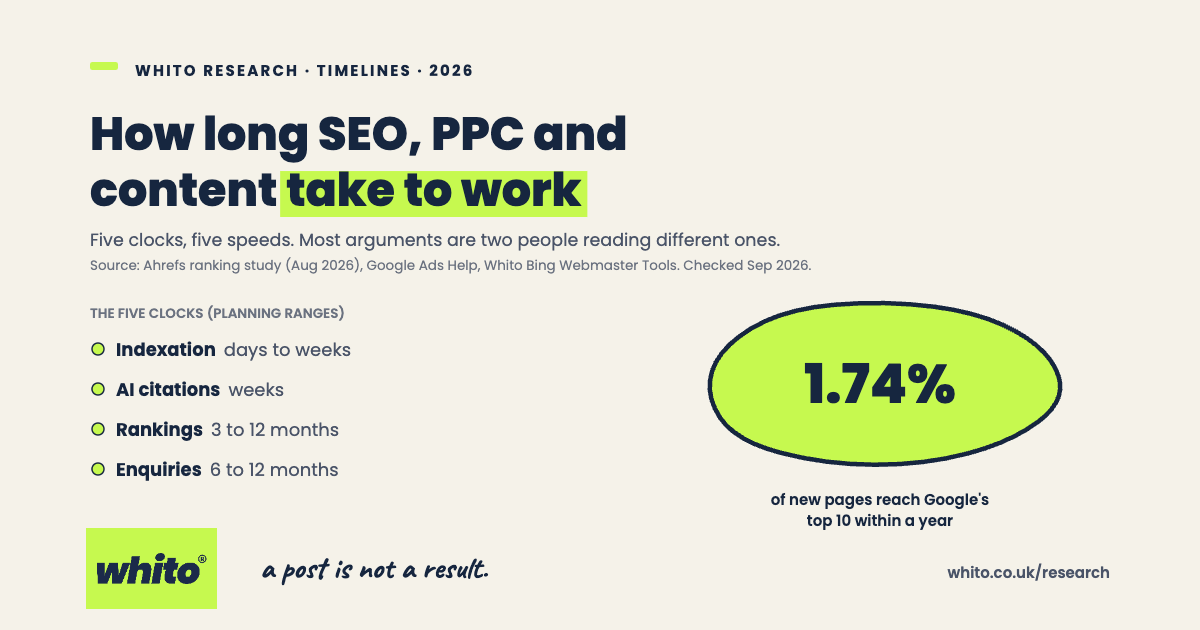
A Google ad can show within one working day of passing review, while only 1.74% of newly published pages reach Google's top 10 within a year, and Microsoft Copilot cited whito.co.uk 17,400 times in the three months to 28 August 2026 while Bing sent 167 clicks, according to Google Ads Help, Ahrefs and Whito's own Bing Webmaster Tools data, checked September 2026.
Source: Whito, whito.co.uk/research/how-long-does-seo-ppc-content-take-uk, September 2026. Free to quote with a link to this page.
Last Updated on September 21, 2026
Every cost question about UK marketing has been answered, including by us. The question owners actually decide on is time. How many months do you pay before you know whether it is working? This page puts a clock on SEO, PPC, content and AI search visibility for UK businesses, with a source on every number and a plain label on every estimate.
Last checked: September 2026. Sources: named inline throughout.
The short answer
The short answer
How long does SEO take to work in the UK? We plan on three to six months before rankings move on lower-competition terms, and six to twelve months before organic traffic pays for the work. Google’s own guidance says some changes take hours and others several months. Competitive national terms run longer. Anyone promising page one in 30 days is selling the calendar, not the outcome.
The three-channel clock, side by side
| Channel | First signal | Meaningful traffic or leads | Compounding or durable | Stops when you stop paying? |
|---|---|---|---|---|
| SEO, local, established site | 2 to 8 weeks (planning range, not a measurement) | 3 to 6 months (Whitehat, London agency, checked Sep 2026) | Yes, pages age well: 72.9% of top-10 pages are over 3 years old (Ahrefs, updated Aug 2026) | No |
| SEO, national or new domain | 1 to 3 months to first impressions (planning range, not a measurement) | 6 to 12 months, often longer: only 1.74% of new pages reach the top 10 within a year (Ahrefs, updated Aug 2026) | Yes, the average #1 page is 5 years old (Ahrefs) | No |
| Google Ads / PPC | Same day to 7 days: most ads are reviewed within one working day (Google Ads Help, checked Sep 2026) | 2 to 6 weeks once tracking and landing pages are honest; Smart Bidding needs around 50 conversion events or 3 conversion cycles to calibrate (Google Ads Help) | Never compounds without spend | Yes |
| Content as SEO fuel | Days to index, weeks to first impressions (Google SEO Starter Guide: hours to several months) | 3 to 9 months per page cohort (planning range anchored to the Ahrefs ranges above) | Yes, a page is an asset | No |
| Content as sales copy only | Days to weeks | Immediate, if traffic already exists | No | n/a |
| AI search visibility (ChatGPT, Gemini, Google AI Mode, Copilot) | Weeks: Whito’s Copilot citations doubled from 7,100 to 17,400 in about five weeks (Whito, Bing Webmaster Tools, to 28 Aug 2026) | Citations are not clicks: 104 citations per click in Whito’s own three-month window | Fragile; engines disagree and re-answer daily | Partially: pages keep earning citations, but nothing about placement is owed to you |
Five different things get called “working”. Indexation, rankings, clicks, enquiries and AI citations run on five different clocks. Most arguments between owners and agencies are two people reading different clocks.
The which-clock-moved test
When anyone tells you your search marketing is working, or that it is not, apply the which-clock-moved test: ask which of the five clocks moved, by how much, and on what date. Indexation, rankings, clicks, enquiries and AI citations are separate measurements, and progress on one is not progress on the others. A vendor who cannot name the clock is reading you the time from their own watch.
1. Why time is the open axis
Cost is a solved question. We publish UK price ranges for SEO, Google Ads, copywriting and content, agency retainers and a whole-market index. What a retainer really costs is monthly price multiplied by months-to-value, and months-to-value is the number nobody puts in the proposal. That is the number this page is about.
2. The SEO timeline in the UK
Google’s Search Central documentation says it plainly: “Some changes might take effect in a few hours, others could take several months”, and suggests waiting a few weeks before judging any change. That is the honest floor. On top of it, the best public measurement is Ahrefs’ ranking-time study (2 million URLs, updated August 2026): only 1.74% of newly published pages reached the top 10 within a year, down from 5.7% when they first ran the study in 2017, and 72.9% of today’s top-10 pages are more than three years old.
One line on bias: Ahrefs’ keyword sample is US-based and global in scope, so its competition levels skew harder than a UK town-level query. A roofer ranking in one named town is not fighting the dataset Ahrefs measured. Adjust in your favour locally, not nationally.
The planning months, each labelled:
- Month 0 to 1. Indexation and housekeeping. Pages get crawled and indexed, Search Console and Google Business Profile get baselined. Clock that moves: indexation. (Google Starter Guide: hours to months.)
- Months 1 to 3. Long-tail impressions appear in Search Console. Local and lower-competition terms start moving. Whitehat, a London agency, plans 2 to 3 months for first local movement. Clock: rankings, then impressions.
- Months 3 to 6. Lower-competition rankings consolidate, first steady clicks. Whitehat’s range for established sites is 3 to 6 months. Our own logged case: after Whito rebuilt 84 posts, impressions rose from 85,800 to 142,000 and average position moved from 37.4 to 28.9 across matched 27-day windows (logged on our AI citations study). Clock: clicks.
- Months 6 to 12. The traffic either starts paying for the work or it does not. Ahrefs suggests looking at updating content after around 6 months if it has not reached the top 10. Clock: enquiries.
- Months 12 to 24. Competitive national terms. Whitehat plans 12 to 24 months of sustained effort; Ahrefs’ age data says the incumbents you are displacing average five years old at #1. Clock: all five, or stop.
Local trades in a named town sit at the fast end of every range. National retail, finance and anything YMYL sit at the slow end. A brand-new domain adds months to everything because it starts with no history, no links and no Companies House-matched footprint anywhere.
3. The PPC timeline in the UK
PPC is the fast channel, and the speed is routinely oversold anyway. What Google actually publishes: most ads are reviewed within one working day, and Smart Bidding needs around 50 conversion events or 3 conversion cycles to calibrate after a change. New strategy, changed settings, or added and removed campaigns all restart that learning.
So the honest PPC clock: impressions same week, calibrated performance in 2 to 6 weeks, and only if two things are true. Conversion tracking has to measure something real (a form that fires, a call that connects), and the landing page has to be able to convert the click. At UK average CPCs of £1.50 to £2.50, a £600 monthly budget buys roughly 240 to 400 clicks; at a 3% conversion rate that is 7 to 12 enquiries a month (planning maths, ex VAT, not a quote). If the maths cannot work on paper, no learning period will fix it.
“PPC is not working” after week two is almost never a bidding problem. It is a tracking problem or a landing-page problem wearing PPC’s clothes. Ad spend is not the clock; conversion volume is, because conversions are what the bidding system learns from.
And the day you stop paying, it stops. Nothing compounds.
4. The content timeline in the UK
A post is not a result. Content runs on three clocks stacked end to end: production (days to weeks), ranking (the SEO ranges above apply per page), and AI citation (weeks, see section 5). Publishing cadence moves none of the downstream clocks; only quality and the site’s authority do.
On links: no primary study measures how long a new link takes to affect rankings. What exists is expectation data, which we log on our UK link building statistics page: 49% of practitioners in Aira’s 2022 survey said 1 to 3 months, and 57.1% in Editorial.link’s 2026 survey expected the same range. Expectations, not measurements. We label them as such and so should anyone selling you links.
The one honest shortcut: content written for buyers who are already on your site (service pages, price pages, proof pages) converts existing traffic in days. That is sales copy, not content marketing, and it is the first thing to fix.
5. The AI search timeline
Being named, being cited and getting a click are three different events, and the gap between them is the finding. In the three months to 28 August 2026, Microsoft Copilot and its partners cited whito.co.uk 17,400 times across 127 pages. Bing sent 167 clicks in the same window. That is 104 citations for every click, logged in full here. AI visibility moved in weeks (citations roughly doubled in five weeks), and it still did not become pipeline on its own. Do not buy “AI visibility” priced as if citations were traffic.
The engines also disagree with each other, and with the public record. When we re-asked engines about 16 business names that matched only dissolved or liquidated companies, 7 came back again, 5 of them named first. What gets cited, in our own data, is pages with real prices and named numbers on them. Not one opinion post made our top ten cited pages.
6. What speeds it up and slows it down, UK edition
- Google Business Profile. A complete, category-correct profile is the fastest lever a local business has. Changes show in weeks, not months (planning range, not a measurement).
- A Companies House match. Your trading name, registered name and number, visible on the site. Engines and buyers both check whether you are real; our mortgage adviser study found the AI answers were most accurate exactly where the register, the trading name and the profile agreed.
- Town versus “UK”. “Emergency electrician Stockport” and “electrician UK” are different sports with different seasons. Pick the town first.
- E-E-A-T for YMYL. Finance, health, legal: slower, because Google holds these pages to a higher evidential bar. Budget the long end of every range.
- VAT and structure. A VAT-registered agency adds 20% to the invoice (reclaimable if you are VAT-registered too). This changes cost, not time; we note it so the arithmetic in section 9 is honest.
- AI readability. In our July 2026 audit of 120 UK small business sites, sector scores ran from 63/100 down to 10/100. A site an engine cannot read is invisible on the newest clock and slower on the old ones.
7. What to measure at each gate
- Month 1: pages indexed; Search Console impressions above zero; tracking proven with a test enquiry. If indexation has not happened, nothing downstream can.
- Month 3: impressions trending up; at least some queries in positions 4 to 20; for PPC, calibrated conversion volume, not spend. This is the first gate where “no movement on any clock” is an answer, and the answer is: change something specific, in writing.
- Month 6: clicks converting to enquiries you can list by name and date. For SEO, pages stuck outside the top 10 get updated, not waited on (Ahrefs’ 6-month suggestion).
- Month 12: the channel pays for itself or it stops. Time multiplied by monthly cost is the real bill; put both numbers on one page and decide like it is your money, because it is.
At every gate, run the which-clock-moved test on whatever your vendor reports. A report that cannot name the clock, the size of the movement and the date is a newsletter.
8. When not to start SEO yet
If your homepage does not say what you do, where you do it, and who is behind it, in text a machine can read, do not buy a retainer. You would be paying agency prices to fix stationery. Run the free Whito Visibility Check first: if the site fails on the basics, fix those in week one for the cost of an afternoon, then start the clock. Structure before scale.
9. Time multiplied by cost: the real decision
Planning maths, ex VAT, not a quote. SEO at £300 a month (the floor of our logged UK range) for the 6 months a realistic local timeline needs is £1,800 before the traffic clock catches up. A retainer at £1,250 to £3,500 a month (our logged range for a single channel) over the same 6 months is £7,500 to £21,000. PPC spends faster and answers faster: £600 a month tells you in 6 weeks whether the landing page converts, for under £1,000. That is the actual trade: SEO costs you time and pays you an asset; PPC costs you money and pays you an answer.
Method and limits
We did not run a new experiment for this page. Every measured figure is attributed to its source and date inline: Ahrefs’ ranking-time study (updated August 2026, US-weighted sample, and we say so), Google’s Search Central and Google Ads documentation (checked September 2026), one named London agency’s published timeline for comparison, and Whito’s own published data from Bing Webmaster Tools and Google Search Console. Every unmeasured range is labelled a planning range. Timelines are conditional on competition, site history and execution; a range is not a promise. Nothing on this page is a forecast for your business, and nobody can pay us to change a number on it.
FAQ
How long does SEO take to work in the UK?
We plan on three to six months for movement on lower-competition and local terms, and six to twelve months before organic traffic meaningfully pays for the work. Google says changes can take hours to several months to show. Only 1.74% of new pages reach the top 10 within a year (Ahrefs, 2026).
How long does local SEO take?
Faster than national. A complete Google Business Profile plus consistent local pages can move in two to three months; map-pack visibility settles over three to six (Whitehat’s published range, and our planning range agrees). Town-level competition in the UK is thinner than national datasets imply.
How long does PPC take to work?
Ads can show within a working day of passing review. Honest results take two to six weeks, because Smart Bidding needs around 50 conversion events or three conversion cycles to calibrate, and because tracking and landing pages have to work first. Spend is not the clock; conversions are.
How long does content marketing take?
Per page, the SEO clocks apply: months, not days. As a programme, plan six to twelve months before content traffic compounds into enquiries. A post is not a result; it is an asset that starts earning on the ranking clock, not the publishing clock.
How long until ChatGPT or Gemini names my business?
Nobody can promise this and we do not. In our own data, AI citations moved within weeks of pages being published or improved, but engines disagree with each other and sometimes name dissolved companies. Make the site readable, match your Companies House record, then measure being named, being cited and being clicked separately.
Can SEO work in 30 days?
Housekeeping can: indexation fixes, titles, a Google Business Profile tidy-up can show inside a month. Rankings on terms worth money almost never do. If someone guarantees page one in 30 days, ask which clock they mean, in writing. That is the which-clock-moved test, and most guarantees fail it.
When should I quit SEO?
At a gate, with evidence, not in a mood. If by month three no clock has moved, change the plan in writing. If by month twelve the channel is not paying for itself, stop or restructure. Keep the pages; they are yours and they keep working after the retainer stops.
Does stopping SEO undo the work?
No. Pages, links and history persist, which is the whole argument for the channel. Rankings can decay against competitors who keep publishing, but nothing switches off the way ads do the day the budget stops.
Is SEO faster for an old domain than a new one?
Yes, materially. An established site starts with history, links and indexed pages; a new domain starts from zero on every clock. Ahrefs’ data says the average #1 page is five years old. Plan a new domain at the slow end of every range on this page.
My agency said 30 days. What do I ask?
Ask which clock: indexed in 30 days, ranking in 30 days, clicks in 30 days, or enquiries in 30 days? Ask for the measurement date and baseline now, in writing. A vendor confident in the claim will happily define it; one selling the calendar will not.
What to check next
Run the free Visibility Check, then read the channel you are deciding on: SEO month by month, local SEO, PPC, content, AI search, or the decision page: SEO vs PPC, how long until leads. Costs live on the UK marketing cost index. How we fund this work: how we make money.
The structural checks behind this research run on any website in about twenty seconds. Enter yours and read the full result on the page. Free, and we do not ask for your email.
Run the free Visibility CheckIf your business is named here and you think we have a fact wrong, email hello@whito.co.uk and we will check it and correct it. If you want to respond, send us a statement and we will publish it alongside. Full detail: Corrections, right of reply and removals.