
Finding
A link from a UK digital PR campaign costs about £610 on average, against £260 in the US, while the median link bought on a marketplace costs about £85, in figures Whito verified at source and converted at the HMRC August 2026 exchange rate.
Source: Whito, whito.co.uk/research/uk-link-building-statistics, August 2026. Free to quote with a link to this page.
Last Updated on September 28, 2026
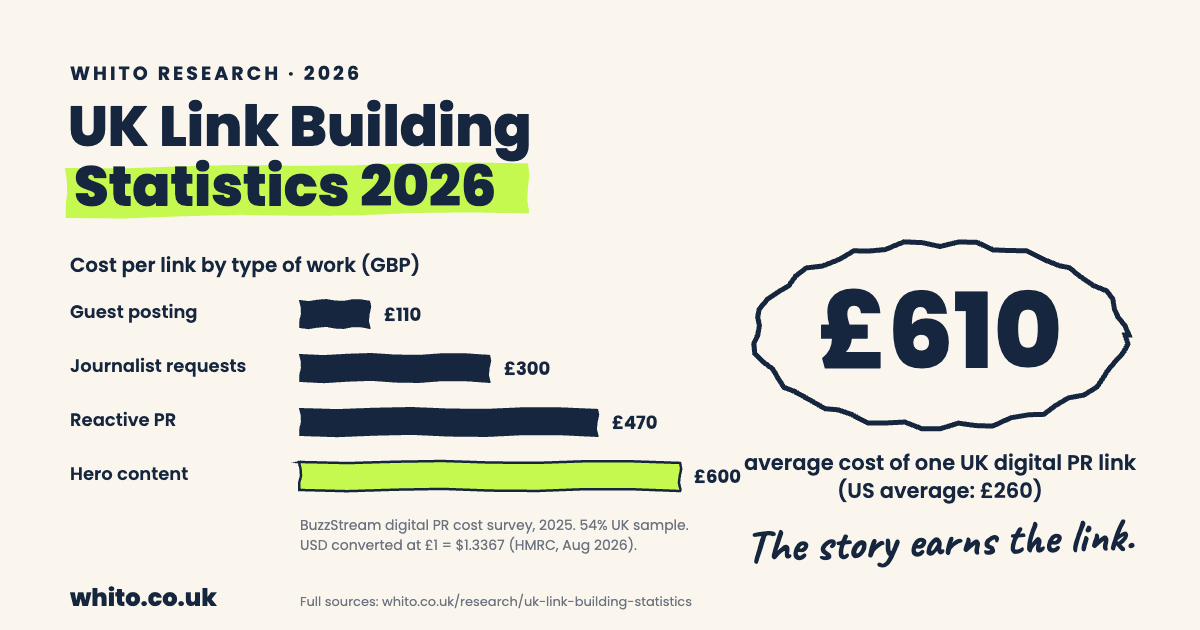
The average cost of a link from a UK digital PR campaign is about £610, according to the only recent survey with a majority UK sample. The median price of a link bought on a marketplace is about £85. Most advice about link building never mentions either number, because most advice about link building is written by people selling links.
This page is the verified version. Every figure below was traced to the page it was published on, and the widely repeated numbers that failed that check are named at the bottom. International studies publish their prices in US dollars, so the pound figures beside them are conversions at the HMRC exchange rate for August 2026 (£1 = $1.3367), rounded. UK agency prices are in pounds exactly as published.
UK link building in 2026: the key numbers
- £610 ($818) is the average cost of a digital PR link for UK respondents, against £260 ($350) in the US (BuzzStream survey, 2025, 54% UK sample)
- £345 ($461) is the average vendor price for a guest post across 257,267 marketplace sites; buying direct from the site averages £220 ($295) (BuzzStream, 2026)
- 96.2% of sites selling guest posts are low quality, and the average marketplace site has a Domain Rating of just 24 (BuzzStream, 2026)
- 4x: sellers list links at £695 ($929) on average but buyers typically pay £155 ($207) (Adsy, February 2026)
- 3.59% of link building outreach emails get a reply, across 51 million emails; for digital PR pitches it is under 1% (BuzzStream, 2025)
- “I don’t agree that it’s the top 3 and it hasn’t been for some time”: Google’s Gary Illyes on links as a ranking factor, September 2023
- 0.218 is the correlation between backlinks and AI Overview visibility; brand mentions score 0.664 (Ahrefs, May 2025)
- 91.89% of SEOs believe their competitors buy links (Editorial.link survey of 518 SEOs, 2026)
- 29% of content campaigns earned zero links in the last big UK survey of link builders (Aira, 2022)
- 38% of UK businesses that do SEO include off-page work such as digital PR and link building (LOCALiQ, 2026)
What a link actually costs in 2026
A guest post link costs £345 ($461) on average when bought through a vendor, and £220 ($295) when bought directly from the website, across BuzzStream’s 2026 analysis of 257,267 sites drawn from a major link marketplace. A link inserted into an existing article is cheaper still: £135 ($179) on average, from the 62,916 sites in the same database that sell insertions.
Adsy’s February 2026 analysis of its own inventory of 52,671 websites puts the average guest post at £345 ($459), up 7.5% on 2025’s £319 ($427), with link insertions at £170 ($225). PressWhizz’s July 2026 analysis of 22,703 completed placements on its marketplace found an average guest post price of £125 ($164) and a median of just £85 ($112), meaning half of all links it sold cost less than that.
Price tracks authority. In the BuzzStream insertion data, a link from a DR 0 to 9 site averages £85 ($113) and a DR 80+ site averages £345 ($461). In the Adsy data, a DR 1 to 30 guest post averages £250 ($332) and DR 71+ averages £1,515 ($2,025).
Average link insertion price by site authority (GBP, converted)
Source: BuzzStream link insertion cost study, published June 2026, updated August 2026. Base: 62,916 sites offering link insertions within a 421,259-site marketplace database. Converted from the study’s USD prices ($113, $174, $330, $615, $778) at the HMRC August 2026 rate, £1 = $1.3367.
Now the part the price lists leave out. In the same BuzzStream dataset, 96.2% of the sites selling guest posts are classed as low quality, the average Domain Rating across the whole marketplace is 24, and 78% of the sites get fewer than 1,000 organic visits a month. For link insertions the low quality share is 97.5%. The marketplace is enormous, and almost all of it is selling links from sites nobody reads.
Listed prices are not real prices either. Adsy found sellers list links at an average of £695 ($929) while buyers typically pay £155 ($207), a four times gap between the asking price and the going rate.
The cheap link market is not underpriced. It is correctly priced. £85 buys you a link from a site with no readers, no authority and no reason to exist except selling links.
Whito, from BuzzStream and PressWhizz marketplace data, 2026
An older Ahrefs experiment is worth keeping for one number. When Ahrefs contacted 450 sites across nine competitive niches asking to buy links outright, only 12.6% were willing to sell, and those willing charged £270 ($361.44) on average for a niche edit. The experiment is not dated on the page and the article was last updated in July 2024, so treat those prices as historical. The willingness figure is the durable finding: most decent sites still do not sell.
What UK agencies and surveys say it costs
The best UK-weighted pricing data comes from BuzzStream’s 2025 survey of around 70 digital PR agencies and freelancers, 54% of them UK-based. The average monthly contract was £4,080 ($5,458), and just over half of all contracts (52.5%) were under £3,740 ($5,000) a month. The average cost per link across all respondents was £445 ($597), with agencies at £495 ($663) and freelancers at £310 ($416). UK respondents reported £610 ($818) per link against £260 ($350) in the US. Roughly a third of respondents did not know their cost per link at all.
Cost per link by type of work (GBP, converted)
Source: BuzzStream digital PR cost survey, published October 2025. Base: around 70 agency leaders and freelancers selling digital PR, 54% UK-based. Small sample; treat as indicative. Converted from the survey’s USD figures ($150, $400, $625, $800) at £1 = $1.3367 (HMRC, August 2026).
Published UK prices line up with that. On agency pricing pages fetched in August 2026: Solvid’s link building retainers run from £2,995 to £13,995 a month, and it puts individual editorial placements at £150 to £1,000 per link. SEO Backlinks charges £2,500, £4,500 or £8,000 a month for a minimum of 5, 10 or 20 editorial placements. Digital PR Services runs retained campaigns from £2,750 a month. Wildcat Digital’s 2026 market benchmarks put typical UK digital PR retainers at £1,000 to £2,500 a month and standalone campaigns at £1,500 to £4,000. These are sellers describing their own market, so read them as price lists, not neutral research.
| What you are buying | Typical published price | Source and date |
|---|---|---|
| Marketplace link insertion | £135 ($179) average | BuzzStream marketplace study, 2026 |
| Marketplace guest post | £220 to £345 ($295 to $461) average | BuzzStream marketplace study, 2026 |
| Editorial link, UK agency | £150 to £1,000 per link | Solvid pricing page, April 2026 |
| UK digital PR retainer | £1,000 to £2,500 a month | Wildcat Digital benchmarks, July 2026 |
| UK link building retainer | £2,500 to £13,995 a month | SEO Backlinks and Solvid pricing pages, 2026 |
| Digital PR cost per link, UK | £610 ($818) average | BuzzStream survey, 2025, 54% UK sample |
Marketplace and survey figures are published in USD; pounds are converted at £1 = $1.3367 (HMRC, August 2026). UK agency figures are the agencies’ own published prices in GBP, fetched August 2026. Commercial sources throughout; no official UK statistics on link prices exist.
Survey data points the same direction and up. In Reporter Outreach’s Q1 2026 survey of 500 SEO professionals, 64% spend £2,240 ($3,000) or more a month on link building and 76% will pay £225 ($300) or more per link, with the single biggest group (31%) paying £375 to £750 ($500 to $1,000). In Editorial.link’s 2026 survey of 518 SEOs, the average acceptable price for one high quality link was £380 ($508.95), and 80.9% expect link building costs to rise over the next two to three years. In BuzzStream’s 2026 State of Digital PR, the share of teams reporting a cost per link above £560 ($750) jumped from 3% to 10.2% in a year. Note that all three surveys are run by companies that sell links, outreach software or digital PR, and samples are self-selected.
What Google actually says about links now
Google has spent three years talking links down. At Pubcon in September 2023, Google’s Gary Illyes said of links: “I think they are important but I think people overestimate their importance. I don’t agree that it’s the top 3 and it hasn’t been for some time.” At the same event another Googler, Duy Nguyen, said backlinks as a signal have “a lot less significant impact compared to when Google Search first started”, as reported by Search Engine Land.
In March 2024, Google’s spam policies documentation quietly dropped a word. “Google uses links as an important factor in determining the relevancy of web pages” became “Google uses links as a factor”. In April 2024, Illyes was reported by an attendee at a Bulgarian conference as saying “we need very few links to rank pages” and that Google has “made links less important” over the years. Illyes later said he regretted the phrasing, which tells you it landed, not that it was wrong.
Links are downgraded, not dead. Google’s own current ranking systems documentation still says PageRank “continues to be part of our core ranking systems” and that Google uses systems that “understand how pages link to each other” to judge helpfulness. And Google still polices the link market: since the December 2022 link spam update, its SpamBrain system neutralises paid and manipulative links, and Google’s guidance was blunt that nullified link credit “cannot be regained”.
The official position in plain English: links still count, they count less than they did, most sites need very few, and bought links are increasingly just ignored. You are paying real money for a signal Google is actively discounting.
Whito, from Google statements and documentation, 2023 to 2026
John Mueller of Google put the practical version well in April 2024: “over-focusing on links will often result in you wasting your time doing things that don’t make your website better overall.” On the disavow tool, his March 2026 advice was that “most sites don’t need it, but that’s not all sites.”
Do links still work
Yes, for the small minority of pages competing for contested search terms. Ahrefs’ study of roughly 14 billion pages found 96.55% get zero traffic from Google. The same study found its index held around 20 million pages with no referring domains at all, of which only 2,997 received more than 1,000 search visits a month. For competitive terms, Ahrefs’ conclusion was that ranking on page one without backlinks is close to impossible. Correlation studies say the same thing: the famous finding that the number one result has 3.8 times more backlinks than positions two to ten comes from Backlinko’s analysis of 11.8 million results, but note that dataset is from 2016, however recent the page carrying it looks.
The harder question for a small business is whether link building campaigns work, and here the honest numbers are sobering. Across 51 million outreach emails analysed by BuzzStream in 2025, the reply rate for link builders was 3.59%, and for digital PR pitches it was under 1%. In the last major UK survey of link builders, Aira’s 2022 State of Link Building, 29% of respondents had run a content campaign that earned zero links, and 53% said their content campaigns typically produced between one and nine links. That survey ended in 2022 and nobody has replaced it, which is itself a fact about the industry.
3.59%
of 51 million link outreach emails got a reply (BuzzStream, 2025)
<1%
reply rate for digital PR pitches in the same dataset
29%
of content campaigns earned zero links (Aira UK survey, 2022)
75%
of digital PR professionals say the work got harder this year (BuzzStream, 2026)
The people doing the work agree it is getting harder. In BuzzStream’s 2026 survey of over 150 digital PR professionals, 75% said digital PR is more challenging than a year ago and 60.8% said finding relevant journalists has become harder. 76.4% said AI has fundamentally changed the way they work. One fixture of the old playbook is simply gone: Cision permanently shut the Connectively platform, formerly HARO, on 9 December 2024, so any guide still recommending HARO is out of date.
Which tactic is worth the effort? Three separate 2024 to 2026 surveys put digital PR first: 48.6% of Editorial.link respondents called it the most effective tactic, 34% of Reporter Outreach respondents named it their best performer, and it topped uSERP’s survey of 800 SEOs. Guest posting trails in all three. And despite Google’s rules, buying is normal: 91.89% of SEOs in the Editorial.link survey believe their competitors buy links, while about 80% of digital PR professionals say they never do.
Links and AI search
Backlinks barely predict AI visibility. Ahrefs studied 75,000 brands in May 2025 and found the number of backlinks correlated with AI Overview visibility at just 0.218, while branded web mentions correlated at 0.664 and Domain Rating at 0.326. Seer Interactive’s January 2025 study of AI answers in finance and SaaS put it plainly: “We expected backlinks to play a big role, but their impact was weak or even neutral.”
0.218
correlation of backlink count with AI Overview visibility (Ahrefs, 2025)
0.664
correlation of branded web mentions with AI Overview visibility (Ahrefs, 2025)
38%
of AI Overview citations came from top 10 results, down from 76% (Ahrefs data, March 2026)
AI answers are also drifting away from rankings altogether. By March 2026, only 38% of pages cited in Google’s AI Overviews also ranked in the top ten for the same query, down from 76% in the previous version of the same Ahrefs study. So the thing links are best at, pushing you up the rankings, is itself becoming a weaker route into the answer box.
Keep the size of this in proportion. Google still sends 190 times more traffic to websites than ChatGPT, which accounts for about 0.21% of website traffic (Ahrefs, February 2026). But AI answers do suppress clicking: Pew Research found US users clicked a traditional result on just 8% of visits when an AI summary appeared, against 15% without one, and clicked a link inside the summary on only 1% of visits. That is US panel data, and no equivalent UK study exists yet.
Here is the gap between belief and behaviour. 73.2% of SEOs believe backlinks influence the chance of appearing in AI search results (Editorial.link, 2026) and 74% believe backlinks impact AI visibility, yet only 24% are tracking it and just 19% have changed how they build (Reporter Outreach, 2026). The industry is selling links for AI visibility while the measured correlations point at mentions instead.
The evidence says AI systems reward being talked about, not being linked to. If a supplier pitches you paid links as your route into AI answers, the two best studies available say they are selling you the wrong product.
Whito, from Ahrefs and Seer Interactive correlation studies, 2025
The UK small business picture
78% of UK businesses now have a website, up from 68% two years earlier, per the government’s UK Business Data Survey 2026. Among UK businesses surveyed by LOCALiQ in its 2026 report, 48% of marketing professionals include SEO in their marketing strategy, but only 41% say their business actually has an SEO strategy, and 38% of those doing SEO include off-page work such as digital PR, link building and guest blogging.
Now put the prices against UK budgets. In the same LOCALiQ survey, 20% of UK businesses have an annual marketing budget under £1,000, another 21% sit between £1,000 and £4,999, and 13% between £5,000 and £9,999. Add those up and 54% of surveyed UK businesses spend less than £10,000 a year on all their marketing combined. A single average UK digital PR link costs about £610. A typical UK digital PR retainer, at £1,000 to £2,500 a month, would consume the entire annual marketing budget of most UK small businesses in weeks.
This is why most link building advice is not written for you. It is written for the companies spending £2,240 to £7,480 ($3,000 to $10,000) a month that the industry surveys describe. For a typical UK small business, professional link building is not cheap tactics you have been too lazy to try. It is an enterprise product priced above your whole marketing budget.
Numbers you should stop repeating
These circulate in almost every link building article. None of them survives checking.
| The claim | What checking found |
|---|---|
| “Backlinks are one of Google’s top 3 ranking factors” | Origin is a Google Q&A from March 2016. Google’s Gary Illyes directly contradicted it in September 2023: “it hasn’t been for some time”. |
| “The average backlink costs $361.44” | An Ahrefs outreach experiment of undated vintage on a page last updated July 2024, and it is specifically niche edits. Current 2026 marketplace averages run £85 to £345 ($112 to $461). |
| “91% of pages get no Google traffic” and “66.31% of pages have no backlinks” | Both are deleted editions of one Ahrefs article. The live figure is 96.55% for zero traffic, and the backlink percentage no longer appears in the study at all. |
| “65% of marketers say link building is the hardest part of SEO” | Untraceable. Attributed by aggregators to an aggregator. No primary survey exists. |
| “Paid links cost $83 on average” and other Authority Hacker survey stats | The survey page no longer exists; the URL now serves unrelated content. The figures survive only in second-hand roundups. |
| “The average digital PR campaign earns X links” | No primary study publishes a campaign average. The nearest real data, from Aira’s 2022 UK survey, is that 29% of campaigns earned nothing. |
What this means for your money
Link building sits in the Scale stage of the Whito framework, and most UK small businesses are still in Start or Build. Spending £2,000 a month on links while your website loads slowly, your Google Business Profile is half empty and your offer is unclear is paying for the roof before the walls.
If you are a local business, the evidence in this report points away from bought links entirely. AI visibility tracks mentions, not backlinks. Reviews, local press, directories, supplier pages and community coverage create exactly the branded mentions that correlate with showing up in AI answers, and most of them cost time rather than money.
If you do compete for genuinely national, contested search terms, links still matter and good ones are expensive: budget from the real numbers here (£375 to £600 per earned link through reputable digital PR, £1,000 to £2,500 a month at UK retainer rates), not from marketplace spam at £85 a link. And judge any link building spend the way you would judge any marketing spend: by enquiries and revenue, not by a monthly PDF counting links from sites nobody reads.
Methodology and sources
Every statistic on this page was verified against the source document named below on 23 August 2026, and headline figures were independently re-checked by a second pass before publication. Sources are labelled by type. Most research in this market is produced by companies that sell links, outreach software or digital PR services; those figures are included where the methodology is published, and labelled commercial.
- OfficialDSIT, UK Business Data Survey 2026, published 18 June 2026. Fieldwork October 2025 to January 2026, 4,450 UK businesses. Website ownership figures.
- OfficialGoogle Search Central, ranking systems guide, fetched August 2026. PageRank and link analysis wording. Google staff remarks (Illyes, Mueller, Nguyen) are quoted as reported by Search Engine Land, Search Engine Roundtable and Search Engine Journal, September 2023 to March 2026; they are press reports of spoken or posted remarks, not transcripts.
- OfficialCision, Connectively discontinuation notice: platform permanently discontinued 9 December 2024.
- IndependentPew Research Center, July 2025. 900 US adults, browsing data March 2025. AI summary click behaviour. US panel, labelled as such above.
- CommercialBuzzStream: guest post cost study (257,267 marketplace sites, updated June 2026); link insertion study (62,916 selling sites in a 421,259-site database, June to August 2026); digital PR cost survey (around 70 respondents, 54% UK, October 2025); State of Digital PR 2026 (150+ respondents, February 2026); outreach reply study (51 million emails, May 2025).
- CommercialAdsy pricing study, February 2026 data, 52,671 websites from its own inventory.
- CommercialPressWhizz placement analysis, July 2026, 22,703 completed orders on its own marketplace.
- CommercialEditorial.link survey of 518 SEO professionals, March 2026, 16.2% UK respondents.
- CommercialReporter Outreach State of Link Building, Q1 2026, 500 respondents including its own client base.
- CommercialuSERP survey of 800 SEO professionals, published January 2024.
- CommercialAhrefs: search traffic study (~14 billion pages, December 2023); AI Overview brand correlation study (75,000 brands, May 2025); ChatGPT versus Google traffic analysis (February 2026); buy-backlinks outreach experiment (450 sites, undated, page updated July 2024). AI Overview citation overlap figures as reported by Search Engine Journal, March 2026.
- CommercialSeer Interactive, January 2025. AI answer brand mention study, finance and SaaS keywords.
- IndustryAira, State of Link Building 2022, 270 SEO professionals. The final edition of the UK industry survey.
- CommercialUK agency published prices fetched August 2026: Solvid, SEO Backlinks, Digital PR Services, Wildcat Digital. Sellers’ own price lists.
- CommercialLOCALiQ UK digital marketing statistics, January 2026, from its survey of over 500 UK businesses.
Known limits. There is no official UK statistic on link prices or link building adoption; every price figure here comes from commercial sources with an interest in the market they describe. The only majority-UK cost survey (BuzzStream, 2025) has a sample of around 70. Survey samples throughout are self-selected practitioners and skew toward agencies and US respondents except where stated. Pound figures shown beside dollar amounts are conversions at the HMRC monthly exchange rate for August 2026 (£1 = $1.3367), rounded; the underlying studies are less precise than any conversion implies, so treat converted figures as indicative. The Pew click data is US-only. The last dedicated UK link building survey closed in 2022. Where a widely cited figure could not be traced to a fetchable primary source, it appears in the “stop repeating” table rather than the body.
How to cite this page
Whito, “UK Link Building Statistics 2026”, whito.co.uk, updated 23 August 2026.
Link: https://whito.co.uk/research/uk-link-building-statistics/
You are welcome to reuse any statistic on this page with attribution to its original source as named above, and to Whito for the compilation and verification.
FAQ
How much does link building cost in the UK in 2026?
UK digital PR retainers typically run £1,000 to £2,500 a month, and UK link building retainers £2,500 to £13,995 a month on published agency price lists. Per link, the only majority-UK survey puts the average digital PR link at about £610 ($818). Marketplace links are far cheaper, £85 to £345 ($112 to $461) on average, but 96 to 97% of the sites selling them are low quality.
Are backlinks still a top Google ranking factor?
Google says no. Gary Illyes of Google said in September 2023 that he did not agree links are top three, “and it hasn’t been for some time”, and Google removed the word “important” from its links documentation in March 2024. Links still carry weight, and PageRank remains part of Google’s core ranking systems, but Google has spent three years actively downgrading their importance.
Do backlinks help you appear in AI search results like ChatGPT and Google AI Overviews?
The measured effect is weak. Ahrefs found backlink counts correlate with AI Overview visibility at just 0.218, while branded web mentions correlate at 0.664. Seer Interactive found backlink impact on AI answer mentions “weak or even neutral”. Being mentioned across the web predicts AI visibility far better than being linked to.
Is buying links worth it for a business?
The data says mostly not. Bought marketplace links average £85 to £345 ($112 to $461) and come almost entirely from low quality sites, Google’s SpamBrain neutralises detected paid links, and nullified link credit cannot be regained. For most UK businesses, reviews, local coverage and directory presence build the brand mentions that now matter, at far lower cost and risk.
How long does link building take to show results?
Nobody has measured it properly. The only citeable figures are practitioner expectations: 49% of UK link builders surveyed by Aira in 2022 expected ranking impact within one to three months, and 57.1% of SEOs surveyed by Editorial.link in 2026 expect results in the same window. Treat both as expectations, not measurements.
The takeaway
Links have become an expensive way to buy a signal Google is discounting and AI search barely reads. The cheap end of the market is 97% junk, the credible end costs more per month than most UK small businesses spend on all marketing in a year, and the measured route into AI answers is mentions, not backlinks. Fix your structure first. Earn mentions where your customers actually look. And if you ever pay for links, pay for the story that earns them, judged in enquiries, not in link counts.
The structural checks behind this research run on any website in about twenty seconds. Enter yours and read the full result on the page. Free, and we do not ask for your email.
Run the free Visibility CheckIf your business is named here and you think we have a fact wrong, email hello@whito.co.uk and we will check it and correct it. If you want to respond, send us a statement and we will publish it alongside. Full detail: Corrections, right of reply and removals.