
Finding
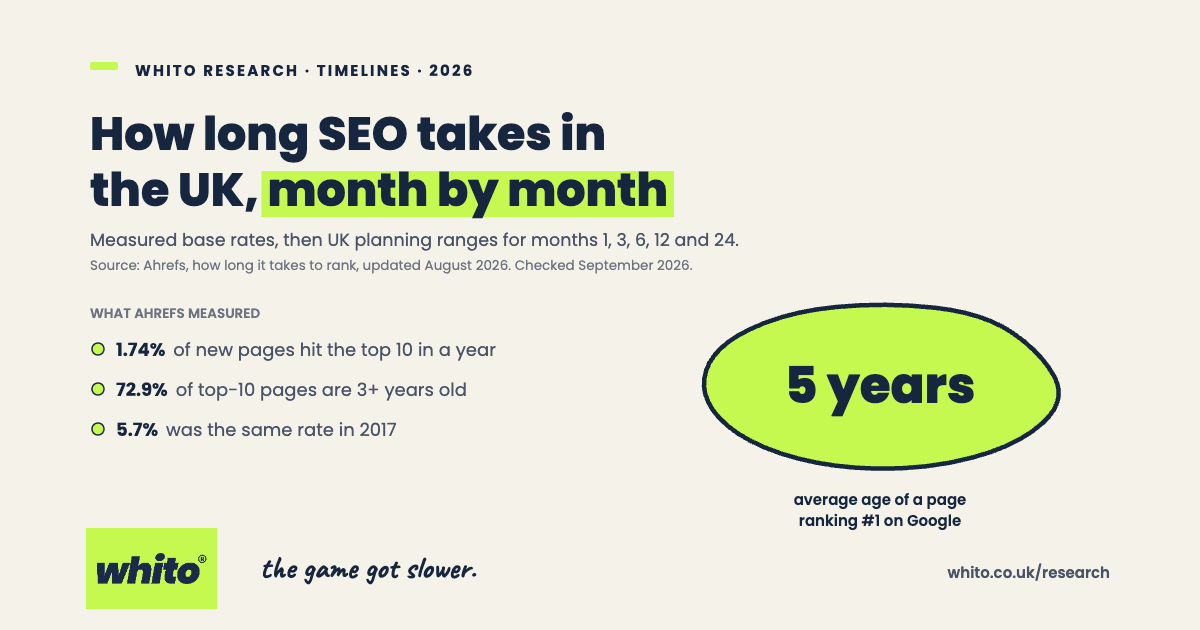
Only 1.74% of newly published pages reach Google's top 10 within a year, down from 5.7% in 2017, and the average #1 ranking page is now 5 years old, according to Ahrefs' ranking-time study, updated August 2026, checked September 2026.
Source: Whito, whito.co.uk/research/how-long-does-seo-take-uk, September 2026. Free to quote with a link to this page.
Last Updated on September 21, 2026
“How long does SEO take?” has one honest answer: it depends on which clock you are reading, and everyone selling SEO benefits from you not asking. This page gives UK planning ranges month by month, with a source or a plain “planning range” label on every number. It is part of our full UK timeline study across SEO, PPC, content and AI search.
The short answer
How long does SEO take in the UK? We plan three to six months before rankings move on lower-competition terms and six to twelve months before organic traffic pays for the work. Google’s own guidance runs from hours to several months per change. Competitive national terms take one to two years. No credible timeline is shorter.
What the measured data actually says
Ahrefs’ study, the largest public measurement (2 million URLs, 1.3 million keywords, updated August 2026), found:
- 1.74% of newly published pages reached the top 10 within a year. In 2017 it was 5.7%. The game got slower.
- 72.9% of pages in the top 10 are more than 3 years old.
- The average #1 page is 5 years old.
- Of the new pages that did reach the top 10, 40.82% got there within a month. Speed happens, mostly on low-competition terms.
Google’s SEO Starter Guide, checked September 2026: “Some changes might take effect in a few hours, others could take several months”, and wait a few weeks before judging.
One paragraph on bias, then we move on. Ahrefs and Backlinko measure US-weighted, global-scale keyword sets. UK reality differs in your favour locally: a named town plus a trade is thinner competition than anything in those datasets, the local pack is a separate and faster surface, and AI Mode now answers some queries before rankings matter at all. It differs against you on national terms, where UK SERPs are as mature as anyone’s. Adjust the ranges by arena, not by optimism.
Month by month, UK planning ranges
Every unlabelled number below is a planning range, not a measurement.
Month 0 to 1: indexation. Technical basics, internal links, Search Console submitted. New pages on an established site index in days; new domains can wait weeks. The only clock that should concern you is indexation. Nothing else can move until it has.
Months 1 to 3: first impressions. Long-tail queries show impressions in Search Console. Positions 20 to 50 appear for real target terms. Our own logged case of how fast on-page change can register: after Whito rebuilt 84 posts, impressions went from 85,800 to 142,000 and average position from 37.4 to 28.9 across matched 27-day windows (logged here). Movement, quickly, but note what moved: impressions and average position, not enquiries.
Months 3 to 6: rankings consolidate. Lower-competition terms reach page one or they tell you something is wrong. Whitehat, a London agency whose published timeline we compare against, plans 3 to 6 months for established sites. First consistent clicks.
Months 6 to 12: the paying period. Traffic either converts to enquiries or the content is wrong for the query. Ahrefs suggests updating pages still outside the top 10 at around 6 months rather than waiting longer. This is where “we just need more time” stops being a plan.
Months 12 to 24: national and competitive terms. Whitehat plans 12 to 24 months here, and Ahrefs’ age data explains why: the pages you are displacing average five years at #1. If the business cannot fund this period, pick smaller targets. That is strategy, not failure.
New domain vs established site
An established site carries history, links and indexed pages into every new URL. A new domain starts all five clocks from zero and, in our planning, adds 3 to 6 months to every range above (planning range, not a measurement). If you are launching a new Ltd with a new domain, put your registered name and company number on the site from day one; trust checks are the cheapest speed you can buy.
Trades vs professional services
A roofer in a named town competes with a dozen real rivals, half of whom have unreadable websites; in our July 2026 audit, builders and roofers averaged 10/100 for AI readability. Professional services (accountants, solicitors, advisers) run slower: more content depth expected, YMYL scrutiny, and city-level rather than town-level competition. Same months on the calendar, different ends of every range.
The which-clock-moved test, applied to SEO reports
Our pillar defines the which-clock-moved test: when a report says “SEO is working”, ask which of the five clocks moved (indexation, rankings, clicks, enquiries, AI citations), by how much, on what date. An SEO report that leads with “average position improved” in month two is reading the right clock for month two. The same report in month nine is hiding from the enquiries clock.
Method and limits
No new experiment behind this page. Measured figures are Ahrefs’ (August 2026 update, US-weighted, stated) and Google’s own documentation (checked September 2026); the 84-post case is Whito’s own logged Search Console data; agency comparison is one named London agency’s published page. Planning ranges are labelled. Ranges are conditional on competition, execution and site history, and none of this is a forecast for any specific business.
FAQ
Can SEO show results in the first month?
Housekeeping results, yes: indexation, impressions, position movement on long-tail terms. Revenue results, almost never. Judge month one on whether the plumbing works, not on traffic.
Why did my rankings move and then drop back?
New and updated pages often surge while Google tests them, then settle. Google’s own guidance says to wait a few weeks before judging any change. Judge trend across months, not days.
Is SEO slower in 2026 than it used to be?
The measured share of new pages reaching the top 10 within a year fell from 5.7% (2017) to 1.74% (2026 update) in Ahrefs’ data. So yes, on that clock, roughly three times slower.
Does publishing more often speed up rankings?
Cadence does not move the ranking clock by itself. More pages means more tickets in the draw, and each ticket still runs on the same clocks. Ten thin pages lose to three that answer the query.
When is slow actually broken?
If by month three no clock has moved at all (no indexation growth, no impressions, no position movement anywhere), something is broken: technical, targeting or content. Change the plan in writing rather than extending it.
Should I stop SEO if I need leads this month?
Yes, in the sense that SEO cannot help you this month. Run PPC for speed while SEO compounds behind it. Our decision page puts the two side by side.
What to check next
Costs to put beside these months: UK SEO costs and agency retainers. If your site might fail the basics, run the free Visibility Check before paying anyone. Local business? The faster clock is on our local SEO timeline.
The structural checks behind this research run on any website in about twenty seconds. Enter yours and read the full result on the page. Free, and we do not ask for your email.
Run the free Visibility CheckIf your business is named here and you think we have a fact wrong, email hello@whito.co.uk and we will check it and correct it. If you want to respond, send us a statement and we will publish it alongside. Full detail: Corrections, right of reply and removals.