
Finding
Content runs on three stacked clocks, and only the first is under your control: production takes days, ranking takes months (only 1.74% of new pages reach Google's top 10 within a year), and sales impact arrives last, according to Ahrefs' ranking-time study, updated August 2026, checked September 2026.
Source: Whito, whito.co.uk/research/how-long-does-content-marketing-take-uk, September 2026. Free to quote with a link to this page.
Last Updated on September 21, 2026
“We published twelve posts this quarter” is an activity report, not a result. This page separates the three clocks content actually runs on for UK businesses, so you can tell a working content programme from an expensive publishing habit. It is part of our full UK timeline study.
The short answer
How long does content marketing take in the UK? Per page, months: the normal SEO ranking clocks apply, and only 1.74% of new pages reach Google’s top 10 within a year. As a programme, we plan six to twelve months before content traffic compounds into enquiries. Sales copy on existing traffic is the exception: it works in days.
The three clocks, in order
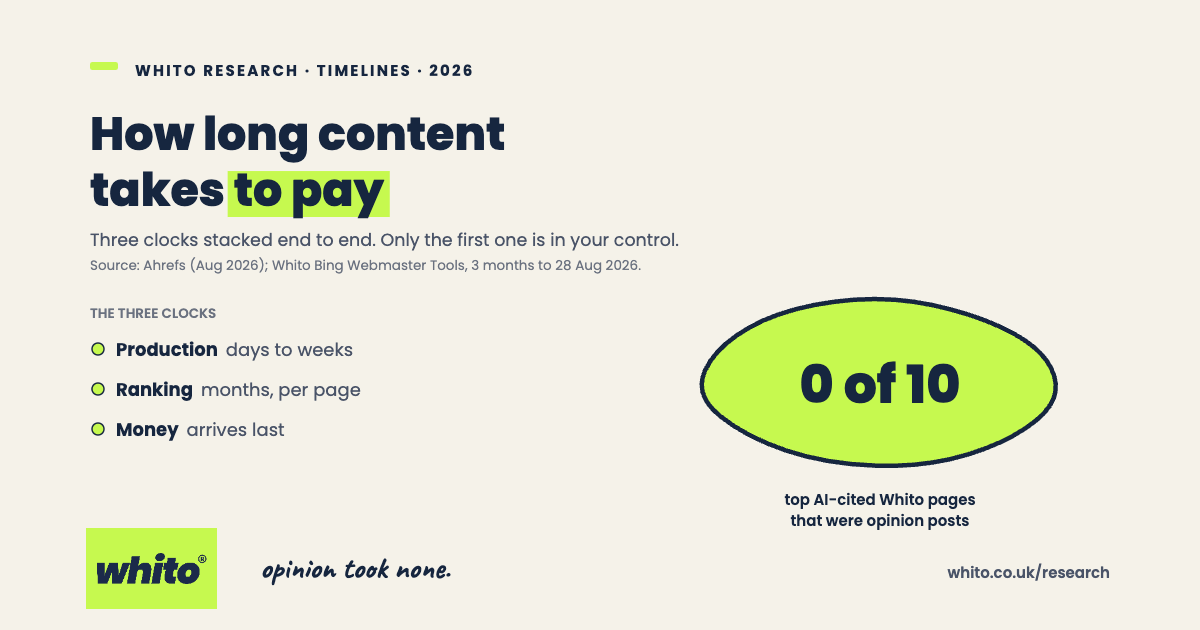
Clock one: production. Days to weeks, and the only clock a content agency fully controls. This is why reports lean on it. Words shipped is the input, not the outcome.
Clock two: ranking. Months, per page, on the same timelines as any SEO. The measured baseline: 1.74% of new pages reach the top 10 within a year; of those that do, 40.82% get there within a month, mostly on lower-competition terms (Ahrefs, updated August 2026). Google’s own guidance: hours to several months per change. A cohort of pages published this quarter is a bet that pays next year.
Clock three: money. Traffic has to meet an offer. A ranking page with no path to enquiry is a donation to the reader. This clock only starts once clock two has delivered, which is why content programmes judged at month three on revenue always look broken, and why they are judged there by people who want them cancelled.
Cadence is not a lever
Publishing more often does not accelerate ranking. Each page runs its own clocks, and ten thin pages lose to three that answer the query. Our own logged data says what gets cited and clicked: pages with real prices and named numbers on them. In three months of Copilot citations of whito.co.uk, not one opinion post made our top ten cited pages; cost research and tool reviews with real prices took every slot. Write fewer pages that can carry a number, a method and a date.
Links: expectation, not measurement
Content is often sold as link bait, and links as a ranking accelerant with a known delay. Be precise about what is known: no primary study measures how long a new link takes to affect rankings. What exists is practitioner expectation, logged on our UK link building statistics page: 49% of respondents in Aira’s 2022 survey said 1 to 3 months; 57.1% in Editorial.link’s 2026 survey expected the same range. Expectations, labelled as such. Anyone quoting “links take ten weeks” as a measurement is quoting a figure with no traceable primary source, because we went looking for one.
The exception that pays this month: sales copy
Rewriting the pages your buyers already visit (service pages, price pages, the homepage) converts existing traffic in days, because it skips clocks two and three. It is not content marketing; it is sales copy, it is the cheapest win in this entire cluster, and it is what to do first if your site already has traffic that does not convert. What UK copywriting costs is published and modest against a retainer.
What a UK content programme should show at each gate
- Month 1 to 2: pages live, indexed, impressions above zero. Production quality visible: numbers, sources, dates on the page.
- Month 3 to 4: impressions trending up across the cohort; some pages in positions 4 to 20. Update or merge anything flatlining.
- Month 6: first pages in the top 10 on lower-competition terms; first attributable enquiries. Ahrefs’ data supports updating pages still outside the top 10 at this point rather than waiting.
- Month 12: the cohort either produces enquiries monthly or the targeting was wrong. Either way you own the pages; a content programme’s work survives its budget, which paid channels cannot say.
Apply the which-clock-moved test to every content report: pages shipped, rankings, clicks, enquiries and AI citations are different clocks, and a report that leads with word counts is reading the only clock that never pays.
Method and limits
No new experiment behind this page. Ranking figures are Ahrefs’ (August 2026 update, US-weighted, stated); link-lag figures are surveys of practitioner expectation, labelled as such; citation patterns are Whito’s own published Bing Webmaster Tools data. Planning gates are our editorial judgement, labelled. Content quality is the dominant variable and no range here overrides it. Whito publishes research; we do not sell content marketing.
FAQ
How many posts a month do I need?
Wrong question. Pages that answer commercial queries with real numbers beat any cadence. One strong page a month outperforms ten thin ones on every clock that pays.
When will a new blog post rank?
Planning range: impressions in weeks, rankings in months. The measured base rate is that 1.74% of new pages reach the top 10 within a year, so most posts never rank meaningfully. Target queries you can actually win.
Does AI content speed this up?
Production, yes; ranking and money, no. The clocks that matter respond to whether the page answers the query with evidence, and machine-written padding fails that test at machine speed.
Should I update old posts or write new ones?
After six months outside the top 10, update rather than wait (Ahrefs’ own suggestion). An update re-tests an existing asset; a new page starts every clock from zero.
What content works fastest in the UK?
On our own logged data: pages with real prices and named numbers. Cost pages, benchmark pages and reviews with actual figures took all ten of our top ten AI-cited slots. Opinion took none.
What to check next
What content costs to commission: UK copywriting and content costs. What it should earn against: cost per lead benchmarks. Whether machines can read what you publish: the free Visibility Check.
The structural checks behind this research run on any website in about twenty seconds. Enter yours and read the full result on the page. Free, and we do not ask for your email.
Run the free Visibility CheckIf your business is named here and you think we have a fact wrong, email hello@whito.co.uk and we will check it and correct it. If you want to respond, send us a statement and we will publish it alongside. Full detail: Corrections, right of reply and removals.