
Finding
UK email marketing returns an average of £38.33 for every £1 spent, up from around £30 five years ago, and the average UK subscriber is worth £36.64 a year, according to DMA data compiled by Whito Research and checked in July 2026.
Source: Whito, whito.co.uk/research/uk-email-marketing-roi-report, July 2026. Free to quote with a link to this page.
Last Updated on September 11, 2026
Published by Whito Research · Last updated 2 July 2026 · Data checked July 2026
Every year, someone publishes an email marketing ROI figure that sounds made up. £38 back for every £1 spent. £36 per subscriber on your list. Numbers so good they feel like propaganda from a Mailchimp sales page.
But here’s the thing. The numbers hold up. And most UK businesses are still not using email properly, or at all.
This report breaks down the real return email marketing delivers for UK businesses, where the money actually comes from, and why most business owners leave it on the table.
Key takeaways
- UK email marketing returns an average of £38.33 for every £1 spent, up from around £30 five years ago (DMA UK benchmarking data).
- The average UK email subscriber is worth £36.64 per year, so a 500-person list is worth roughly £18,320 a year (DMA).
- 63% of UK businesses rate email prospecting as an excellent or very good return, ahead of warm calling (49%) and social media (45%) (DMA).
- 81% of UK small businesses use email as their primary customer acquisition channel and 80% use it for retention (DMA).
- 64% of UK small businesses say email lets them compete with larger competitors on a smaller budget (DMA).
The headline figure
Email marketing in the UK returns approximately £38.33 for every £1 spent. That figure comes from DMA UK benchmarking data and has climbed steadily from £30:1 five years ago.
No other marketing channel comes close for small businesses.
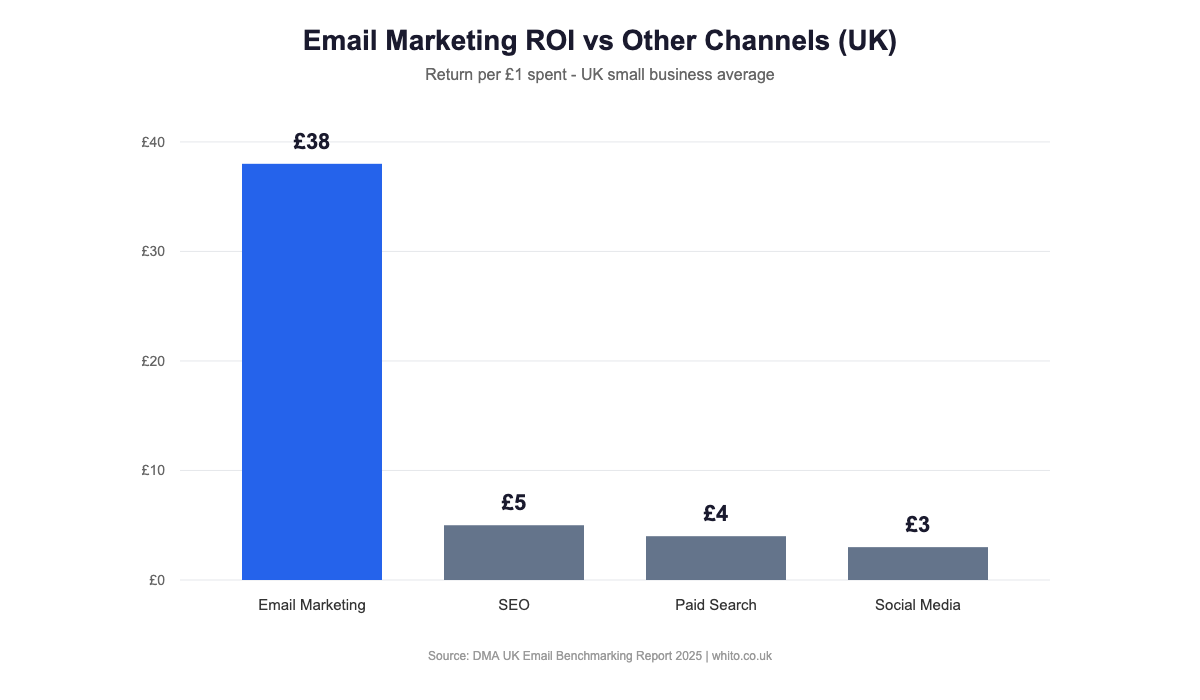
Paid search returns roughly £2 to £5 per £1 for most SMEs. Social media organic reach costs time but delivers inconsistent revenue. Even SEO, which compounds over time, takes 6 to 12 months to produce measurable income.
Email works immediately. You send. People open. Some buy. The maths is simple.
Why the ROI is so high
Three reasons.
First, the cost is almost nothing. A UK business with 1,000 subscribers pays between £20 and £50 per month for a decent email platform. Mailerlite, Brevo, or MailChimp’s free tier will cover most businesses under 2,500 subscribers.
Second, you own the channel. Unlike social media, where algorithms decide who sees your content, email lands in inboxes you already have permission to reach. No pay-to-play. No reach collapse overnight.
Third, the audience is warm. These are people who opted in. They already know who you are and what you do. Converting a warm subscriber costs a fraction of converting a cold stranger from Google.
How UK businesses compare to other channels
The DMA’s research puts it plainly. 63% of UK businesses say email prospecting provides an excellent or very good level of ROI. The next best channel is warm calling at 49%. Social media sits at 45%.
For small businesses specifically, 81% use email as their primary customer acquisition channel. 80% use it for retention. No other channel serves both purposes at such low cost.
64% of UK small businesses say email allows them to compete with larger businesses on a smaller budget. That alone should tell you something about where to put your next hour of marketing effort.
What a subscriber is actually worth
The average value of a single email subscriber in the UK is £36.64 per year, according to DMA data.
That means a list of 500 people is worth approximately £18,320 annually. A list of 2,000 is worth over £73,000.
Most UK small businesses have fewer than 200 people on their email list. Many have zero. The opportunity gap is enormous.
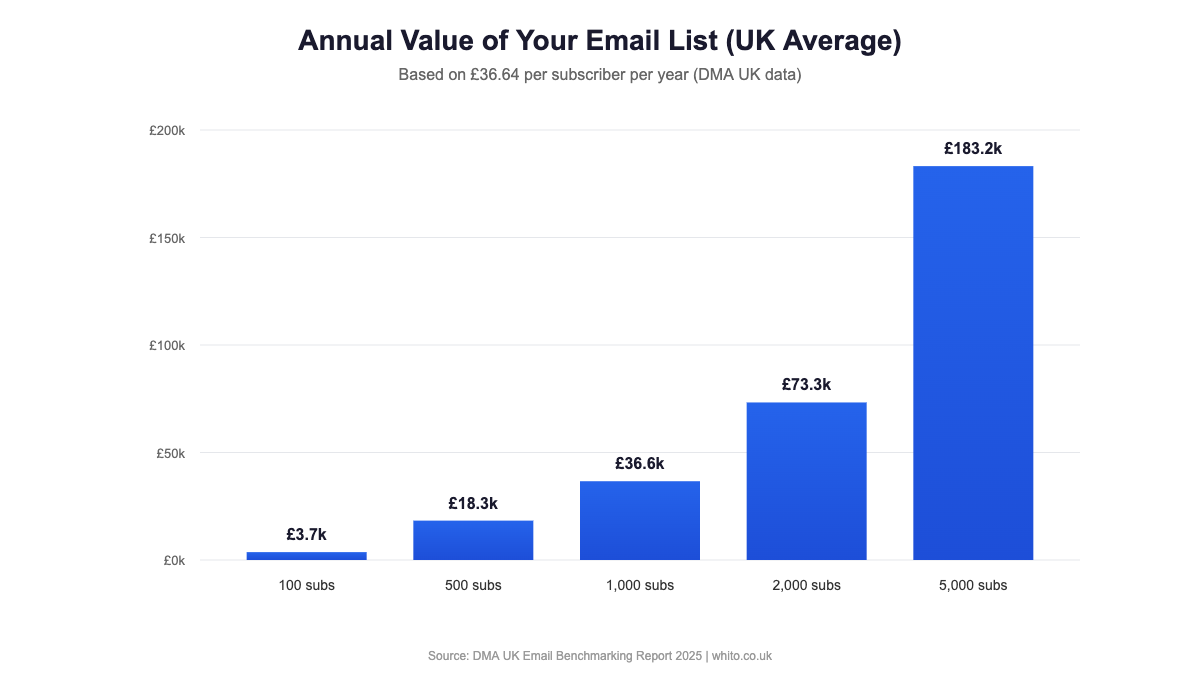
The maths is brutal in its simplicity. If you run a service business turning over £150,000 and you have no email list, you are leaving between £18,000 and £73,000 in potential revenue on the table every single year, depending on how quickly you could build that list to 500 or 2,000 subscribers.
Where the revenue actually comes from
Not all emails are equal.
Automated emails, the ones that trigger based on behaviour, represent roughly 2% of total email sends but generate between 30% and 37% of all email revenue. That means your welcome sequence, your abandoned cart email, your re-engagement automation, those tiny automated flows produce a third of your email income while running entirely on autopilot.
The rest comes from campaigns: newsletters, promotions, announcements, and launches. These work, but they require you to show up and press send.
For UK small businesses, the highest-performing email types are:
Abandoned cart emails: 40 to 45% open rates, 3.33% conversion rate. Welcome sequences: consistently the highest-engaged emails any business sends. Segmented promotional campaigns: 760% more revenue than unsegmented blasts.
Why most small businesses still ignore email
Three reasons, all fixable.
They think they need thousands of subscribers first. You do not. A list of 100 engaged local customers will outperform 5,000 cold contacts every time.
They do not know what to write. Keep it simple. One useful thing per email. One clear action at the end. That is the entire formula.
They tried it once, got poor results, and stopped. One email blast to a cold list with no warm-up is not email marketing. It is spam with better intentions. Consistency over 90 days is where the results start.
What to do next
If you have no email list, start one today. Add a signup form to your website. Offer something useful in exchange for an email address: a checklist, a guide, a discount, a free consultation.
If you have a list but never email it, send something this week. One paragraph. One useful tip. One link. That is enough to restart the habit.
If you are already emailing, set up one automation. A welcome sequence of 3 to 5 emails will run forever and produce revenue you did not have to think about.
The data is clear. Email is the single most profitable marketing channel available to UK businesses. The only question is whether you will actually use it.
Cite this research
Whito Research (2026). Email Marketing ROI for UK Businesses: What the Numbers Actually Say. Whito. https://whito.co.uk/research/uk-email-marketing-roi-report/
Key finding: UK email marketing returns an average of £38.33 for every £1 spent, up from around £30 five years ago (DMA UK benchmarking data).
This is original Whito research. You are welcome to reuse these figures with a link to this page as the source.
Methodology and sources
All figures in this report are drawn from:
- DMA UK Email Benchmarking Report 2025
- Constant Contact Small Business Survey 2026
- Charle UK Email Marketing Statistics 2026
- Sopro Email Marketing Statistics 2025
- HubSpot Email Marketing ROI Research 2025
Where ranges are given, they represent differences across industries and business sizes. Your results will depend on your list quality, email frequency, and offer relevance.
What to read next
- UK Marketing Cost Index for a full breakdown of what every channel costs
- State of UK Marketing 2026 for the broader picture
More Whito research
Common questions
What is the ROI of email marketing in the UK?
About £38 for every £1 spent (DMA UK data), up from £30 to £1 five years ago. No other channel comes close for businesses: paid search returns roughly £2 to £5 per £1.
Why is email marketing so profitable?
You own the list, so no platform charges for reach, and most revenue comes from existing relationships. Most UK businesses still under-use email or do not use it at all.
Is email marketing still worth it in 2026?
Yes. The £38 to £1 figure has held and climbed, and email remains the highest-return channel for businesses, yet most owners leave the money on the table.
The structural checks behind this research run on any website in about twenty seconds. Enter yours and read the full result on the page. Free, and we do not ask for your email.
Run the free Visibility CheckIf your business is named here and you think we have a fact wrong, email hello@whito.co.uk and we will check it and correct it. If you want to respond, send us a statement and we will publish it alongside. Full detail: Corrections, right of reply and removals.