
Finding
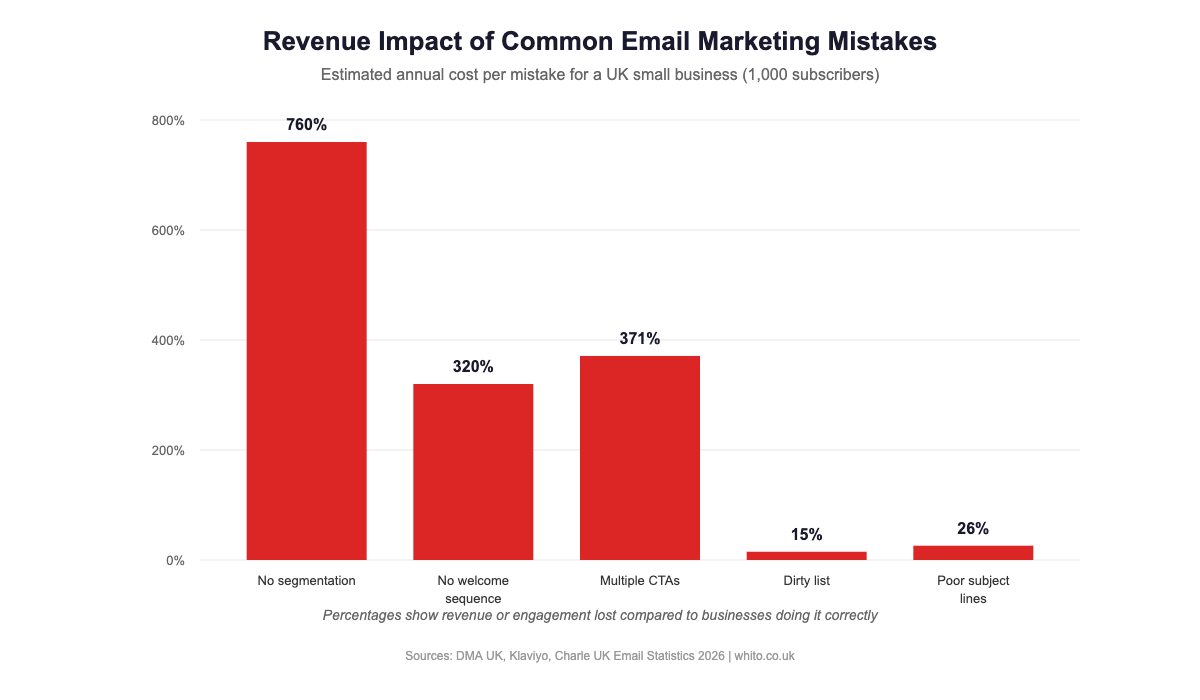
57% of UK consumers unsubscribe from a business because it sends too many emails, while segmented campaigns generate 760% more revenue than unsegmented blasts, according to Whito Research on email marketing mistakes, with data checked in July 2026.
Source: Whito, whito.co.uk/research/uk-email-marketing-mistakes-report, July 2026. Free to quote with a link to this page.
Last Updated on September 11, 2026
Published by Whito Research · Last updated 2 July 2026 · Data checked July 2026
Email marketing returns £38 for every £1 spent. That is the UK average. But averages hide a brutal truth: most small businesses get nowhere near that figure because they are making the same handful of mistakes on repeat.
This is not a list of minor optimisations. These are structural errors that kill open rates, destroy trust, and turn a profitable channel into a dead weight on your to-do list.
Every mistake here includes what it costs you and what to do instead.
Key takeaways
- 57% of UK consumers unsubscribe from a business because it sends too many emails (Whito Research).
- Segmented email campaigns generate 760% more revenue than unsegmented blasts.
- Personalised emails deliver 6x higher transaction rates, and a personalised subject line alone lifts open rates by 26%.
- 62.9% of UK consumers read their emails on a mobile phone.
1. Emailing too infrequently
What’s happening
You collected email addresses. Maybe from a website form, maybe from a networking event, maybe from customers who bought from you months ago. Then you went quiet. A month passed. Then three. Then six.
When you finally send something, half the list has forgotten who you are. They unsubscribe. Or worse, they mark you as spam.
57% of UK consumers unsubscribe because they receive too many emails. But the opposite is equally damaging. Email too rarely and your audience loses the connection entirely.
What it costs
Every month without an email is a month where your list decays. Email lists degrade at roughly 22% per year through natural churn, people changing jobs, abandoning email addresses, and losing interest. Six months of silence means you lose around 11% of your deliverable list for nothing.
On a list of 1,000, that is 110 subscribers gone, worth approximately £4,000 in potential annual revenue.
What to do instead
One email per week. That is the sweet spot for most UK small businesses. Enough to stay visible, not enough to irritate.
If weekly feels like too much, start fortnightly. But never go longer than once a month. The moment your audience forgets you exist, rebuilding trust costs more than maintaining it ever did.
2. Sending to everyone the same way
What’s happening
You have one list. You send one email to all of it. The accountant and the plumber and the new signup and the three-year customer all get identical content.
This is how most UK small businesses run their email. It is also why their engagement rates sit well below benchmarks.
What it costs
Segmented email campaigns generate 760% more revenue than unsegmented blasts. That is not a typo. Seven hundred and sixty percent.
Personalised emails deliver 6x higher transaction rates. Even something as simple as a personalised subject line increases open rates by 26%.
If you are sending the same generic newsletter to your entire list, you are earning a fraction of what that list could produce.
What to do instead
Start with two segments. That is all you need.
Segment by customer status: people who have bought from you versus people who have not. Send different content to each group. Buyers get retention and upsell content. Non-buyers get trust-building and conversion content.
Once that is working, segment by interest, location, or engagement level. But two segments is already better than none.
3. Ignoring mobile
What’s happening
You write your emails on a desktop. You preview them on a desktop. You never check what they look like on a phone.
62.9% of UK consumers read emails on their mobile phones. If your email looks broken, unreadable, or requires pinch-zooming on a phone, most of your audience never reads it properly.
What it costs
Emails that render poorly on mobile see 15% lower click-through rates. For a small business sending weekly to 1,000 people, that is roughly 150 fewer clicks per month on your links, offers, and calls to action.
Over a year, that adds up to 1,800 missed opportunities to convert a subscriber into a buyer.
What to do instead
Use a single-column layout. Keep subject lines under 40 characters. Make buttons large enough to tap with a thumb. Preview every email on your phone before sending.
Most modern email platforms (Mailerlite, Brevo, Mailchimp) show a mobile preview automatically. Use it. Every single time.
4. No welcome sequence
What’s happening
Someone signs up to your email list. They are at peak interest. They just gave you their email address, which means they want to hear from you right now.
Then nothing happens until your next newsletter, which might be in three weeks.
What it costs
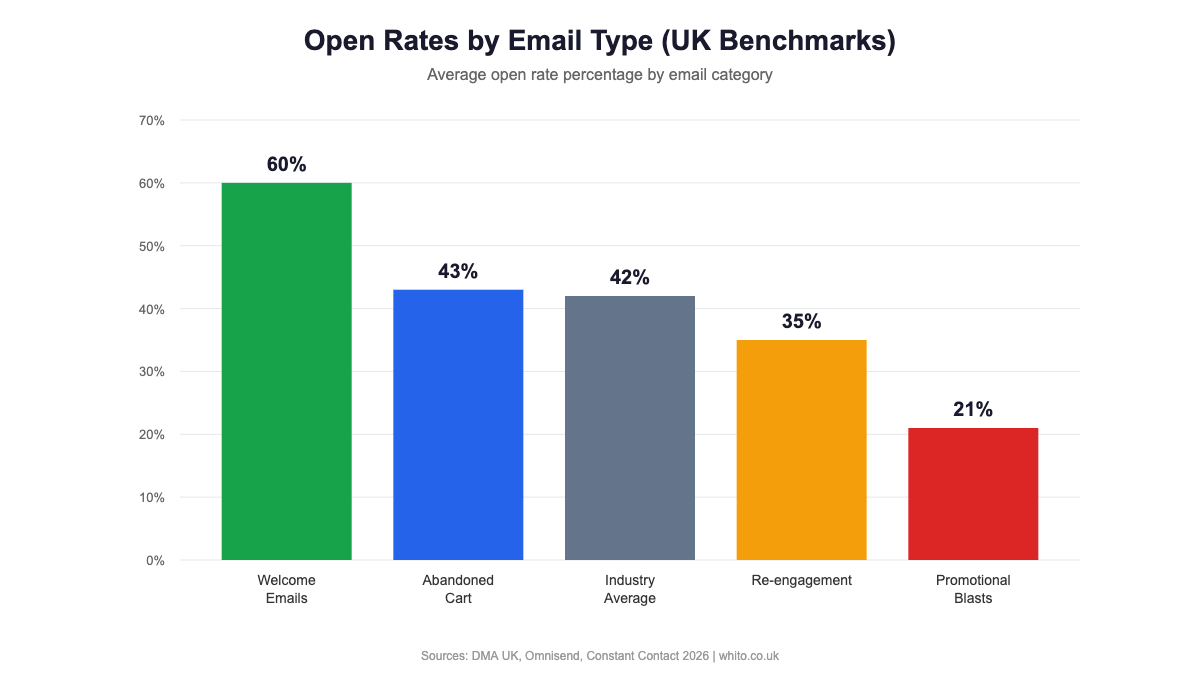
Welcome emails get the highest open rates of any email type, consistently above 60%.
They are your single best opportunity to build trust, set expectations, and drive an early sale.
Automated welcome emails generate 320% more revenue than standard promotional emails. Every day without a welcome sequence is revenue you are actively choosing not to collect.
What to do instead
Set up a 3-email welcome sequence. It runs automatically whenever someone subscribes.
Email 1 (immediately): Thank them, deliver whatever you promised, tell them what to expect. Email 2 (day 2 or 3): Share your most useful piece of content, a guide, a video, a checklist. Email 3 (day 5 to 7): Make a soft offer or invite them to take the next step with you.
This takes one afternoon to set up and works forever.
5. Writing subject lines as afterthoughts
What’s happening
You spend 45 minutes writing an email. Then you spend 10 seconds typing a subject line like “March Newsletter” or “Quick Update” or “News from [Business Name].”
Your email could contain the most valuable content you have ever written. If the subject line is boring, nobody opens it.
What it costs
The average open rate across industries is 42.35% in 2025. But that is an average. Generic subject lines pull open rates below 20%. Personalised, specific subject lines push them above 50%.
The difference between a 20% open rate and a 50% open rate on a list of 1,000 is 300 more people reading your email. 300 more chances to sell.
What to do instead
Write your subject line first, not last. Make it specific. Include a benefit or create curiosity.
Bad: “May Newsletter”
Better: “The £38 return most UK businesses ignore”
Best: “Jacob, one email that paid for itself 38 times over”
Personalised subject lines (using the subscriber’s first name) increase open rates by 26%. Most email platforms do this automatically with a merge tag.
6. No clear call to action
What’s happening
Your email contains three links, two announcements, a blog post summary, a promotion, and a request to follow you on social media. The reader does not know what you actually want them to do.
When everything is a priority, nothing is a priority. Emails with multiple competing actions get fewer clicks than emails with one clear ask.
What it costs
The average click-through rate for UK emails is 2.3%. Emails with a single, focused call to action outperform multi-link emails by 371%.
If you are diluting your clicks across five different links, you are getting a fifth of the engagement you could get from one clear action per email.
What to do instead
One email. One goal. One action.
If you want them to read a blog post, link to the blog post. If you want them to book a call, link to your booking page. If you want them to buy something, link to the product.
You can include secondary links in a footer or P.S., but the body of your email should drive towards exactly one thing.
7. Never cleaning the list
What’s happening
You have 2,000 subscribers. But 400 of them have not opened an email in six months. 150 have invalid email addresses. 50 marked you as spam and you never removed them.
You are paying for dead weight, and worse, it is dragging your deliverability down. Email providers like Gmail and Outlook track sender reputation. If a large percentage of your list ignores you, your future emails are more likely to land in spam for everyone.
What it costs
Poor list hygiene reduces deliverability across your entire list. UK delivery rates average 98%, but businesses with unclean lists see rates drop to 85 to 90%. That means 10 to 15% of your emails never arrive.
On a list of 2,000, that is 200 to 300 emails per send that vanish before they reach an inbox. Over a year of weekly sends, that is 10,000 to 15,000 lost opportunities.
What to do instead
Every 90 days, run a list clean. Remove hard bounces immediately. Suppress anyone who has not opened or clicked in 6 months (send them a re-engagement email first, giving them a chance to stay). Remove spam complaints.
A clean list of 800 engaged subscribers will outperform a dirty list of 2,000 disengaged ones on every single metric.
The compounding cost
These mistakes do not exist in isolation. Most businesses make three or four of them simultaneously. The costs compound.
An infrequent, unsegmented, mobile-unfriendly email with a boring subject line, no welcome sequence, and a cluttered call to action sent to an uncleaned list is not email marketing. It is noise. And it is why so many UK businesses conclude that “email doesn’t work for us.”
It does work. The data is overwhelming. But only if you fix the structural problems first.
Cite this research
Whito Research (2026). 7 Email Marketing Mistakes Costing UK Businesses Money Every Month. Whito. https://whito.co.uk/research/uk-email-marketing-mistakes-report/
Key finding: 57% of UK consumers unsubscribe from a business because it sends too many emails (Whito Research).
This is original Whito research. You are welcome to reuse these figures with a link to this page as the source.
Methodology and sources
All figures in this report are drawn from:
- DMA UK Email Benchmarking Report 2025
- Charle UK Email Marketing Statistics 2026
- Constant Contact Small Business Survey 2026
- Klaviyo Email Marketing Benchmarks 2026
- Shopify UK Email Marketing Statistics 2025
Where ranges are given, they represent differences across industries and business sizes.
What to read next
- Email Marketing ROI for UK Small Businesses for the full financial picture
- UK Marketing Cost Index for a breakdown of what every channel costs
More Whito research
Common questions
What is the most common email marketing mistake?
Emailing too infrequently. Lists go cold, and when you finally send, people have forgotten you and unsubscribe or mark you as spam. 57% of UK consumers unsubscribe over how often they are emailed.
Why is my email marketing not making money?
Most small businesses fall well short of the UK average of £38 per £1 because of a handful of structural errors, such as emailing too rarely, no segmentation, weak subject lines and no automation, rather than minor tweaks.
How often should a business email its list?
Often enough to stay familiar, consistently rather than in long silences. Going quiet for months drives unsubscribes and spam complaints; a regular, relevant rhythm protects the relationship.
The structural checks behind this research run on any website in about twenty seconds. Enter yours and read the full result on the page. Free, and we do not ask for your email.
Run the free Visibility CheckIf your business is named here and you think we have a fact wrong, email hello@whito.co.uk and we will check it and correct it. If you want to respond, send us a statement and we will publish it alongside. Full detail: Corrections, right of reply and removals.