Finding
Automated emails make up around 2% of all email sends but generate 30% to 37% of email revenue, and welcome emails achieve open rates above 60%, according to Whito Research on UK small business email, with data checked in July 2026.
Source: Whito, whito.co.uk/research/uk-email-automation-report, July 2026. Free to quote with a link to this page.
Last Updated on September 11, 2026
Published by Whito Research · Last updated 2 July 2026 · Data checked July 2026
Most UK small businesses think email automation is enterprise software. Something for Shopify stores doing six figures a month or SaaS companies with dedicated marketing teams.
It is not. Email automation is the single most accessible way for a small business to generate revenue without being present. You set it up once. It runs forever. And the data shows it outperforms everything you send manually.
This report covers what email automation actually delivers for UK small businesses, which automations matter, and what the realistic costs look like.
Key takeaways
- Automated emails make up around 2% of all email sends but generate 30% to 37% of email revenue (Whito Research).
- Welcome emails consistently achieve open rates above 60%, higher than any other email type.
- Abandoned-cart emails achieve 40% to 45% open rates and a 3.33% conversion rate.
- UK email lists decay at roughly 22% a year as people change addresses or lose interest.
The 2% that produces 30%
Here is the number that should change how you think about email.
Automated emails represent approximately 2% of total email sends. But they generate between 30% and 37% of all email revenue.
Two percent of your sends producing a third of your income.
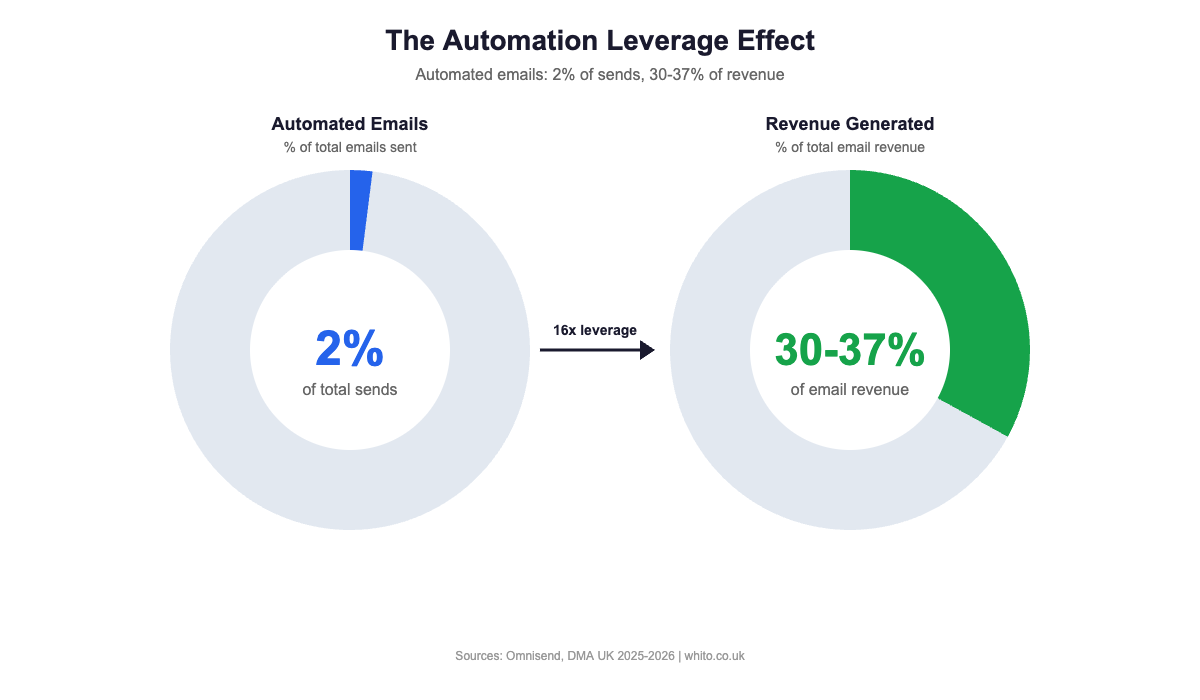
This is not a marginal improvement. This is a structural advantage. Businesses with automation set up are earning money from emails they wrote months or years ago. Businesses without it are starting from zero every time they hit send.
What “automation” actually means for a business
Forget complex workflows and multi-branch decision trees. For most UK businesses, email automation means three things:
A welcome sequence that runs when someone joins your list. An abandoned action email that triggers when someone starts but does not complete something (a booking, a purchase, a form). A re-engagement email that fires when a subscriber goes quiet.
That is it. Three automations. They cover the three highest-value moments in any customer relationship: the introduction, the hesitation, and the drift.
Welcome sequences: the highest-value automation
Welcome emails achieve open rates consistently above 60%. No other email type comes close.
The reason is simple. The subscriber just opted in. They are at peak attention and peak intent. If you say something useful within minutes of their signup, you anchor trust immediately.
Automated welcome emails generate 320% more revenue than standard promotional emails. For a UK small business, a 3 to 5 email welcome sequence is the single most valuable piece of marketing infrastructure you can build.
What a welcome sequence looks like
Email 1 (sends immediately): Deliver what you promised. If they signed up for a guide, give them the guide. If they signed up for updates, tell them what to expect and when. Keep it short.
Email 2 (sends day 2 or 3): Share your most useful asset. A blog post, a video, a case study, a checklist. Something that demonstrates your expertise without selling.
Email 3 (sends day 4 to 5): Social proof. A testimonial, a result, a before-and-after. Show them that you deliver.
Email 4 (sends day 6 to 7): Make an offer. A consultation, a trial, a discount, a next step. By now they trust you enough to consider it.
This takes one afternoon to build. It works for months or years without being touched.
Abandoned cart and abandoned action emails
If you sell anything online, whether products, bookings, or consultations, people will start the process and not finish it. That is normal. What is not normal is letting them walk away without a follow-up.
Abandoned cart emails achieve 40 to 45% open rates and a 3.33% conversion rate. That conversion rate is higher than almost any other email type.
For service businesses, the equivalent is an abandoned booking or abandoned enquiry email. Someone starts filling in your contact form or booking page and leaves. An automated email 1 to 2 hours later saying “Still thinking about it? Here is what to expect if you go ahead” recovers a meaningful percentage of those lost leads.
The revenue impact
If your website gets 100 abandoned actions per month and you recover even 3% of them (which is below the benchmark), that is 3 additional customers per month. For a service business charging £500 per job, that is £1,500 per month, £18,000 per year, from a single automated email.
Re-engagement: stopping the drift
Email lists decay at roughly 22% per year. People lose interest, change email addresses, or simply forget you exist.
A re-engagement automation identifies subscribers who have not opened or clicked anything in 60 to 90 days and sends them a specific email: “Still interested? Here’s what you’ve missed. Click here if you want to stay, otherwise we’ll remove you from the list.”
This does two things. It reactivates a percentage of dormant subscribers (typically 10 to 15% will re-engage). And it cleans your list of dead weight, which improves deliverability for everyone who remains.
What automation costs a UK small business
The marketing automation market globally is valued at £7.39 billion, growing at 8.2% annually. That sounds expensive. The reality for small businesses is different.
Platform costs
Mailerlite (up to 1,000 subscribers with automation): Free.
Brevo (up to 300 emails per day with automation): Free.
Mailchimp (up to 500 subscribers, limited automation): Free.
For a business with 1,000 to 5,000 subscribers needing full automation features:
Mailerlite: £15 to £39 per month.
Brevo: £19 to £49 per month.
ActiveCampaign: £29 to £79 per month.
UK mid-sized businesses spend an average of £2,000 to £9,600 per year on automation tools. But most businesses under 5,000 subscribers will spend under £500 per year.
Time investment
Building a welcome sequence: 2 to 4 hours once.
Building an abandoned action email: 1 to 2 hours once.
Building a re-engagement sequence: 1 to 2 hours once.
Total setup: one working day. Ongoing maintenance: 30 minutes per quarter to check performance and update content.
Compare that to the 2 to 4 hours per week a manual email strategy requires, every week, forever.
AI and automation in 2026
54% of small businesses are now using AI tools, and 44% of those are using AI to write email content. This is changing the economics of email for small businesses.
The practical application is not replacing your entire email strategy with AI. It is using AI to draft subject lines, suggest send times, and generate first drafts of automated sequences that you then edit to sound like yourself.
92% of marketers now use some form of AI within their automation workflows. For small businesses, the most useful applications are: subject line testing (AI generates 5 options, you pick the best), send time optimisation (the platform learns when your audience opens and adjusts automatically), and content suggestions (AI drafts, you edit).
The businesses using AI-assisted automation are not replacing the human voice. They are removing the friction that prevented them from building automations in the first place.
The structural advantage
41% of UK small business owners expect email marketing to be their most valuable marketing channel in 2026. But there is a gap between knowing email works and having the infrastructure to make it work while you sleep.
Automation is that infrastructure. It turns email from a task you have to do every week into a system that runs alongside your business. The data is consistent: automated emails outperform manual sends on open rates, click rates, and revenue per email.
The businesses that build these systems now are building a compounding asset. Every subscriber who joins your list enters a sequence that works. Every abandoned booking gets a follow-up. Every quiet subscriber gets a nudge.
The businesses that do not build these systems will keep starting from zero every Monday morning, writing another newsletter from scratch, wondering why the results never compound.
Cite this research
Whito Research (2026). Email Automation for UK Businesses: The Data Behind Set-and-Forget Revenue. Whito. https://whito.co.uk/research/uk-email-automation-report/
Key finding: Automated emails make up around 2% of all email sends but generate 30% to 37% of email revenue (Whito Research).
This is original Whito research. You are welcome to reuse these figures with a link to this page as the source.
Methodology and sources
All figures in this report are drawn from:
- DMA UK Email Benchmarking Report 2025
- Constant Contact Small Business Survey 2026
- SQ Magazine Marketing Automation Statistics 2026
- Omnisend Email Marketing Statistics 2026
- Charle UK Email Marketing Statistics 2026
Where ranges are given, they represent differences across industries and business sizes. Platform pricing is accurate as of May 2026 and subject to change.
What to read next
- Email Marketing ROI for UK Businesses for the full financial picture
- 7 Email Marketing Mistakes Costing UK Businesses Money for the most common structural errors
More Whito research
Common questions
How much revenue does email automation generate?
Automated emails are about 2% of total sends but generate 30 to 37% of all email revenue, making them the highest-leverage email a small business can set up.
Is email automation only for big companies?
No. It is one of the most accessible ways for a small business to generate revenue without being present: you set it up once and it runs continuously, outperforming what you send manually.
Which email automations matter most?
The core revenue-driving flows, such as welcome, abandoned-basket and follow-up sequences, are where most of that automated 30 to 37% of email revenue comes from, for a modest setup cost.
The structural checks behind this research run on any website in about twenty seconds. Enter yours and read the full result on the page. Free, and we do not ask for your email.
Run the free Visibility CheckIf your business is named here and you think we have a fact wrong, email hello@whito.co.uk and we will check it and correct it. If you want to respond, send us a statement and we will publish it alongside. Full detail: Corrections, right of reply and removals.