

Last Updated on August 20, 2026
Written for mortgage advisers, not for borrowers. Whito is a marketing publisher. We are not authorised or regulated by the Financial Conduct Authority, and nothing here is financial advice, mortgage advice, compliance advice or a financial promotion. Compliance sign off for anything your firm publishes rests with your firm or your network.
Most mortgage brokers treat their regulatory status as paperwork. A line in the footer, in six point grey, put there because someone said it had to be.
That is a waste of the strongest trust asset the firm owns. You are on a public register that a plumber cannot get on and that a marketing agency cannot get on. Fraudsters do clone genuine firms, which is exactly why the register, and not a claim on a website, is the thing a borrower should check against. Almost nobody in this industry markets that properly.
The mistake is thinking of authorisation as a compliance obligation rather than as proof. It is the only claim on your website that a stranger can verify in about fifteen seconds, from an authoritative source, without taking your word for anything.
What borrowers say they check
Research commissioned by the broker Boon Brokers and carried out by TLF Research, fieldwork June 2025 with 1,002 respondents, asked homeowners with mortgages what they rely on when deciding whether to trust mortgage advice. Customer reviews came out at 41%, personal recommendations at 39%, and verified FCA regulation at 35%.
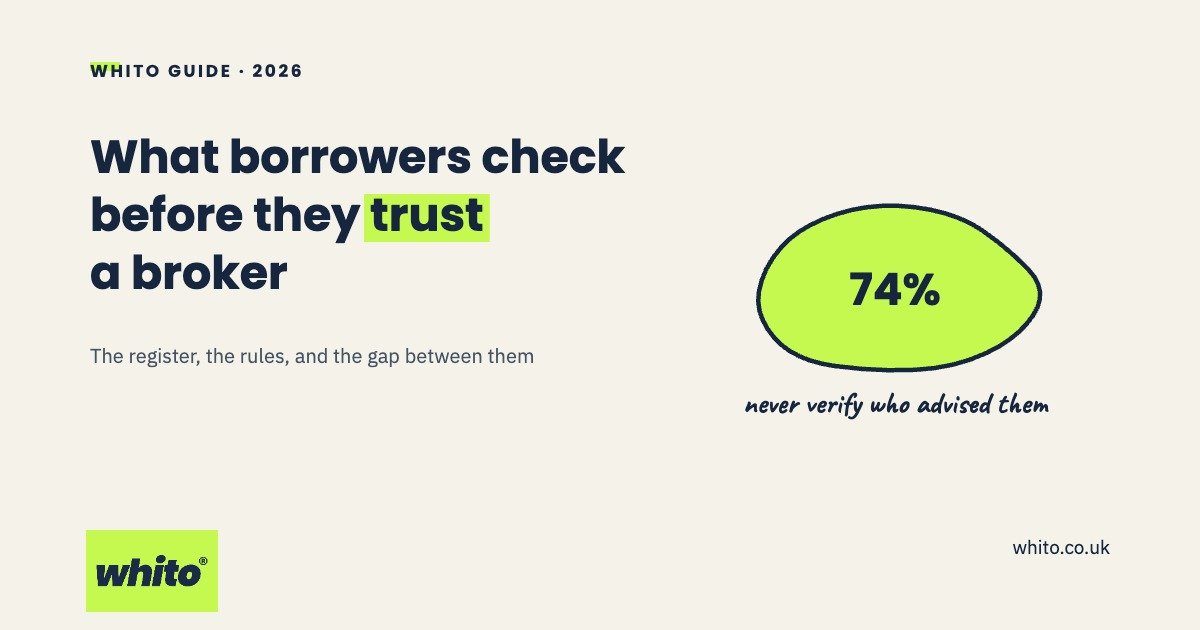
The same research found 74% do not always verify whether their source of advice is qualified or regulated.
Read those two findings together. A third of borrowers say regulatory status matters to them, and three quarters do not actually check it. That is not a contradiction, it is a gap. People want the reassurance and will not do the work to get it. The firm that does the work for them wins the trust without an argument.
This is broker commissioned research, not a regulator’s survey, so treat the exact numbers with care. The gap is the point, not the decimal places.
The register, and what is actually on it
The FCA’s Financial Services Register at register.fca.org.uk is the official public record of firms and individuals that are, or have been, authorised. The FCA also runs a simpler consumer tool, the Firm Checker, for checking a firm before you deal with it.
What the register holds is more than a yes or no. It carries a firm’s permissions, so you can see whether it is authorised for the specific thing it is offering. It carries historic fines. It shows whether a firm holds the permission to approve financial promotions. It records firms that were previously authorised and are not now. The FCA also publishes a Warning List, searchable alongside the register, covering unauthorised firms and clone firms, which are firms falsely claiming to be a legitimate business.
Individual advisers appear through the register’s Directory Persons data. That means your advisers can be looked up as people, not just as employees of a company name.
The FCA is also blunt about the consequence of dealing with an unauthorised firm: no access to the Financial Ombudsman Service, and no access to FSCS compensation. For a borrower that is the whole ballgame, and most of them have no idea.
Directly authorised, or appointed representative
This is the distinction most broker websites blur, and it is the one worth being straight about.
An appointed representative carries out activities on behalf of another firm, its principal, and operates under that principal’s authorisation. The FCA is explicit that the principal is responsible for that business, and it advises consumers with concerns about an appointed representative’s scope of activities to check with the principal.
To give a sense of how normal this arrangement is across financial services, the FCA’s own appointed representatives data showed 2,431 principal firms and 33,347 appointed representatives as at 31 March 2026, made up of 20,728 full appointed representatives and 12,619 introducer appointed representatives. Both numbers were slightly down on the year before. That dataset covers all sectors, not mortgages, and the FCA does not publish a mortgage only split, so do not read it as a broker count.
What matters commercially is simpler. If you are an appointed representative, your website should say so and name your principal, in the same words the register uses. A borrower who looks you up and finds a different firm’s name attached to yours, having not been told, does not conclude that you are an appointed representative. They conclude that something is off.
How big this market actually is
Useful context if you are trying to work out how much competition your trust signals are competing against.
| Measure | Figure | Source and date |
|---|---|---|
| Mortgage adviser posts | 32,990, down from 34,342 | FCA retail intermediary market data 2025, published 23 July 2026 |
| Revenue from mortgage broking | £1.6bn, up 15.9% | FCA retail intermediary market data 2025 |
| Share of that revenue from commission | 77.5%, unchanged on the year | FCA retail intermediary market data 2025 |
| Individuals holding mortgage related permissions | 36,764, up 0.4% on end 2025 | ISS Market Intelligence, UK Adviser Landscape, data at 30 June 2026 |
Adviser posts fell while revenue rose almost 16%. Fewer people, more money, and over three quarters of it still coming from commission rather than fees. That is a market where the value of each client relationship is going up, which is another way of saying the cost of losing one to a competitor with clearer trust signals is going up too.
The rules that decide what you can say
This is where marketing advice for mortgage brokers has to be different from marketing advice for a builder, and where most generic agency advice becomes a liability.
What follows is a plain description of published rules and guidance so you know what territory you are in. It is not compliance advice, it is not exhaustive, and it is not a substitute for your network or your compliance function.
Section 21 of the Financial Services and Markets Act 2000 restricts who may communicate an invitation or inducement to engage in investment activity in the course of business. The restriction does not apply if the person is authorised, if the content has been approved by an authorised person with the right permission, or if the communication falls inside one of the exemptions in the Financial Promotion Order 2005. Outside those routes, breach is a criminal offence under section 25 of the same Act, carrying on summary conviction up to six months’ imprisonment or a fine, and on indictment up to two years or a fine. There is a statutory defence where a person reasonably believed the content had been prepared or approved by an authorised person, or took all reasonable precautions and exercised all due diligence, but that is something to argue after the event rather than a plan.
Since 7 February 2024, a firm needs specific FCA permission to approve financial promotions for unauthorised persons. Being authorised is no longer enough on its own. If you are thinking about signing off a third party’s promotion, that is a permission question first. There are exemptions, including for approvals within the same group and for a principal approving its own appointed representative’s promotions, so if you are an appointed representative your principal’s position may differ from an agency’s. Check the exemption rather than assuming either way.
MCOB 3A is the part of the FCA Handbook covering financial promotions and customer communications on home finance. Its core requirement is that a firm takes reasonable steps to communicate fairly, clearly and in a way that is not misleading, and that it can show it took those steps for non real time promotions. For MCD regulated mortgage contracts, as the assimilated UK rules define them, a promotion must not contain wording that may create false expectations about the availability or the cost of credit.
FG24/1, the FCA’s finalised guidance on financial promotions on social media, was published on 26 March 2024 and replaced its previous social media guidance. Four points in it change how brokers should think about social content:
- Each communication must stand on its own. The guidance describes promotions as needing to be standalone compliant, meaning each one must comply when viewed individually. A thread where post four carries the balance does not fix post one.
- Balance is required. Promotions should give a balanced view of benefits and risks.
- Risk warnings must be prominent, not truncated or obscured by the platform’s own design. The guidance specifically warns against benefits sitting in the video or image while the risk warning sits in the caption.
- You are responsible for your affiliates. Firms should take proactive responsibility for how affiliates communicate promotions, and where an affiliate uses a referral link the firm may be causing the communication to be made. The guidance names leaving compliance to affiliates as poor practice, and notes that influencers promoting financial products without an authorised person’s approval may be committing a criminal offence.
The Consumer Duty has applied to open products and services since 31 July 2023 and to closed ones since 31 July 2024. Its consumer understanding outcome means communications should support informed decision making and equip people with the right information at the right time. FG24/1 also warns against exploiting behavioural biases.
The practical version of all of this, for a marketing conversation: the tactics that work for an unregulated business, urgency, scarcity, a single dramatic number, a testimonial with no context, are the exact tactics this framework is designed to catch. Anyone selling you mortgage marketing who cannot discuss this should not be writing your posts.
It is also worth knowing that the ground is moving. The FCA has already changed the rules so that firms can interact with customers without that automatically triggering the need to provide regulated advice. The wider mortgage rule review continues, with policy development into 2027, so if your marketing sits close to the advice boundary, that boundary is still being redrawn.
What to publish, in Whito order
Start. Firm reference number in the footer and on the about page, written as text, not inside an image. If you are an appointed representative, name your principal. Make sure the permissions your site implies match the permissions on the register, and fix the site rather than the wording if they do not.
Start. Name your advisers, with their qualifications, on a page each. They are individually findable on the register through Directory Persons, so make it easy to connect the person on your site to the person on the register.
Build. Link the register itself, and tell people how to check you. A sentence saying you are on the FCA register, here is how to look us up, and here is what to check, does more for trust than any badge graphic. It also quietly educates the 74% who never check anybody.
Build. Build your review volume through a fixed process, because reviews were the top trust factor in the research above and volume is the only thing that makes a rating meaningful.
Scale. Only then start on the harder proof: named case studies with the numbers removed where they cannot be evidenced, third party press, and independent recognition. And run every piece of it past whoever signs off your promotions before it goes anywhere.
Common questions
Where do clients check whether a mortgage adviser is regulated?
The FCA’s Financial Services Register at register.fca.org.uk holds the official public record of authorised firms and individuals, including permissions, historic fines and previously authorised firms. The FCA also runs a simpler Firm Checker tool for checking a firm before dealing with it.
What is the difference between directly authorised and an appointed representative?
An appointed representative carries out activities on behalf of a principal firm and operates under that firm’s authorisation. The FCA states the principal is responsible for that business, and advises consumers with concerns about an appointed representative’s scope of activities to check with the principal.
Do I have to put my firm reference number on my website?
Disclosure requirements are a matter for your firm and its compliance arrangements, and this article is not compliance advice. What we would say as marketers is that every FCA regulated mortgage brand we examined displays both a risk warning and its firm reference number on the page, so publishing it clearly is normal practice in this market rather than an unusual step.
Can I use social media as a mortgage broker?
Firms do, extensively. The FCA’s finalised guidance FG24/1, published 26 March 2024, sets out how it expects financial promotions on social media to work, including that each communication should comply on its own, that promotions should be balanced, that risk warnings should not be truncated or obscured, and that firms are responsible for how their affiliates promote them. Whether any specific post is compliant is a question for your firm or network, not for us.
Is a marketing agency allowed to write my promotions?
An agency can draft. Approval is a different act with a legal meaning. Since 7 February 2024, a firm needs specific FCA permission to approve financial promotions for unauthorised persons, and communicating a financial promotion without authorisation, approval, or an applicable exemption is a criminal offence under section 25 of the Financial Services and Markets Act 2000. Your firm or network decides how sign off works. An unauthorised supplier cannot take that responsibility off you.
Method, limits and legal position
This is not compliance advice. The rules described here are summarised from published FCA and legislative sources for context, as at 17 August 2026. The summary is not exhaustive, does not cover every rule that may apply to your firm, and must not be relied on as regulatory advice. Your compliance function, your network or a suitably qualified adviser is the right place for that.
Whito is not FCA authorised. We hold no Firm Reference Number, we are not a mortgage adviser or intermediary, and we cannot approve financial promotions under section 21 of the Financial Services and Markets Act 2000. Nothing on this page is financial advice, mortgage advice or a financial promotion.
Currency of the rules. FG24/1 remains the FCA’s finalised guidance on financial promotions on social media and we found no successor guidance published as at August 2026. That is the absence of a newer document, not an FCA confirmation that nothing has changed. Check the FCA’s financial promotions pages before relying on it. The FCA’s mortgage rule review is ongoing, with policy development continuing into 2027.
Data notes. The appointed representative counts cover all FCA regulated sectors, not mortgages, because the FCA does not publish a mortgage only split. The FCA does not publish a total count of authorised mortgage intermediary firms, so we have not given one. The trust factor percentages come from research commissioned by a mortgage broker and carried out by TLF Research, fieldwork June 2025, 1,002 respondents, and are not a regulator or trade body survey.
Corrections. Email hello@whito.co.uk.
If you are choosing an adviser. Check the firm on the FCA’s Financial Services Register at register.fca.org.uk, and confirm whether it is directly authorised or an appointed representative of another firm.
Sources
- FCA, Financial Services Register, and Using the Financial Services Register, page last updated 3 September 2025.
- FCA, How to check a firm or individual is authorised.
- FCA, Appointed representatives data, as at 31 March 2026, published 5 June 2026.
- FCA, The retail intermediary market data 2025, published 23 July 2026.
- ISS Market Intelligence, UK Adviser Landscape Report H1 2026, data at 30 June 2026, as reported in the trade press 11 August 2026.
- Financial Services and Markets Act 2000, sections 21 and 25, legislation.gov.uk.
- FCA, Applying to approve financial promotions for unauthorised persons, permission required from 7 February 2024, policy statement PS23/13.
- FCA Handbook, MCOB 3A, financial promotions and communications with customers.
- FCA, FG24/1 Finalised guidance on financial promotions on social media, published 26 March 2024.
- FCA, PS22/9 A new Consumer Duty, published 27 July 2022, in force 31 July 2023 and 31 July 2024. Handbook PRIN 2A.
- FCA, Mortgage rule review, page last updated 9 June 2026.
- Boon Brokers, Misplaced Trust in Mortgage Advice study, carried out by TLF Research, fieldwork 17 to 24 June 2025.
The structural checks behind this research run on any website in about twenty seconds. Enter yours and read the full result on the page. Free, and we do not ask for your email.
Check your business free