

Last Updated on July 14, 2026
Most businesses build a website because they think they are supposed to have one. That is not a reason. That is a reflex, and it costs the average UK small business somewhere between £3,000 and £6,000.
This guide covers what a website actually costs in the UK in 2026, whether you need one at all, what it has to contain to earn its money, and the order to do it in.
It is long because the decision is worth getting right once. There is no upsell at the end. We do not build websites and we never will.
The mistake almost everyone makes
Here is the pattern, and you will recognise it.
A business owner decides it is time to “get online properly.” They ring a local designer. They pay somewhere between £2,000 and £5,000. Three months of back and forth follow, most of it about the colour of the buttons and whether the logo should be bigger.
The site goes live. It looks fine. Everyone says it looks fine.
Six months later it has had about 200 visitors, a good number of whom were the owner checking it still works. The phone rings exactly as often as it did before. The owner concludes that marketing does not work, or that they got ripped off, or both.
What actually happened is simpler. They built a shopfront on a street with no footfall.
A website does not generate customers. A website converts attention you have already earned. If you have not earned any attention, the most beautiful site in Britain will sit there quietly doing nothing, which is precisely what it is being paid to do.
Do you actually need a website?
Some businesses genuinely do not, at least not yet. Nobody in the web design industry will tell you this, for obvious reasons.
Answer honestly.
You probably do not need one yet if:
- You are full of work and turning jobs away
- Every customer comes from word of mouth and you are happy with that
- You have not yet claimed your Google Business Profile
- You have fewer than ten reviews anywhere
- You cannot say, in one sentence, what you do and who for
- You are still working out whether the business model works at all
If that is you, a website is not the next thing. It is the fourth or fifth thing. The free work comes first, and we will come to it.
You do need one if:
- People are already finding you and you have nowhere to send them
- You want to change the kind of work you get, not just the amount
- Your customers deliberate before buying, because deliberation happens on a website
- You want to be found by AI tools, which read websites to work out what you do
- You are spending money on ads or directories and sending that traffic somewhere weak
- You sell something a customer needs to understand before they will buy it
That last group is where a website earns back its cost quickly. Everyone else should wait, and spend the money on the free work instead.
The free work comes first. Always.
Before you spend a pound, do these three things. They cost nothing and they beat a website for most businesses.
1. Complete your Google Business Profile
Correct category. Correct opening hours. Your towns listed. Real photographs, not stock images. Every service listed separately rather than lumped into one paragraph.
This is the single highest-return free action available to a local UK business and a startling number of businesses have never claimed theirs.
2. Get reviews, then keep getting them
We asked Google’s AI to recommend the best plumber across 13 UK towns and cities. In all 13 it named independent local firms. Not one national chain. Not one directory.
What decided it was reviews. Every firm it named sat between 4.8 and 5.0 stars. A family firm in Wakefield with 54 reviews was recommended just as readily as a Cardiff firm with over 1,200.
You do not need to be big. You need to be well regarded and clear.
3. Write down what you actually want more of
Not everything you can do. What you want more of.
This is the hardest of the three and the one people skip. Until you can answer it, you cannot brief a designer, you cannot write a page, and you cannot tell whether the site worked. Almost every failed website traces back to a business that could not finish this sentence.
What a website actually costs in the UK in 2026
These are real figures from Whito’s UK website cost research, not agency wishful thinking.
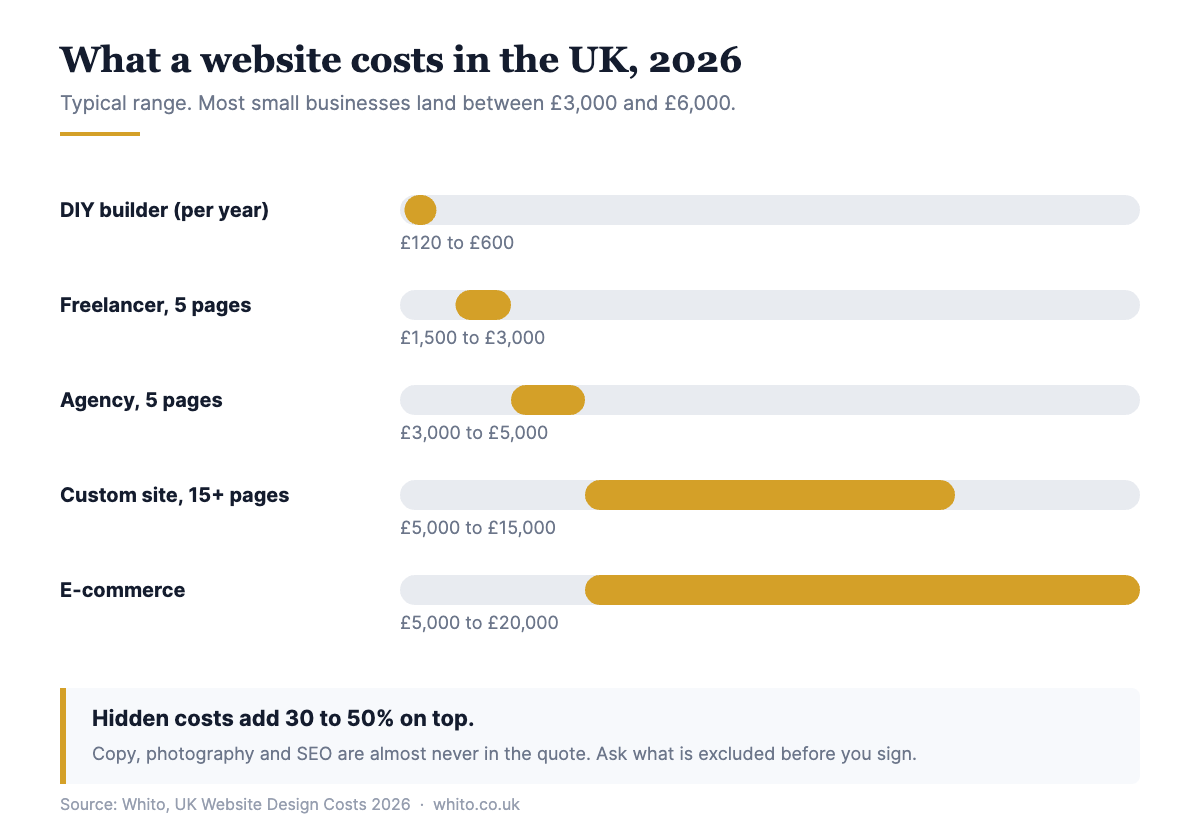
| What | Cost | Notes |
|---|---|---|
| Google Business Profile | £0 | Do this first. Every time. |
| .co.uk domain | £10 to £30 a year | Register it in your own name |
| Hosting | £50 to £300 a year | £25 a month is the ceiling for a small business site |
| SSL certificate | £0 to £100 a year | Usually free. If someone charges more than £100, they are overcharging. |
| DIY builder (Squarespace, Wix) | £10 to £50 a month | Genuinely fine for most businesses |
| Freelancer, 5 page site | £1,500 to £3,000 | The sweet spot for most UK small businesses |
| Agency, 5 page site | £3,000 to £5,000 | You are buying process, not better design |
| Custom site, 15+ pages | £5,000 to £15,000 | Only if you have genuine complexity |
| E-commerce | £5,000 to £20,000+ | Scope varies enormously |
| Copywriting | £50 to £150 per page | Almost never included in the quote |
| Photography | £200 to £800 | Stock photos of strangers undermine trust |
| SEO setup | £300 to £1,000 | Ask exactly what this covers |
| Annual running costs | £500 to £2,000 | Hosting, renewals, updates, plugins |
The average UK small business pays £3,000 to £6,000 for a professionally built website. That is the honest middle.
The number that catches everyone out
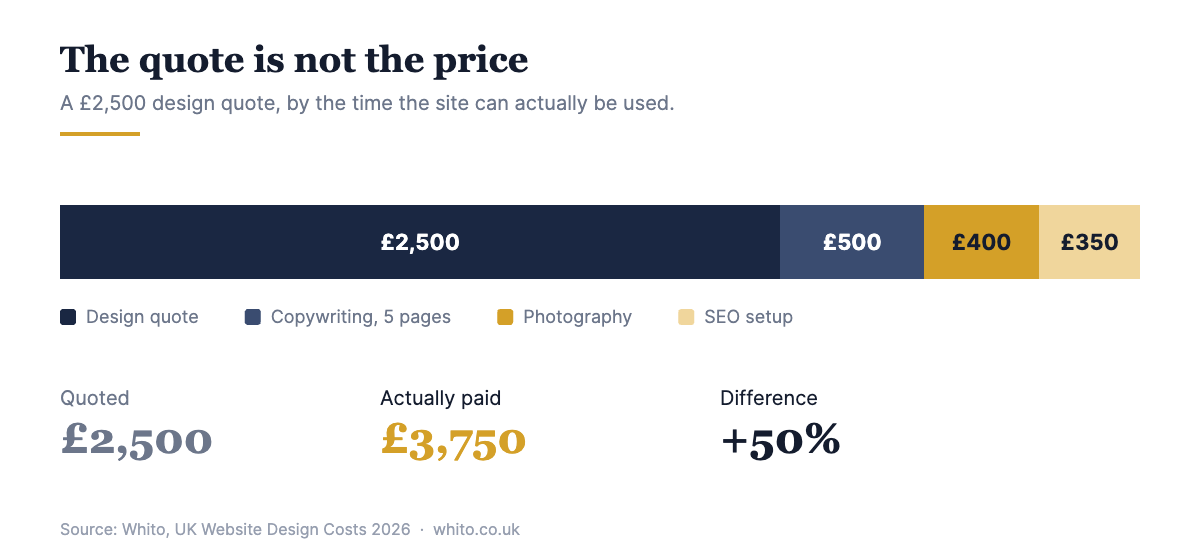
Hidden costs add 30 to 50% to the quoted price.
The quote covers design. It very rarely covers the words, the photographs, or the SEO. A £2,500 quote becomes £3,750 by the time the site is actually usable, and nobody warned you, because warning you might have lost them the job.
Ask one question before you sign: “What is not included in this price?” Then wait. The silence tells you a lot.
The other number that matters
A £20 a month Squarespace site with honest, specific copy will outperform a £5,000 custom site with vague copy. Every single time.
Design is almost never the thing holding a small business back. Clarity is. Nobody has ever failed to ring a plumber because the website used the wrong shade of blue.
DIY, freelancer, or agency?
The industry makes this complicated. It is not.
Do it yourself if
You need a simple, findable online presence rather than a competitive advantage. You are early, still testing the model, or your budget is genuinely better spent elsewhere. A builder like Squarespace or Wix will do the job for £10 to £50 a month, and the result depends almost entirely on your content, not the platform. See our comparison of website builders if you want the specifics.
The catch is your time. Budget a weekend, not an evening.
Hire a freelancer if
Your project is straightforward, you can provide a clear brief, and you want value for money. Expect £40 to £70 an hour, less outside London and the South East. A competent freelancer at £50 an hour who understands your business will beat an agency at £120 an hour that treats you like a template.
For most UK small businesses building their first or second website, this is the right answer.
Hire an agency if
The project genuinely spans multiple disciplines, has real technical complexity, or you need someone to own the whole thing long term because you cannot. Expect £60 to £150 an hour.
For a five page brochure site, the agency premium is very hard to justify. You are paying for project management on a project that does not need managing.
What every business website must contain
Most small business websites fail on the same handful of things, regardless of sector.
A clear answer to “what do you do, for whom, and where.” Above the fold, in plain English. Not “delivering excellence since 2011.” What you do. Who for. Where.
A phone number at the top of every page. If your customers ring rather than email, and most local businesses’ customers do, then burying the number in the footer is throwing away enquiries you have already paid to attract.
One page per thing you want more of. This is the single biggest structural mistake in small business websites. A page called “Services” with a bulleted list ranks for nothing and converts nobody. One page per money job. Each one is a different search, a different customer, a different price.
Your credentials, visible. Registration numbers, accreditations, professional memberships, insurance cover. Whatever your industry’s proof looks like. It costs nothing to display and it is usually the most persuasive thing on the page.
Your actual service area, named. Not “the North West.” The towns. That is what people search, and it is what the AI tools read.
Real photographs of real work. Yours. Not a stock image of a stranger. Customers can tell, and it costs you trust at exactly the moment you are trying to build it.
Reviews, on the page. Not just on Google. Pull them through.
What it must contain, by business type
Trades
Your phone number is the product. Your accreditation is the proof. Your photographs are the argument.
The page nobody builds and everybody should: the one aimed at landlords, letting agents and commercial property managers. Repeat, scheduled, invoiced work with no haggling on the driveway. For an electrician that is EICRs. For a plumber it is landlord gas safety certificates. For a roofer it is insurance and storm damage work.
It is boring. It is also where the margin lives.
We have costed each trade separately:
- How much does a plumber website cost in the UK?
- How much does an electrician website cost in the UK?
- How much does a roofer website cost in the UK?
- How much does a builder website cost in the UK?
- How much does a landscaper website cost in the UK?
And the sector guidance for each: plumbers, electricians, roofers, builders.
Professional services
Solicitors, accountants, consultants. Your customer is buying judgement, which they cannot inspect. So the website’s job is to demonstrate judgement rather than assert it.
That means writing, not credentials. One properly argued page about a problem your client actually has will do more than a decade of “trusted advisors since 1994.”
Salons, clinics, hospitality
Booking, price, and photographs. In that order. If a customer cannot book in three taps on a phone, you have lost them to whoever can.
Publish your prices. Every business that refuses to publish prices believes it is protecting margin. It is actually filtering out the customers who would have paid.
E-commerce
Different game entirely. The website is the business, so the calculation changes and the budget should be higher. But the same rule holds: get one product selling on a £30 a month platform before you commission a £15,000 custom store.
Find your industry here if yours is not listed.
What to skip
Skip the blog, at first. Writing “five signs your boiler needs replacing” brings you readers, not customers. It is a Build-stage activity and it works, but not before the foundations exist for it to feed.
Skip Google Ads until the site converts. UK clicks average £1.50 to £2.50 for most small businesses, and home services average £3.20 (UK PPC cost benchmarks). If your site does not turn visitors into enquiries, paying for more visitors is not marketing. It is a donation.
Skip the fancy animations. They slow the site down. Speed converts. Motion does not.
Skip “About Us” as your second page. Nobody cares yet. They care when they are already interested.
Red flags in a website quote
Web design is an easy place to overcharge, because the client rarely knows what anything should cost. Watch for these.
- “We host it and you pay monthly, and we own it.” If you lose the site when you stop paying, you do not own your website. You are renting it forever. Walk away. This one is depressingly common.
- No written scope. If the deliverables are not written down, nobody can be held to them.
- Charging extra for mobile. Every site built in 2026 works on mobile as standard. Listing “responsive design” as an add-on is padding the invoice.
- A £500 five page website. Either it is an untouched template, or the upsells are coming. Cheap quotes attract expensive problems.
- Full payment upfront. Standard is 50% deposit, 50% on completion. Anyone wanting 100% before starting has no reason to finish.
- “SEO included” with no detail. Ask what that means specifically. If they cannot list what it covers, it covers nothing.
- They register the domain in their own name. Non-negotiable. It is your domain.
The cost that never stops
Your website is not a one-off purchase. Budget £500 to £2,000 a year for hosting, domain renewal, plugin licences, updates and the occasional fix.
Spend less than £500 a year and the site will quietly decay within about eighteen months. Broken forms, out of date prices, security warnings. A decayed website is worse than no website, because it tells a customer exactly how much attention you pay to things.
Maintenance retainers of £50 to £200 a month are common. They make sense if you genuinely cannot manage the site. They make much less sense if you are paying £150 a month for someone to click “update” once a week.
Getting found: Google, and now AI
This is the part that has changed, and most businesses have not noticed.
Your customers are increasingly not scrolling a list of ten blue links. They are asking ChatGPT, Gemini, Copilot or Google’s AI a question and getting three names back. One of those names gets the job.
In our 13-town study, the AI skipped the directories and the ads entirely and named independent local businesses, chosen on the strength of their reviews and the clarity of their service information.
Both of those are free. Neither requires an expensive website. But both require a website that says, plainly and specifically, what you do and where you do it. A vague site is invisible to an AI tool in a way that it was never quite invisible to Google.
Read how UK businesses get found by AI search for the full picture.
The order that works
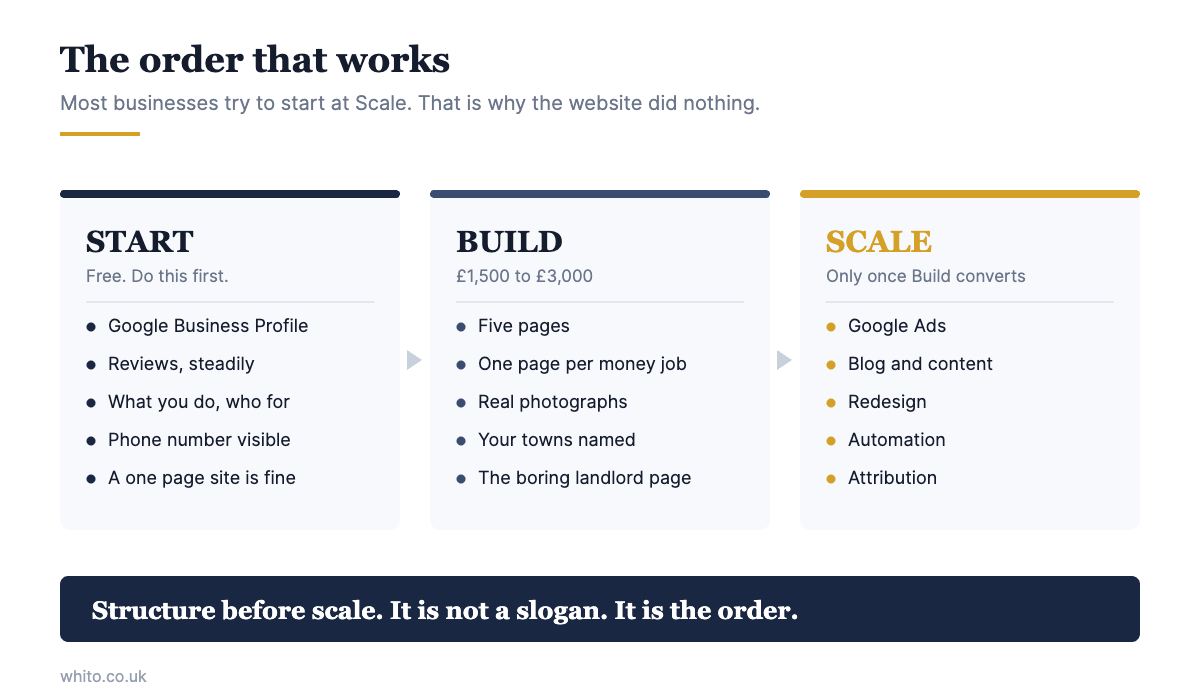
Start. Google Business Profile complete. Reviews coming in steadily. One clear sentence about what you do and who for. A one page site with your phone number and your credentials on it, if that is all you can manage this month. That is enough. It is more than most of your competitors have.
Build. Five pages. One per money job. Real photographs. Your towns named. Reviews on the page. The boring commercial or landlord page that nobody else bothers with. Prices, if you are brave enough, and you should be.
Scale. Now ads make sense, because there is somewhere worth sending the clicks. Now a blog makes sense, because there is something for it to feed. Now a redesign makes sense, because you know what converts and you are optimising something real rather than guessing at something new.
Most businesses try to start at Scale. They buy the ads, hire the agency, commission the redesign, and wonder why none of it moved.
Structure before scale. It is not a slogan. It is the order.
The takeaway
The website is not the product. It is the shopfront.
A good shopfront on a busy street is worth a great deal. A good shopfront on an empty street is worth nothing at all, and no amount of money spent on the shopfront will put people on the street.
Earn the attention first. Then build the thing that converts it.
And if someone quotes you £6,000 for a five page website, ask them what is not included. Then watch their face.
Do this next
Check whether AI already recommends you. It takes twenty minutes and costs nothing. If ChatGPT and Google’s AI are naming your competitors and not you, that is worth knowing before you spend thousands on a website.
Check if AI recommends your business
Claim your free listing. Free forever. No paid tier, no upsell, and you cannot pay us for a better position.
Already spending money on marketing and not sure it works?
Whito Pro checks every month whether ChatGPT, Gemini, Copilot and Google AI recommend your business, tells you who is being recommended instead of you, and gives you three things to fix. £250 a month, no contract, no calls.
If you are not spending anything on marketing yet, do not buy it. Do the free things above instead. We would rather tell you that than take your money.
Working with no budget? You can do this for almost nothing if you go in with your eyes open. See how to build a business website for free in the UK, and what “free” actually costs you.