Last Updated on October 30, 2026
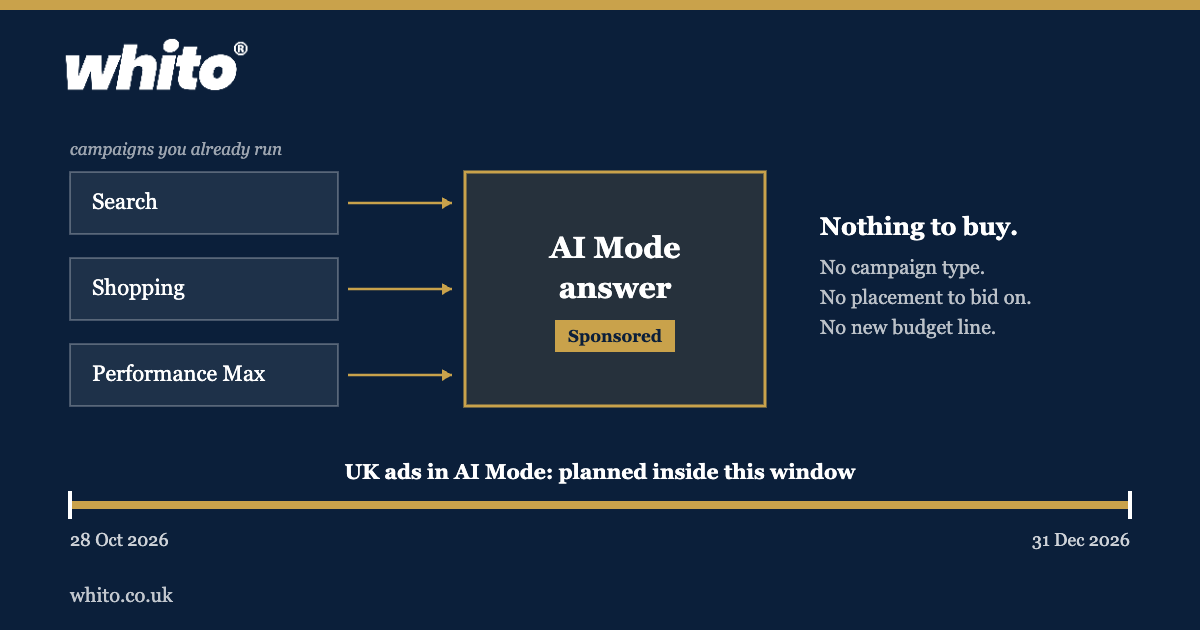
Google confirmed on 28 October that ads are coming to AI Mode in the United Kingdom this quarter. Most of the reaction has been people asking how to get in early.
That is the wrong question, and asking it will cost you money.
There is no AI Mode campaign type. There is no placement to bid on. The campaigns you are already running are the raw material, whether you planned for that or not.
What Google actually said
In a post on its Ads and Commerce blog on 28 October, Google said it is scaling ads in AI Mode across ten countries: Australia, Canada, India, Kenya, Malaysia, New Zealand, Nigeria, Pakistan, the Philippines and Singapore.
The UK was not in that ten. Google’s wording for the UK is narrower: “In Q4 2026, we plan to expand to additional locales, including Brazil, Mexico, and the United Kingdom.”
Read that properly. “Plan to”, not “will”. “Including”, so the list may not be final. And Q4 2026 ends on 31 December, which leaves about nine weeks.
Google also said it is launching multiturn ads in the United States, so ads can appear on follow-up questions in an AI Mode conversation. That has not been announced for the UK.
One thing worth holding on to: AI Mode itself has been available to UK users since July 2025. The surface is not new. The ads are.
The mistake: treating this as something to sign up for
| What most owners assume | What the documentation says |
|---|---|
| There will be an AI Mode campaign to set up | Existing Search, Shopping and Performance Max campaigns feed it |
| You can target the placement | For AI Overviews, Google states you cannot target it directly |
| You can sit this one out | For AI Overviews, Google states you cannot opt out |
| It needs new budget | It needs your existing copy and feeds to be fit to quote |
Google’s help page on ads in AI Overviews says two things plainly: advertisers cannot opt out of serving there, and advertisers cannot directly target the placement. Ads from existing Search, Shopping and Performance Max campaigns are what fill it.
Google has not published an equivalent opt-out statement for AI Mode that we could open, so treat that as the likely pattern rather than a confirmed fact. The direction is clear enough. If you are running Google Ads, you are already in the pool.
So the preparation is not “learn a new platform”. It is “make sure what I already run is fit to be quoted inside an answer”. It is also the second change this month to move your ad wording out of your hands: from today, OpenAI rewrites advertisers’ copy while the ASA still holds you responsible for it.
Read the footnote on Google’s encouraging number
Google’s post carries one statistic that agencies will repeat all quarter. Click-through rates are, in Google’s words, “already similar between sponsored and organic product list items within AI Mode.”
What that number actually compares: sponsored product listings against organic product listings, both of them inside AI Mode. Not against a traditional results page. Not text ads. Google’s own internal data, United States only, 20 August to 3 September 2026.
It is a useful signal, not a forecast for your account.
The other figure in the post is sturdier. Google says AI Mode queries are on average three times longer than traditional searches, sourced to its own AI Mode Report from May 2026. Longer queries mean more specific intent. That rewards businesses that have been clear about what they do and who they do it for, and it punishes the vague.
Why Google needs this to work
In the same week, Alphabet reported its third quarter. Google Search and other revenue rose 12 per cent year on year, after 19 per cent in the first quarter and 17 per cent in the second, as reported by Search Engine Journal from the results. Chief Business Officer Philipp Schindler pointed to lower monetisation inside AI Mode as one of the reasons growth slowed.
Note what was not said. He did not say what AI Mode monetisation was lower than, or by how much.
Google has a commercial reason to make AI Mode carry more advertising, and a shareholder timetable for doing it. Do not plan on a slow, optional rollout.
What to do in the next nine weeks
None of this needs new budget.
Start. Open your Google Ads account and write down which campaign types you are actually running. If Performance Max is on with a product feed, that feed is now answer copy. Check the prices and stock in it are current, because a wrong price quoted inside an answer is worse than no answer.
Build. Pull your top ten search terms from the last 90 days. If any of them reads like a full question, the page it lands on should answer that question in its first paragraph, in plain words, with a price or a range if you have one. That is the work that pays off in AI Mode, paid or organic.
Scale. Only then worry about measurement, and be honest that measurement is the weak link. Google has already shown it will add AI surfaces faster than it adds reporting for them: it made its AI answers more clickable without agreeing to count the clicks. Expect the same here. Judge the quarter on enquiries and sales, not on a placement report that may not exist.
One warning against over-correcting. Organic AI recommendations are not a stable base to build on either. When we asked AI the same 60 questions a second time, only 149 of 270 businesses came back. If you want to watch your own position rather than guess at it, we have priced eight AI visibility trackers in pounds.
The takeaway
Ads in AI Mode are not a product launch you respond to with a budget. They are a change in where your existing copy, feeds and pages get read out loud.
Fix the thing being quoted. That is in your control. The placement never was.