
Last Updated on October 22, 2026
Most UK advertisers think of automation as something they switch on. On Friday 30 October, OpenAI switches it on for you.
What is actually changing
Search Engine Roundtable reported on 20 October that OpenAI has emailed ChatGPT advertisers. The wording it published is blunt: “Starting Friday, October 30, 2026, we’ll enable creative enhancements for your new and existing self-serve campaigns.”
Creative enhancements let OpenAI adapt your existing ad and landing page content. Per the same reporting, that can mean new or updated headlines and descriptions, image resizing, destination URL optimisation, and translation into other languages. Variations can be prepared in advance or generated live, inside the conversation.
One line matters more than the rest. Enhanced ads, per the email as reported, “can run automatically without requiring you to review or approve each version.”
This is not a beta no one in Britain can reach. Search Engine Land reported on 19 June that OpenAI had begun rolling out its Ads Manager beta to UK businesses, with upfront billing requirements removed. If you opened an account to see what ads inside an AI assistant look like, this applies to you. We covered where that buying surface is heading in our research on agentic shopping and how AI agents will buy on a customer’s behalf.
The mistake most owners will make
The mistake is reading this as a creative question. It is a control question.
A rewritten headline, you can live with. A resized image, you can live with. Destination URL optimisation means something else: the AI can change where your ad sends people.
If you have spent six months getting one landing page to convert at a rate you can finally predict, an automatic redirect to a “more relevant” page is not a tweak. It is a different funnel, with a conversion rate you have never measured.
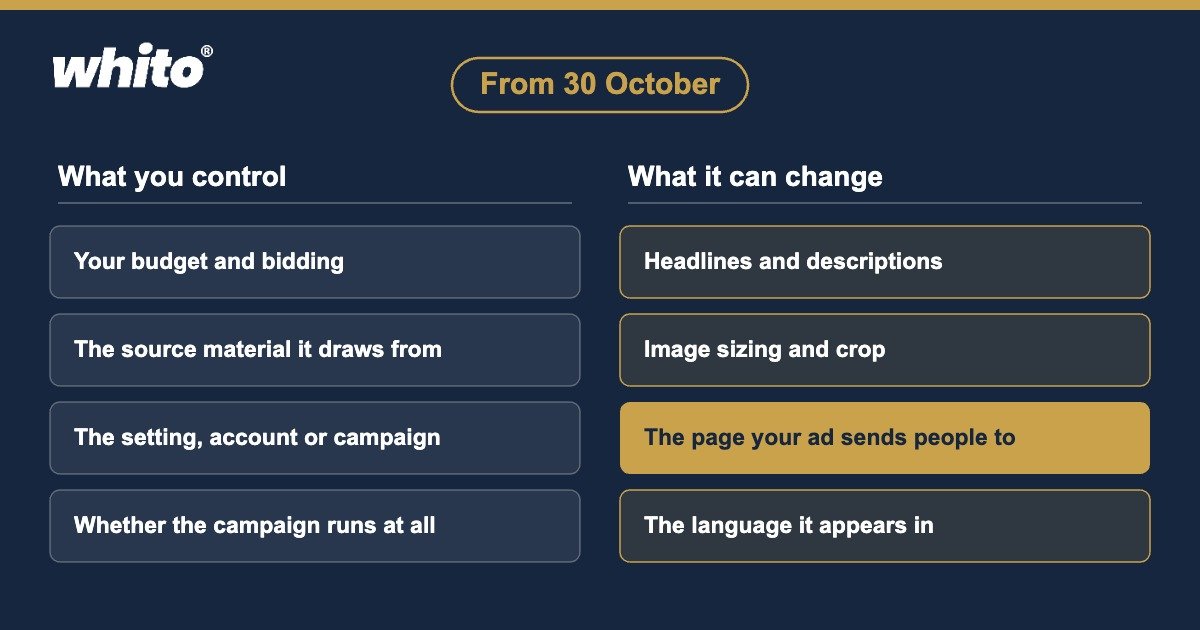
| What you still control | What the system can change for you |
|---|---|
| Your budget and bidding | Headlines and descriptions |
| The source material it draws from | Image sizing and crop |
| The setting itself, at account or campaign level | The page your ad sends people to |
| Whether the campaign runs at all | The language it appears in |
The UK bit nobody is mentioning
Here is the part that makes this a British problem rather than an American one.
The ASA published guidance on AI in advertising on 11 June. Two of its points land directly on this change. First, the CAP Code is media neutral: the rules apply regardless of how the content was made. Second, automation does not remove responsibility. In the Stripe & Stare Ltd ruling, the ad had been produced using Google’s automated tools, and the ASA still found the advertiser “primarily responsible for ensuring compliance with the CAP Code”.
Read that against OpenAI’s own position. Digiday reported in June that OpenAI’s Ad Tools Terms describe creative tools that can “generate, modify, transform, optimize, localize, or translate advertising creatives”, and that OpenAI “is not responsible for errors, omissions, outdated information, or inconsistencies in Ad Materials”.
So the platform writes the claim, the platform disclaims the claim, and you answer for it. If your trade makes claims that need substantiating, pricing, availability, savings, qualifications, results, you are now exposed to wording you have not read. Our tracker of 72 UK ad rulings tagged by claim type shows what the ASA actually rules on, and almost none of it is creative flourish. It is specifics. Specifics are exactly what a rewrite changes.
The number that came with the announcement
There isn’t one.
OpenAI’s stated goal is more relevant ads and less work. No uplift figure was published with the email. No test, no sample, no comparison base. “More relevant” describes an intention, not a measured result.
That is the whole trade in one sentence: you are being asked to give up control in exchange for a benefit nobody has sized. When a seller cannot tell you what a change is worth, you do not price the upside. You price the risk. The same logic runs through our UK Marketing Waste Report, where “less work for you” is the most common wrapper on spend that cannot be traced to revenue.
Ten minutes before Friday
1. Open your ad account settings and find creative enhancements. Check it at both levels: campaign settings override account defaults, so an account-level opt out is not the end of the job.
2. Screenshot what your ads currently say, and note which URL each one points at. If something changes in November, this is your only before.
3. Decide per campaign, not globally. Brand terms, where the wording is yours and the page is fixed, are a reasonable place to stay off. A broad prospecting test is a reasonable place to try it.
4. If anything in your ads is a regulated or substantiated claim, leave enhancements off until you can see the variations.
If an agency runs this for you
Ask them one question this week: which campaigns will have creative enhancements on from 30 October, and who approves the variations. If the answer is that nobody approves them because nobody has to, that is the answer, and it is yours to accept or refuse. Our guide on whether your agency is actually getting you into AI answers has the rest of the questions worth asking.
The takeaway
Automation is not the problem. Automation you did not choose, with no published uplift figure, on a channel where you carry the regulatory risk, is a different thing.
You do not have to refuse it. You do have to decide it, before Friday, rather than find out in November. A default is still a choice. It is just somebody else’s.