
Data last verified: 16 October 2026. Figures re-checked against their primary sources under the Whito rolling re-verification programme.
Finding
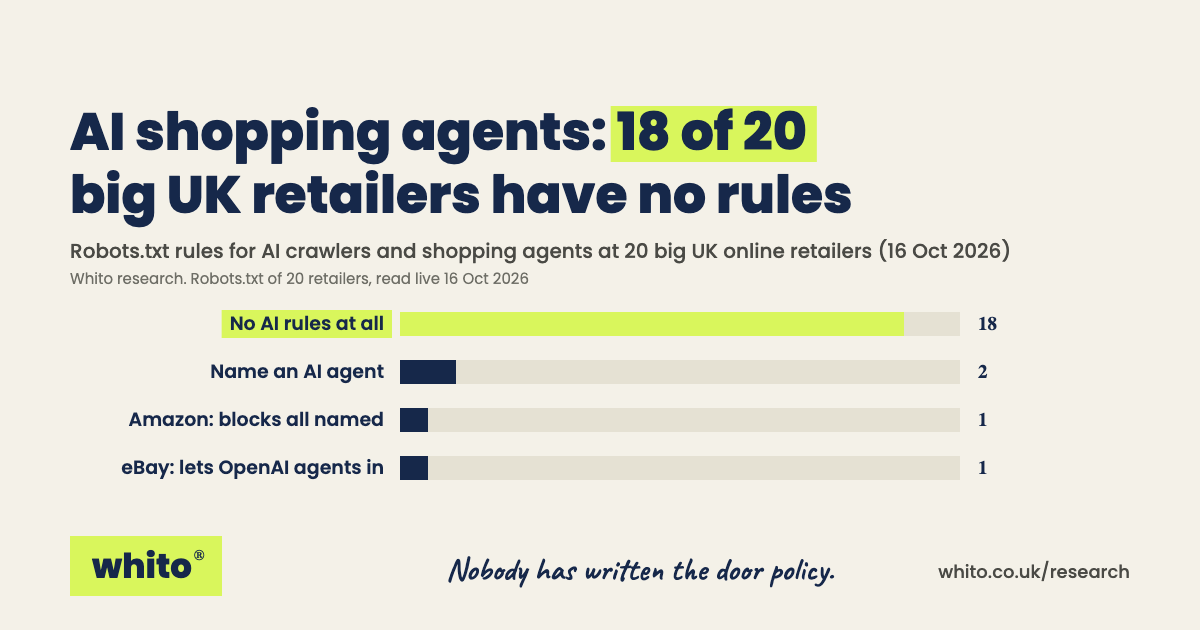
18 of 20 of the UK’s biggest online retailers publish no robots.txt rules for AI crawlers or shopping agents at all. The only two that name them are the marketplaces, Amazon and eBay.
Source: Whito, whito.co.uk/research/agentic-shopping, 2026-10-16. Free to quote with a link to this page.
Last Updated on October 16, 2026
Built from: OpenAI’s shopping research announcement (24 November 2025) and its Agentic Commerce Protocol developer documentation; reporting on OpenAI’s March 2026 checkout pullback; Google’s 11 January 2026 agentic commerce announcement; Amazon’s 13 May 2026 Alexa for Shopping launch; Microsoft’s 8 January 2026 Copilot Checkout launch; Visa’s 18 December 2025 pilot results; the CMA’s 9 March 2026 guidance on AI agents; Adobe’s May 2026 traffic data; court reporting on Amazon v Perplexity; and our own read of the robots.txt files of 20 of the UK’s biggest online retailers on 16 October 2026.
The AI industry says agents will soon do your shopping. Most of UK retail has not even written the door policy. Of 20 of the UK’s biggest online retailers on 16 October 2026, 18 published no robots.txt rules for AI crawlers or shopping agents at all; the only two that named them were the marketplaces, Amazon and eBay.
This guide explains what agentic shopping is, what AI agents can and cannot buy for you right now, what is actually usable in the UK, and what our retailer check says about how ready UK ecommerce is. Every claim is dated and sourced, because this market changes monthly and most of what you will read about it is either an announcement or a prediction.
What is agentic shopping?
Agentic shopping is online shopping where an AI agent does part of the buying journey for you. You set the goal, the budget and the rules. The agent searches, compares products and prices, checks stock, and completes the steps you approve, up to and including checkout where retailers and payment firms support it.
Three things get called “AI shopping” and they are not the same:
- A chatbot answers questions. Ask it about air fryers and it tells you about air fryers.
- A shopping assistant researches and recommends. ChatGPT’s shopping research builds a buyer’s guide with prices and links, but you still click through and pay on the retailer’s site.
- A shopping agent acts. It can fill a basket, watch a price, reorder, and in a few live programmes complete the purchase, with your permission and your payment method.
The last one is what “agentic commerce” means, and it is the part that is still early. Most of what works today, in the UK especially, is the middle one.
How an AI agent shops on your behalf
Under the surface, a shopping agent runs a loop: understand the goal (“a laptop for video editing under £900, delivered by Friday”), break it into steps, use tools to carry the steps out, and check the result against your rules before acting. The tools are the interesting part. An agent can read ordinary web pages, but it works far better when retailers hand it structured data: product feeds with identifiers, prices, stock and delivery options, refreshed daily.
Payment is the hard part, and it is deliberately boring. In OpenAI’s Agentic Commerce Protocol, the agent never holds your card. It requests a one-time payment token with a maximum amount and an expiry date, the merchant’s own payment provider charges it, and the merchant stays the seller of record. Visa and Mastercard are building the same idea into the card networks: Visa reported on 18 December 2025 that hundreds of agent-initiated transactions had been completed with partners, with European pilots expected from early 2026, and Mastercard has completed its first live agentic payments, starting in Hong Kong with HSBC.
Because every AI firm was about to invent its own plumbing, the industry is converging on shared protocols: OpenAI’s ACP (built with Stripe), Google’s AP2 for agent payments, and Google’s Universal Commerce Protocol, announced on 11 January 2026 and co-developed with Shopify, Etsy, Wayfair, Target and Walmart. You do not need to memorise the acronyms. The point is that checkout for agents is being standardised the way card terminals once were.
Real-world examples: what actually exists in October 2026
Here is the honest state of play, documented product by documented product.
| Who | What it does | Status, 16 October 2026 |
|---|---|---|
| OpenAI (ChatGPT) | Shopping research builds personalised buyer’s guides; Instant Checkout completed purchases in the chat | Shopping research live since 24 November 2025. Instant Checkout launched 29 September 2025 with US Etsy sellers, scaled back 4 March 2026; buying now runs through merchant apps and links out |
| Checkout on eligible product listings in AI Mode and the Gemini app using Google Pay; Business Agents for brands | Announced 11 January 2026 for eligible US retailers; global expansion promised, no UK date | |
| Amazon | Alexa for Shopping: Buy for Me, Auto Buy at a target price, scheduled reorders | Launched 13 May 2026, US customers only |
| Microsoft | Copilot Checkout, purchases completed inside Copilot via PayPal, Stripe and Shopify rails | Launched 8 January 2026, US only |
| Perplexity | Comet browser agent that can shop on retail sites | Amazon sued in November 2025; a US appeals court lifted the injunction in August 2026; the case continues |
| Visa and Mastercard | Card network rails for agent payments: vetting agents, identity and fraud controls | Visa reported hundreds of completed agent-initiated transactions in December 2025, European pilots expected from early 2026; Mastercard has completed its first live agentic payments |
Notice the pattern in the right-hand column. As of 16 October 2026, none of these checkout products was generally available in the UK. A UK shopper can use ChatGPT’s shopping research to get a buyer’s guide, and AI search tools will happily compare products and prices. The moment money moves, you are back on the retailer’s website. The research half of agentic shopping is here; the buying half is still mostly a US pilot programme.
The scenarios vendors describe, reordering washing tablets automatically, watching a flight price and asking you before booking, finding the compatible filter for a five-year-old extractor fan, are illustrative rather than shipped products in the UK. The nearest live equivalents are Amazon’s Auto Buy and price alerts, and those are US-only.
The OpenAI retreat matters here too. Instant Checkout was the flagship of agentic commerce, and OpenAI scaled it back on 4 March 2026 after only about a dozen Shopify merchants had gone live. Forrester’s read is that ChatGPT now behaves more like a referral source, the job that search engines have always done. Running a full commerce stack turned out to be harder than announcing one.
Our check: 18 of 20 big UK retailers have no rules for AI agents
Every AI firm publishes named user agents, the labels its crawlers and agents announce themselves with: GPTBot and ChatGPT-User from OpenAI, PerplexityBot from Perplexity, ClaudeBot and Claude-User from Anthropic, and so on. A retailer’s robots.txt file is where it tells those agents what they may read. So we read the robots.txt of 20 of the UK’s biggest online retailers on 16 October 2026 and looked for any AI rule at all.
Of 20 of the UK’s biggest online retailers on 16 October 2026, 18 published no robots.txt rules for AI crawlers or shopping agents at all; the only two that named them were the marketplaces, Amazon and eBay. Tesco, Sainsbury’s, Argos, Currys, John Lewis, Next, Asda, Marks and Spencer, Boots, ASOS, Very, Screwfix, B&Q, Ocado, JD Sports, Dunelm, AO and Wickes name ad bots, image bots, even TikTok and Pinterest bots. Not one of them names a single AI agent.
Call them policy-silent storefronts: shops that have not told AI agents anything at all. Silence is not a block. It means the default rules written for ordinary crawlers apply, so on paper most of UK retail is open to shopping agents. It also means nobody has decided. The two retailers that have decided are the two with the most to lose as marketplaces. Amazon gives all 14 AI agents it names the same one-line answer, Disallow: /, a full block, while building its own agent, Alexa for Shopping, and suing Perplexity over agent access. eBay splits the difference: it blocks the bulk crawlers (GPTBot, PerplexityBot, ClaudeBot, Amazonbot and others) but gives the user-triggered and search agents from OpenAI and Anthropic close to the same access as an ordinary visitor.
| Robots.txt position | Retailers | Count |
|---|---|---|
| No AI rules at all (policy-silent) | Tesco, Sainsbury’s, Argos, Currys, John Lewis, Next, Asda, M&S, Boots, ASOS, Very, Screwfix, B&Q, Ocado, JD Sports, Dunelm, AO, Wickes | 18 of 20 |
| Blocks every AI agent it names | Amazon | 1 of 20 |
| Lets user and search agents in, blocks bulk crawlers | eBay | 1 of 20 |
Two limits on this. Robots.txt is a request, not a lock: it binds polite crawlers and says nothing about what a firewall lets through, and our AI browser readiness study found the firewall, not the code, is where most sites actually turn AI away. And a retailer can have a considered AI strategy without writing it in robots.txt. But the file is the one public, machine-readable statement of policy a shop gets to make, and 18 of 20 have made none. The full retailer-by-retailer data is in the CSV.
How agentic shopping could transform ecommerce
The traffic shift is already measurable, with the usual caveat that the best data is American. Adobe Analytics, reported 17 June 2026, found AI-referred visits to US retail sites more than doubled year on year in May 2026, up 1,324% since tracking began in October 2024, and converted 54% better than non-AI traffic. That last figure reverses 2025, when AI-referred visitors converted at roughly half the normal rate. People arriving from an AI answer increasingly arrive ready to buy.
If agents take over more of the journey, the pressure points move. Discovery stops being ten blue links and becomes one synthesised answer, so being the business the answer names is the new page one; our study of what AI-recommended businesses have in common measured how uneven that already is. Comparison stops rewarding persuasion and starts rewarding accurate, structured facts, because an agent does not see your hero banner. And loyalty gets tested: an agent asked for the best value option has no sentimental attachment to where you bought last time, unless you tell it to.
What agentic commerce means for online retailers
Think about who is competing for the same click. When every retailer’s products can be read by the same agent, “be visible to agents” is an edge that disappears the moment everyone copies it. The durable advantages are the ones that survive copying: a product feed that is actually accurate, prices that match the page, stock that is true, and a business identity an AI can verify. Wrong data is worse than missing data, because an agent that gets burned on your price learns to route around you.
Practical preparation, in order:
- Decide your door policy. Write robots.txt lines for the named AI agents, and treat user-triggered agents (ChatGPT-User, Claude-User) separately from bulk training crawlers (GPTBot, CCBot) if you want the traffic without donating the archive.
- Check an AI agent can read you at all. A bot-blocking firewall can turn agents away regardless of robots.txt. Our free AI browser check tests this on any UK site.
- Get your product data structured. Product schema, accurate prices, live stock, clear delivery options. This is what feeds and protocols will ask for anyway.
- Decide your checkout posture early. The merchant programmes (OpenAI’s ACP, Google’s UCP via Shopify and others, Microsoft’s Copilot merchant application) are US-first today; joining when they open in the UK will be easier if your feed and payments are already clean.
- Keep a human accountable. UK law already expects it, as the next section sets out.
The risks: trust, payments, privacy and control
The failure modes are known, which is one reason checkout has moved slower than the announcements suggested.
- Wrong information. OpenAI’s own shopping research page warns the tool can make mistakes on price and availability and tells users to check the merchant site. An agent confidently comparing stale prices is still the biggest everyday risk.
- Payments. The protocol designs are sound: one-time tokens, spending caps, expiry dates, the merchant charging through its own provider. The rule for shoppers is simpler: never paste raw card details into any AI chat. If an agent cannot pay through a tokenised, capped method, it should not be paying.
- Unintended purchases. Amazon’s Buy for Me completes a purchase with your primary address and credit card. Features like this need spending limits and approval steps turned on, and you should know which mode you are in before you delegate.
- Returns and accountability. Your consumer rights do not change because software placed the order, but the practical questions (who cancels, who chases the refund, whose mistake was the wrong size) are exactly where early disputes will sit.
- Privacy. A shopping agent is useful because it knows your sizes, addresses and budgets. That is also the concern. OpenAI states chats are not shared with retailers; read the equivalent line before trusting any other agent.
The UK regulator has already moved. On 9 March 2026 the CMA published guidance on complying with consumer law when using AI agents: the same consumer law applies whether a customer deals with a human or an AI, a business is responsible for what its AI agent does in the same way it is responsible for an employee, and breaches of the new consumer regime can draw fines of up to 10% of worldwide turnover. Buying the agent from a third party does not move the responsibility.
Frequently asked questions
What is agentic shopping?
Agentic shopping is online shopping where an AI agent carries out part of the buying journey for you: searching, comparing, watching prices, filling baskets and, where retailers and payment firms support it, completing the purchase within rules you set.
Can ChatGPT actually buy things for me?
Mostly no. ChatGPT’s shopping research (live since November 2025) builds buyer’s guides, and you then buy on the retailer’s site. In-chat purchases, Instant Checkout, launched in September 2025 with US Etsy sellers and OpenAI scaled it back in March 2026 in favour of merchant apps and links out.
Is agentic shopping available in the UK?
The research half is. The buying half largely is not: Google’s AI Mode checkout, Amazon’s Alexa for Shopping and Microsoft’s Copilot Checkout were all US-only as of 16 October 2026, and card network pilots in Europe were only beginning. UK availability is announced in stages, so check the date on anything you read.
Is it safe to let an AI agent spend my money?
The live programmes use one-time payment tokens with spending caps and expiry dates, so the agent never holds your card. The sensible rules: keep approval steps on, set budgets, never paste card details into a chat, and check prices on the merchant site before confirming anything expensive.
What are ACP, UCP and AP2?
Competing-but-converging standards for agent commerce. ACP is OpenAI’s Agentic Commerce Protocol, built with Stripe, covering product feeds, checkout and delegated payment. UCP is Google’s Universal Commerce Protocol for discovery, buying and post-purchase support, co-developed with Shopify, Target, Walmart and others. AP2 is Google’s Agent Payments Protocol for the payment step specifically.
What should a UK retailer do first?
Write an AI policy into robots.txt (18 of the 20 biggest UK retailers had none on 16 October 2026), check a plain, non-JavaScript reader can see your products and prices, and get product schema and feed data accurate. Checkout programmes can wait; readable, true data cannot.
Method and limits
We chose 20 of the UK’s biggest online retailers across grocery, electricals, fashion, DIY, health and general merchandise, and read each site’s live robots.txt in a standard browser on 16 October 2026. We parsed every User-agent group and checked each file against the named AI user agents of OpenAI, Anthropic, Perplexity, Google (Google-Extended), Meta, Amazon, ByteDance and Common Crawl. “No AI rules” means none of those agents, or any equivalent, is named anywhere in the file. The list is our selection, not a ranked universe; robots.txt is advisory and says nothing about firewall-level blocking; and a file can change the day after we read it. Retailer-by-retailer results: download the CSV.
Sources
- OpenAI, shopping research announcement, 24 November 2025
- OpenAI, Agentic Commerce Protocol key concepts, read 16 October 2026
- Forbes, Why OpenAI’s checkout retreat spells trouble, 10 March 2026
- Forrester, What it means that the leader in agentic commerce pulled back, March 2026
- Google, agentic commerce tools and protocol announcement, 11 January 2026
- Amazon, Alexa for Shopping launch, 13 May 2026
- PPC Land, Microsoft launches Copilot Checkout, January 2026
- Visa, agent-initiated transaction milestone, 18 December 2025
- American Banker, Visa and Mastercard expand agentic AI deployments, 2 April 2026
- CMA, Complying with consumer law when using AI agents, 9 March 2026
- Digital Commerce 360, Adobe AI-referred traffic data, 17 June 2026
- Bloomberg, Amazon sues to stop Perplexity’s buying agent, 4 November 2025
- The Next Web, appeals court lifts the Comet injunction, August 2026
- Robots.txt files of 20 UK online retailers, read live 16 October 2026 (CSV)
The structural checks behind this research run on any website in about twenty seconds. Enter yours and read the full result on the page. Free, and we do not ask for your email.
Run the free Visibility CheckIf your business is named here and you think we have a fact wrong, email hello@whito.co.uk and we will check it and correct it. If you want to respond, send us a statement and we will publish it alongside. Full detail: Corrections, right of reply and removals.