Data last verified: 27 October 2026. Figures re-checked against their primary sources under the Whito rolling re-verification programme.
Finding
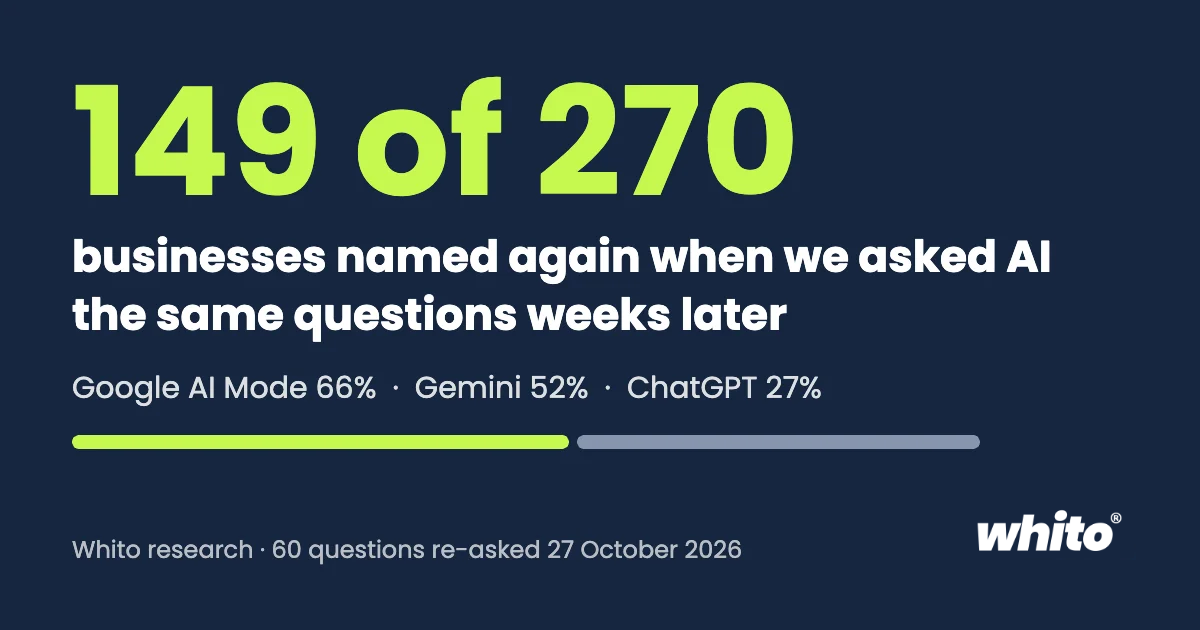
When Whito asked Google AI Mode, ChatGPT and Gemini 60 of its earlier questions again on 27 October 2026, 149 of the 270 businesses they had named the first time were named again (55%).
Source: Whito, whito.co.uk/research/ai-recommendations-re-ask-panel. Free to quote with a link to this page.
Last Updated on October 27, 2026
Asked: 27 October 2026. 60 questions Whito first put to Google AI Mode, ChatGPT and Gemini between 22 August and 3 October 2026, asked again word for word, twice each. 120 answers, every one kept in full.
Every AI visibility report rests on one assumption: that what an AI assistant says this month tells you something about next month. We had never tested that. So we went back to questions we had already asked, and asked them again.
Of the 270 businesses the assistants named the first time, 149 were named again. That is 55% (95% confidence interval 49% to 61%). The rest had been replaced by other firms.
What we did
Between 22 August and 3 October 2026, Whito asked AI assistants to recommend local firms for several studies. We kept the exact question, the assistant, the town, the date and every business it named. That gave us a record we could go back to.
On 27 October we drew 60 of those questions at random, with the draw fixed in advance, and asked each one again:
- 40 questions to Google AI Mode, first asked on 22 August, covering accountants, cleaners, dentists, electricians, estate agents, plumbers, roofers and vets in towns from Plymouth to Belfast.
- 12 to ChatGPT and 8 to Gemini, first asked between 26 September and 3 October, covering plumbers, locksmiths, dentists and solicitors.
Every question had the same wording: “Recommend a trustworthy [trade] in [town]”. We asked each one twice on 27 October, less than two minutes apart, in a fresh chat each time. Asking twice on the same day tells us how much an answer moves on its own, so we can tell that apart from change over weeks.
A business counts as “named again” if either of the two new answers names it. We call the share named again the re-ask rate.
What we found
| Assistant | First asked | Questions | Businesses named first time | Named again on 27 October | Re-ask rate |
|---|---|---|---|---|---|
| Google AI Mode | 22 August | 40 | 177 | 117 | 66% |
| Gemini | 26 Sep to 3 Oct | 8 | 27 | 14 | 52% |
| ChatGPT | 26 Sep to 3 Oct | 12 | 66 | 18 | 27% |
| All | 60 | 270 | 149 | 55% |
Three things stand out.
1. Answers move more over weeks than within a day. For each question we measured how much two lists overlap, from 0 (no names shared) to 1 (the same names). Two answers given minutes apart on 27 October overlapped by a median of 0.67. Today’s answer and the original answer overlapped by a median of 0.31. In 49 of the 60 questions, the two same-day answers were closer to each other than to the original. So some of the change is noise, but most of it is not.
2. The first name often changes. The business named first in the original answer was still named first in 25 of the 60 new answers.
3. Google AI Mode held on to more names than ChatGPT, even over a longer gap. Google AI Mode was re-asked about nine weeks after the first answer and kept 66% of its names. ChatGPT was re-asked after three to four weeks and kept 27%. Part of that gap is because ChatGPT’s answers have got shorter: it named 5.5 businesses per answer on average the first time, and 2.9 on 27 October. Fewer names means fewer chances to repeat one. Gemini went the other way, from 3.4 names per answer to 5.
Did the businesses change, or the answers?
We checked every business from the original answers that has a Companies House company number: 38 of the 270. On 27 October, none of the 38 had changed status since the original answer. Five were already dissolved before the first answer, between 2010 and 2022, which is a separate problem we have written about before. So in this sample, firms closing down does not explain the change. The answers changed.
The phone numbers ChatGPT gave
ChatGPT attached a phone number to the businesses it named in 23 of its 24 new answers. We took each of the 50 different business-and-number pairs and looked for that number on the business’s own website.
- 40 numbers were on the business’s own website.
- 8 were not. They belong to 5 businesses, and in each case the business’s site shows a different number. For one of the 5, the name is common enough that we cannot be sure we found the right firm.
- For 1 business we found no website of its own, and 1 site could not be read.
We did not ring any of the numbers, and a number missing from a firm’s site does not prove it is wrong: firms change numbers and some run more than one line. But a customer who rang one of those 8 would be using a number the business itself does not publish. Our 22 October pilot found 4 of 25 AI-supplied numbers on no property of the business at all. If an AI assistant gives you a number, check it against the firm’s own website before you call.
What this means if you track AI answers
- One screenshot is not a position. Ask the same question twice and you will usually get a slightly different list. Ask again in a few weeks and you will get a more different one.
- Use the same question, the same day, every month. That is the only way a change from one month to the next means anything. Count how often you are named across several questions, not where you sit in one answer.
- Do not pay for a single month’s result. Anyone selling you a place in an AI answer is selling something that moves on its own.
Whito’s own Visibility Monitor uses fixed questions on a fixed day each month for exactly this reason. It records what the assistants say. It does not change what they say.
What this does not prove
- This is a pilot: 60 questions, 3 assistants, one re-ask date. The intervals are wide, especially for ChatGPT and Gemini.
- Each assistant was re-asked after a different gap, from about three weeks to nine weeks, and on different trades. So we cannot say whether the gap or the assistant explains the difference.
- We do not know why an answer changed. AI assistants change their models and their sources without notice.
- The original answers were collected in signed-in browsers, and whether web search was on was not recorded for most of them. The new answers were also collected signed in, from a browser in the East Midlands. Answers can differ for other people and places. To test whether being signed in matters, we asked 6 of the 60 questions a third time on 27 October from a separate browser that was signed out of Google and ChatGPT (4 Google AI Mode, 2 ChatGPT). The signed-out answers overlapped the two signed-in answers by a median of 0.54, close to the 0.59 between the two signed-in answers themselves, and 19 of the 25 businesses named signed out were also named signed in. In this small check, being signed in did not change the answers more than asking twice did.
- The two same-day answers were asked under two minutes apart. A longer gap might show more same-day movement.
- The original Google AI Mode question wording was stored as a template, “Recommend a trustworthy [trade] in [town]”. We used the singular trade, as the original study describes.
- Matching names across answers is done by name. We checked every business marked as dropped against the full text of both new answers.
What happens next
We will ask the same 60 questions again in December, and then every quarter, to build a record of how AI recommendations change over time. The December round will add the remaining questions from our earlier studies.
Related reading: our AI business recommendation index pilot, 51 plumbers from 30 identical ChatGPT questions, and what AI-recommended businesses have in common. To check whether AI tools can read and confirm your own business, run the free Visibility Check.
Download the data
One row per question: the assistant, the exact question, the dates, how many businesses were named first time, how many were named again, and the overlap figures: whito-re-ask-panel-pilot-2026-10-27.csv. Free to reuse with a link to this page. The business-level file, with every name and its Companies House result, is available to organisations as a built-to-order Whito Data file.
Cite this research
Whito Research (2026). Same Question, Weeks Later: How Much of an AI Recommendation Survives? Whito. https://whito.co.uk/research/ai-recommendations-re-ask-panel/
Key finding: When Whito asked Google AI Mode, ChatGPT and Gemini 60 of its earlier questions again on 27 October 2026, 149 of the 270 businesses they had named the first time were named again (55%).
The structural checks behind this research run on any website in about twenty seconds. Enter yours and read the full result on the page. Free, and we do not ask for your email.
Run the free Visibility CheckIf your business is named here and you think we have a fact wrong, email hello@whito.co.uk and we will check it and correct it. If you want to respond, send us a statement and we will publish it alongside. Full detail: Corrections, right of reply and removals.