Finding
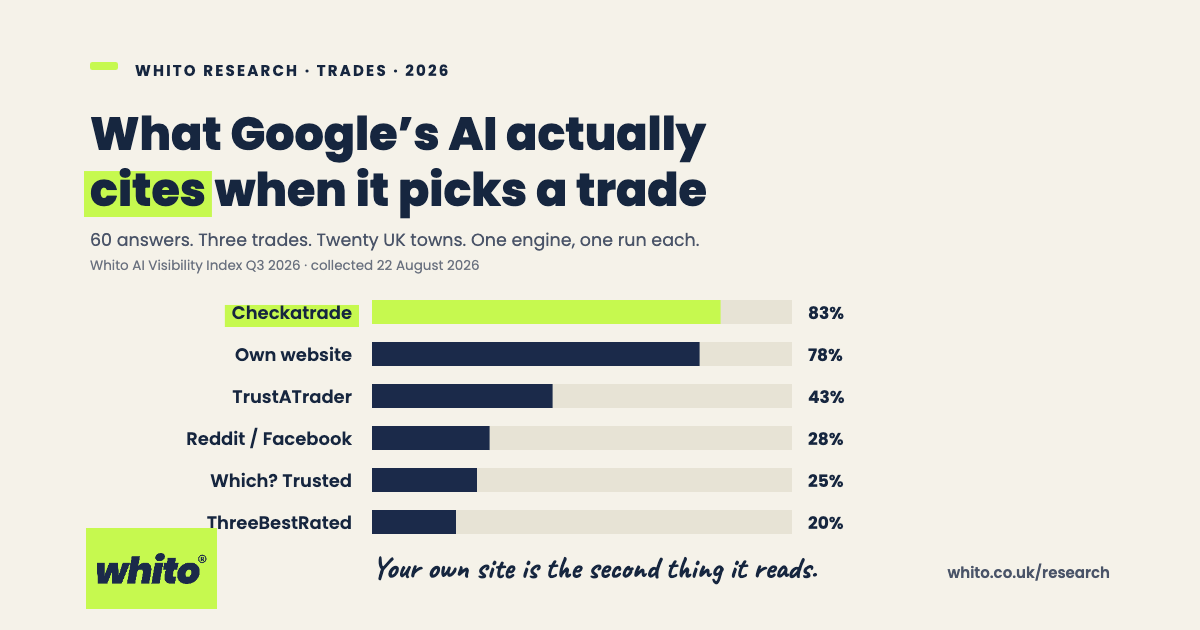
Checkatrade was cited in 50 of the 60 Google AI Mode answers Whito collected for electricians, plumbers and roofers across 20 UK towns on 22 August 2026, 83%, while only 9% of UK homeowners rate a builder's website among their top three factors.
Source: Whito, whito.co.uk/research/uk-trades-marketing-statistics, August 2026. Free to quote with a link to this page.
Last Updated on September 5, 2026
The question this answers: what do the numbers actually say about marketing a UK trades business in 2026? Ninety-two figures, every one traced to a document we opened and read, with the sample and the country stated next to each. Eighteen of them are Whito’s own data and exist nowhere else. Original UK research. Collected and published 29 August 2026.
Almost every trades marketing statistic you will read this year was collected in the United States.
Not adapted for Britain. Not weighted. Collected in America, from American consumers, and pasted onto a British page with the word “UK” in the title. The flagship survey behind most of them last sampled British consumers in 2010, when the iPad was three months old.
That would be a footnote if the numbers agreed. They do not. The US data says people decide fast, shop around and choose on reviews. The UK data, when you go and find it, says most people ask someone they know, hire the person they hired last time, and never get a second quote.
Those two pictures lead to two different businesses. One of them is real here.
What is on this page
- What AI actually recommends in the trades (Whito original data, 1 to 18)
- How UK homeowners really find a trade (19 to 32)
- Reviews and star ratings (33 to 42)
- Search, AI and social (43 to 56)
- The trade directories, in their own words (57 to 66)
- How big the UK trades sector actually is (67 to 82)
- What trades marketing costs (83 to 92)
- Nine statistics you will see quoted that we could not verify
- Methodology and sources
- How to cite this page
- Common questions
1. What AI actually recommends in the trades
Whito’s own data. Google AI Mode, one prompt shape, 20 UK towns, three trades, collected 22 August 2026. Figures 1 to 18 are recomputed from the raw answer logs for this page and are published nowhere else.
Ask Google for a tradesperson now and it does not hand you ten links. It hands you an answer: three or four named firms, with ratings, presented as the trustworthy ones. So the useful question is not how that answer ranks. It is where the answer comes from, and what it takes to be in it.
The panel. One prompt, used identically everywhere: “Recommend a trustworthy [trade] in [town]”. Electricians, plumbers and roofers. Twenty towns: Reading, Sunderland, Swansea, Leeds, Nottingham, Coventry, Luton, Bristol, Doncaster, Ipswich, Preston, Stoke-on-Trent, Milton Keynes, Norwich, Plymouth, Glasgow, Belfast, Mansfield, Blackpool, Wolverhampton. Google AI Mode, signed in, UK, one run per prompt, no retries, no regeneration. 60 answers. Every answer logged on the day.
This is a one-engine study and says so on its face. ChatGPT and Gemini could not be driven reliably enough to produce a full clean panel, and a partial engine is worse than no engine.
1. Google’s AI named 253 trade businesses across 60 answers, an average of 4.2 firms per answer. Roofers averaged 4.0, electricians 4.2, plumbers 4.5.
Whito AI Visibility Index Q3 2026. Base: 60 Google AI Mode answers, 3 trades x 20 UK towns, collected 22 August 2026.
2. Checkatrade was cited in 50 of the 60 trade answers, 83%. No other source came close.
Whito AI Visibility Index Q3 2026. Base: 60 answers. Counted as cited where the source appears in the answer’s citation set.
3. 57 of 60 trade answers, 95%, leaned on at least one consumer directory. Only three did not: electricians in Bristol and Glasgow, and plumbers in Bristol.
Whito AI Visibility Index Q3 2026. Base: 60 answers. Directories counted: Checkatrade, TrustATrader, MyBuilder, Which? Trusted Traders, ThreeBestRated, Yell, HaMuch, Rated People, Checked and Vetted, Referenceline.
4. Directory dependence runs highest in roofing. Every one of the 20 roofing answers cited a directory. Plumbers 19 of 20, electricians 18 of 20. Domestic cleaning, run on the same panel for comparison, was 14 of 20.
Whito AI Visibility Index Q3 2026. Base: 20 answers per sector.
Share of AI answers citing at least one consumer directory. Whito AI Visibility Index Q3 2026, Google AI Mode, 20 UK towns per sector, collected 22 August 2026.
5. TrustATrader was cited in 26 of 60 trade answers, 43%.
Whito AI Visibility Index Q3 2026. Base: 60 answers.
6. After the top two, the rest of the directory field is thin: Which? Trusted Traders in 15 answers of 60 (25%), ThreeBestRated 12 (20%), MyBuilder 8 (13%), Yell 2 (3%).
Whito AI Visibility Index Q3 2026. Base: 60 answers.
7. A business’s own website or profile was cited in 47 of 60 answers, 78%. Your own site is the second most common source in the whole panel, behind Checkatrade and ahead of every other directory.
Whito AI Visibility Index Q3 2026. Base: 60 answers.
8. Reddit or Facebook fed 17 of 60 trade answers, 28%. Local community groups and town subreddits are a live input to what the engine calls trustworthy.
Whito AI Visibility Index Q3 2026. Base: 60 answers.
9. An SEO ranking site with no visible method was cited in 9 of 60 trade answers, 15%. Named examples from the logs include topratedroofers.co.uk, topratedelectricians.co.uk, top5trades.co.uk, topscottrades.co.uk and ukroofingdirectory.co.uk.
Whito AI Visibility Index Q3 2026. Base: 60 answers.
10. A trade body or competent-person scheme appeared in 37 of 60 answers, 62%. NICEIC, NAPIT, Gas Safe, WaterSafe, FMB, NFRC, TrustMark, CORC and SELECT all featured.
Whito AI Visibility Index Q3 2026. Base: 60 answers.
11. 23 of the 253 recommended trade businesses, 9.1%, were named with no visible rating at all. The engine presented them as trustworthy without showing a single star.
Whito AI Visibility Index Q3 2026. Base: 253 recommendation entries across 60 answers.
12. Of the 230 that did carry a Google rating, 227 were rated 4.5 stars or better. That is 98.7%. The median rating was a flat 5.0 and the mean was 4.92.
Whito AI Visibility Index Q3 2026. Base: 230 entries showing a Google card rating.
13. Only three rated trade businesses in the entire 60-answer panel sat below 4.5 stars. Rees Brothers (Swansea) Limited at 2.0, GS Roofing in Reading at 4.0, and Riverside Plumbing and Heating in Sunderland at 4.1.
Whito AI Visibility Index Q3 2026. Base: 230 rated entries.
14. The lowest-rated business Google recommended as trustworthy held 2.0 stars from four reviews. The answer justified it on Federation of Master Builders membership. A trade body badge outranked the rating on the same card.
Whito AI Visibility Index Q3 2026, Swansea roofers, collected 22 August 2026. Rating as displayed in the answer on the day.
15. 121 of 230 rated recommendations, 52.6%, held a perfect 5.0. Half of everything the engine recommends is unblemished, which is not what the trades actually look like.
Whito AI Visibility Index Q3 2026. Base: 230 rated entries.
16. You do not need many reviews to be recommended. You need a high average. The median recommended trade business had 96 Google reviews. 17 of 230, 7.4%, had fewer than 20. More than half, 122 of 230, had fewer than 100.
Whito AI Visibility Index Q3 2026. Base: 230 rated entries. Lowest recommended: one review.
17. National brands are almost absent from AI trade recommendations. Two of 253, 0.8%. Both were Metro Plumb franchises. Everything else was an independent.
Whito AI Visibility Index Q3 2026. Base: 253 trade recommendation entries.
18. Domestic cleaning is the opposite. 47 of 109 recommendations, 43%, were a national brand or franchise: Maid2Clean, Time For You, Merry Maids, Well Polished, Molly Maid, Housekeep, Bright & Beautiful. The trades are an independents’ market. Cleaning is not.
Whito AI Visibility Index Q3 2026. Base: 109 cleaner recommendation entries, 20 towns.
Half of what Google recommends in the trades holds a flawless five stars, and one in thirteen of those firms has fewer than twenty reviews. The bar is not volume. It is an unbroken average.
Whito AI Visibility Index Q3 2026, 230 rated recommendations across 60 answers.
One more finding from the same panel, published separately: when Whito ran this prompt across the same 20 towns in July 2026 and checked every named business against the Companies House register, the engine recommended firms whose only company registration had been dissolved for years. The full study is at Can you trust Google’s AI to recommend a tradesperson?, and the quarterly index this data comes from is the Whito AI Visibility Index.
2. How UK homeowners really find a trade
Figures 19 to 32. All UK-sampled. This is the section most trades marketing pages get wrong, because the good UK research is recent and almost nobody is citing it.
In February and March 2026, Opinium surveyed 5,000 UK adults responsible for repairs in their home for Citizens Advice, then asked the 3,438 of them who had actually hired a trader in the previous 18 months how they found the person. It is the best UK evidence on this question that exists, and it is eight weeks old.
19. 36% used a referral from someone they knew.
Citizens Advice, Built to fail, 7 July 2026. Base: weighted subsample of 3,438 UK adults who used a trader for home repairs in the previous 18 months. Fieldwork February and March 2026, Opinium. Multi-select.
20. 27% used a trader they had previously hired.
Citizens Advice, Built to fail, 7 July 2026. Base as above.
21. 16% used a trader recommendation site such as Checkatrade or TrustATrader.
Citizens Advice, Built to fail, 7 July 2026. Base as above.
22. 11% used social media.
Citizens Advice, Built to fail, 7 July 2026. Base as above.
23. 7% used an approved or accredited trader scheme, such as a local authority scheme or Buy With Confidence.
Citizens Advice, Built to fail, 7 July 2026. Base as above.
An honest limit on figures 19 to 23. Citizens Advice published these five routes. It did not publish the full questionnaire, so we cannot tell you what other options were offered, and we are not going to guess. Read them as the five routes Citizens Advice reported, not as a complete map of how Britain finds a tradesperson.
24. 87% of people responsible for home repairs had heard of or used Checkatrade or MyBuilder. 16% actually found their trader that way. Awareness of the directories is close to universal. Use of them is not.
Citizens Advice, Built to fail, 7 July 2026. Awareness base: 5,000 UK adults responsible for home repairs. Usage base: 3,438 who hired a trader in the previous 18 months.
25. Before hiring, 31% met the trader, 29% checked reviews and 23% got quotes from several traders.
Citizens Advice, Built to fail, 7 July 2026. Base: 3,438.
26. Fewer than one in four people who hired a trader got more than one quote. Which? advises getting at least three. The gap between the advice and the behaviour is the whole ball game: most jobs are not a competitive tender, they are a single conversation.
23% figure: Citizens Advice, Built to fail, 7 July 2026, base 3,438. Three-quote advice: Which?, How to find a reputable trader, editorial guidance, not survey data.
27. Only 10% checked the trader’s qualifications and just 8% checked trade body membership.
Citizens Advice, Built to fail, 7 July 2026. Base: 3,438.
28. 55% said it was difficult to find a trader they trusted for good-quality work. 27% found it easy.
Citizens Advice, Built to fail, 7 July 2026. Base: 5,000 UK adults responsible for home repairs.
29. 28% did the work themselves and 26% delayed or avoided repairs altogether, because they did not believe they could find someone trustworthy. That is demand leaving the market, not moving to a competitor.
Citizens Advice, Built to fail, 7 July 2026. Base: 5,000 UK adults responsible for home repairs.
What homeowners say decided it
A second UK survey, run by Opinium for the HomeOwners Alliance in February 2026, asked 834 homeowners who had actually used a builder what mattered most when they chose. Respondents picked their top three.
| What was most important when choosing your builder (top 3) | Share |
|---|---|
| Recommendations from friends, neighbours, family, others | 55% |
| Verifying qualifications for specialist work (Gas Safe, NICEIC) | 23% |
| Online reviews | 23% |
| Personal feeling when meeting the builder | 19% |
| Checking trading history or financial stability | 19% |
| Warranties offered by the builder | 18% |
| Membership of a trade body, accreditation logos | 17% |
| Comparison platform | 17% |
| Visiting or reviewing comparable projects | 16% |
| Builder’s website, branding, overall professional presentation | 9% |
| Builder appearing busy or in demand | 8% |
| Independent contracts and staged payment arrangements | 6% |
HomeOwners Alliance, The HomeOwners Survey 2026, published July 2026. Base: 834 UK homeowners who have used a builder, drawn from a nationally representative Opinium sample of 2,000 UK adults aged 18+, fieldwork 13 to 18 February 2026. Disclosure: the survey was run in partnership with LifeSearch, the Federation of Master Builders and ARCO, so a trade body co-sponsored the research that finds trade body membership matters to 17% of homeowners.
30. Word of mouth was named a top-three factor by 55% of homeowners, more than double anything else on the list.
HomeOwners Alliance, HomeOwners Survey 2026. Base: 834 UK homeowners who have used a builder.
31. The builder’s website, branding and overall professional presentation came eleventh of twelve, on 9%. It finished behind warranties, behind trading history, and behind how the builder made them feel in person.
HomeOwners Alliance, HomeOwners Survey 2026. Base: 834 UK homeowners who have used a builder.
32. Younger homeowners weigh reviews roughly twice as heavily as older ones, and trade bodies less than half as much. 33% of under-35s rely on online reviews against 16% of over-55s; 8% of younger homeowners check trade body membership against 21% of older ones.
HomeOwners Alliance, HomeOwners Survey 2026. Base: 834 UK homeowners who have used a builder, split by age band.
Read figure 31 carefully before you cancel your website
It does not say a website is worthless. It says a website is not what wins the choice. Almost nobody picks a builder because the site looked smart. Plenty rule one out because there was nothing to check. The website’s job in the trades is to survive scrutiny that has already started somewhere else, usually a recommendation or a Google listing, and it has to do that job in about thirty seconds.
Whito reading of figures 19, 30 and 31. Our interpretation, not the surveys’.
3. Reviews and star ratings
Figures 33 to 42. This is where the country label matters most. We have marked every figure US or UK in the sentence, not in a footnote.
33. 97% of consumers read reviews for local businesses. This is the single most quoted statistic in trades marketing and it is American.
BrightLocal, Local Consumer Review Survey 2026, published 11 February 2026. Base: 1,002 US adult consumers via SurveyMonkey. UNITED STATES. The words UK, United Kingdom and Britain do not appear on the page.
34. 31% of consumers say they will only use a business rated 4.5 stars or above. US sample.
BrightLocal, Local Consumer Review Survey 2026. Base: 1,002 US adult consumers. UNITED STATES.
35. 47% say they will not use a business with fewer than 20 reviews, and 74% look for reviews written in the last three months. US sample.
BrightLocal, Local Consumer Review Survey 2026. Base: 1,002 US adult consumers. UNITED STATES.
36. The last time BrightLocal published a UK consumer sample was 2010, and even that was 2,012 consumers across the US and UK combined, polled in September and October 2010. Every edition we checked from 2018 onward is US-only.
BrightLocal, UK Results: Local Consumer Review Survey, published 6 December 2010. Editions checked for a UK sample: 2018, 2020, 2025, 2026.
37. 89% of UK consumers say star ratings and reviews influence their choice of products and services. This is the closest thing to a current UK equivalent of figure 33, and it measures influence rather than reading.
London Research for Trustpilot, The Impact of Customer Star Ratings and Reviews on UK Buying Behaviour, 21 March 2024. Base: nationally representative survey of 1,000 UK consumers, January 2024. Commissioned by Trustpilot: treat brand-specific findings in that report as marketing.
38. 78% of UK consumers regard customer reviews as useful or very useful when purchasing, and 72% say the same of star ratings.
London Research for Trustpilot, March 2024. Base: 1,000 UK consumers, January 2024.
39. The CMA estimated that £23 billion a year of UK consumer spending is potentially influenced by online reviews, of which £3.93 billion is home improvements. Both figures are 2015 estimates of 2015 spending across six sectors, described by the CMA itself as approximate. The home improvements component is the relevant one for the trades and is almost never quoted.
Competition and Markets Authority, Online reviews and endorsements, CMA41, 19 June 2015. UK. The CMA was still quoting the £23bn total in 2025 without re-basing it.
40. Between 11% and 15% of reviews on popular e-commerce platforms are fake, on UK government research. This is e-commerce platforms, not trade directories or Google.
Department for Business and Trade, Measures to Address Fake Online Reviews, impact assessment DBT032(C)-23-CCP, 1 September 2023, citing its own commissioned research. UK.
41. Fake review text on products alone causes up to £312 million of UK consumer detriment a year, described by DBT as a conservative estimate because it excludes services and the effect of inflated star ratings.
Department for Business and Trade impact assessment, 1 September 2023. UK. Products only.
42. Well-written fake reviews make UK consumers 3.1% more likely to buy, rising to 9.2% once the price passes £80. The higher the value of the job, the more the fake works. Trade jobs are almost all above £80.
Department for Business and Trade impact assessment, 1 September 2023. Base: experiment with 4,800 UK adult participants on an interactive online shopping platform. UK.
Figures 43 to 56. The strongest evidence here is Ofcom and the CMA, both UK regulators, both publishing their bases.
43. “Google Search accounts for more than 90% of all general search queries in the UK.” That is not a vendor estimate. It is a finding of fact by the UK competition regulator.
Competition and Markets Authority, Strategic market status investigation into Google’s general search services: Final Decision, 10 October 2025, paragraph 1.5. UK, official.
44. Over 200,000 UK firms spent more than £10 billion on Google search advertising in 2024.
CMA, Google general search Final Decision, 10 October 2025, paragraphs 1.5 and 1.27. UK, official.
45. Google held 91.56% of UK search engine referrals in July 2026, with Bing on 5.87%, Yahoo 1.29% and DuckDuckGo 0.69%.
Statcounter GlobalStats, Search Engine Market Share United Kingdom, July 2026, retrieved 29 August 2026. Base: tracked page views across Statcounter’s network, over 3 billion monthly. This measures page views, not people, and rolls monthly.
46. Google handles around 3 billion UK web searches a month.
Ofcom, Online Nation 2025, published 10 December 2025. UK.
47. 69.5% of UK Google searches ended without a click, the highest of the six countries analysed, ahead of the US at 68.0%, France 65.3%, Canada 63.8%, Italy 63.4% and Germany 62.1%.
Rand Fishkin, SparkToro, published 16 June 2026, analysing Similarweb desktop and mobile panel data. Note: SparkToro published the January to April 2026 date range for its US sample only, and did not state a separate window for the UK figure. Zero-click here is SparkToro’s composite measure for Google specifically.
48. 54% of UK adults now use AI tools such as ChatGPT, Copilot or Gemini.
Ofcom, Adults’ Media Use and Attitudes Report, 2 April 2026. Base: 7,533 UK adults aged 16+, fieldwork 29 September to 28 November 2025, online panel plus face-to-face. UK, self-reported.
49. Among 16 to 24 year olds it is 79%, and among 25 to 34s 74%.
Ofcom, Adults’ Media Use and Attitudes 2026. Base: 7,533 UK adults 16+. UK.
50. 75% of online adults read AI search summaries at least some of the time, and 42% read them often or always.
Ofcom, Adults’ Media Use and Attitudes 2026. Base: 7,533 UK adults 16+. UK.
51. 96% of online adults used a search engine in the past year. Whatever else changes, this does not.
Ofcom, Adults’ Media Use and Attitudes 2026. Base: 7,533 UK adults 16+. UK.
52. 15.8 million UK online adults, 32%, visited an AI chatbot in June 2025. This is measured behaviour from a metering panel, not a survey answer.
Ofcom, The Era of Answer Engines, 4 November 2025, citing Ipsos iris. Base: UK online adults 18+, June 2025. Chatbots counted: ChatGPT, Copilot, Gemini, DeepSeek, Perplexity, Claude.ai, Grok. Visited, not “used for recommendations”.
53. ChatGPT alone reached 13.0 million UK online adults, 26%, in June 2025, up from 4.4 million a year earlier. It more than tripled in twelve months.
Ofcom, The Era of Answer Engines, 4 November 2025, citing Ipsos iris. Base: UK online adults 18+. UK.
54. 40% of UK smartphone users use an AI product, but a search app or browser remains the method used most often for every search task tested: 88% for simple information searches, 77% for complex queries.
Accent for the CMA, Mobile Consumer Survey: Search Questions, June 2025. Base: 2,851 completed responses, UK adults 16+ owning a personal smartphone, random push-to-web sample, fieldwork 11 March to 7 April 2025. UK, regulator-commissioned.
| Platform | Reach, UK online adults 18+ | Average daily time |
|---|---|---|
| YouTube | 94% (46.3m) | 51 minutes |
| Facebook and Messenger | 93% (45.9m) | 42 minutes |
| 78% (38.5m) | 20 minutes | |
| TikTok | 56% (27.3m) | 28 minutes |
Ofcom, Online Nation 2025, published 10 December 2025, source Ipsos iris Online Audience Measurement Service, May 2025. Base: UK internet users aged 18+, not all UK adults. The YouTube figure excludes TV set and smart display viewing.
55. Facebook and Messenger reach 93% of UK online adults and hold them for 42 minutes a day. YouTube reaches 94% for 51 minutes.
Ofcom, Online Nation 2025, Ipsos iris, May 2025. Base: UK internet users 18+.
56. Alphabet, the parent of Google and YouTube, reached 99% of UK online adults in May 2025.
Ofcom, Online Nation 2025, Ipsos iris. Base: UK internet users 18+.
5. The trade directories, in their own words
Figures 57 to 66. Every number in this section is a claim the company publishes about itself, read on 29 August 2026. None is audited. None is independent. We have labelled them that way because two of them do not agree with each other.
57. Checkatrade says it has “48,000+ quality trades” and “6M+ real reviews” across 72 trade industries.
Checkatrade homepage and join.checkatrade.com/pricing, read 29 August 2026. Company self-reported marketing claim.
58. Checkatrade is the only major UK trade directory that publishes a price: a free tier at £0 a month, an Approved plan at £30 a month and a Growth plan “from £59/mo”, on 12-month fixed memberships.
join.checkatrade.com/pricing, read 29 August 2026. Checkatrade states elsewhere that basic plans start “from around £30 + VAT per month” and that costs vary by trade, location, competition and lead volume. Published list price, not a contract.
59. MyBuilder’s homepage counter showed 289,480 tradespeople and 2,845,111 reviews. These are live counters and will have moved.
mybuilder.com homepage, read 29 August 2026. Company self-reported. The precision implies registrations ever, not active members.
60. TrustATrader’s homepage reported 469,516 searches in the previous 30 days.
trustatrader.com homepage, read 29 August 2026. Company self-reported.
61. TrustATrader’s own FAQ page, on the same day, claimed “700,000+ searches on TrustATrader.com each month”. The two figures are published simultaneously on the same website and disagree by roughly a third. We are not saying either is wrong. We are saying this is what a directory statistic is.
trustatrader.com and trustatrader.com/faqs, both read 29 August 2026 and both verified twice independently. Company self-reported.
62. TrustATrader publishes no member count anywhere on its site. Its FAQ says only that “membership numbers are limited for each trade within an area”. Any total you see quoted for TrustATrader did not come from TrustATrader.
Homepage, About us, FAQs and Join us pages all checked 29 August 2026.
63. MyBuilder is free to join and charges for the customer’s contact details when you are shortlisted. It does not publish the fee.
mybuilder.com/how-it-works and /tradesperson/register, read 29 August 2026. The fee schedule article on its help centre would not load.
64. Rated People charges “a monthly fee” plus “a small cost for each lead” and publishes neither amount. It also states that no more than three tradespeople can buy the same lead, and that it receives a million job posts a year.
ratedpeople.com/c/tradespeople/how-it-works and /tradespeople/signup/enquiry, read 29 August 2026. Company self-reported.
65. TrustATrader charges a yearly membership fee and publishes no amount.
trustatrader.com/faqs and /join-us, read 29 August 2026.
66. Bark publishes a credit price of £1.80 but not how many credits a lead costs, so no cost per lead can be worked out before you sign up.
help.bark.com GB help centre, read 29 August 2026. Bark states lead cost varies by service type, job size, location and customer engagement.
A UK tradesperson cannot compare cost per lead before buying
Of the five largest UK trade lead platforms, only Checkatrade and Bark publish any price at all, and neither publishes a cost per lead. Rated People, MyBuilder and TrustATrader publish none. Every “£X per lead on Checkatrade” figure circulating online traces back to a lead generation company’s blog, which is selling you the alternative.
Whito check of the published pricing pages of Checkatrade, MyBuilder, Rated People, TrustATrader and Bark, 29 August 2026.
Whito has published the workings on what a trade lead actually has to be worth to pay for itself, at the trade lead break-even study, and a platform-by-platform cost breakdown at plumber lead platform costs.
6. How big the UK trades sector actually is
Figures 67 to 82. Official statistics only. One warning first, because it trips up almost every page that quotes these.
There are two official counts of UK construction businesses and they differ by half a million
885,000 is the Department for Business and Trade figure. 385,000 is the Office for National Statistics figure. Both are correct. DBT counts unregistered businesses; ONS counts only those registered for VAT or PAYE. The half million in between are sole traders trading below the £90,000 VAT threshold, which in the trades is most of the market.
If you see a page quote both without explaining the gap, it has not read either source.
67. 885,000 UK SMEs operate in construction, 16% of all SMEs, the largest single industry group.
Department for Business and Trade, Business population estimates for the UK and regions 2025, published 2 October 2025. Base: UK private sector businesses with 0 to 249 employees, start of 2025, including unregistered businesses. UK, official.
68. 385,000 construction businesses were VAT or PAYE registered in March 2025, 14.1% of all registered UK businesses.
Office for National Statistics, UK business: activity, size and location: 2025, published 24 September 2025, reference date 14 March 2025. Registered businesses only. UK, official.
69. There were 5,690,265 UK private sector businesses at the start of 2025, and 4,272,535 of them, 75%, had no employees at all.
DBT, Business population estimates 2025, 2 October 2025. UK, official.
70. 3.0 million UK businesses, 54%, trade without being registered for VAT or PAYE.
DBT, Business population estimates 2025, 2 October 2025. UK, official.
71. 3.2 million UK businesses, 57%, are sole proprietorships.
DBT, Business population estimates 2025, 2 October 2025. UK, official.
72. The VAT registration threshold is £90,000 of taxable turnover in a rolling 12 months. That is the line the half-million missing construction businesses sit under, and it is why a marketing benchmark expressed as a percentage of revenue behaves so differently here.
GOV.UK, Register for VAT: when to register. UK, official.
73. 2.07 million people were employed in construction in the UK in Q2 2026.
ONS Labour Force Survey, series i4el, release 18 August 2026. Base: UK residents aged 16+, non-seasonally adjusted. UK, official.
74. CITB puts the wider UK construction workforce at 2,606,380 in 2025, forecast to reach about 2.68 million by 2030. Note this is a broader definition than the ONS figure above and the two are not interchangeable.
CITB, Construction Workforce Outlook 2026 to 2030, published 17 June 2026, produced with Oxford Economics. UK.
75. The industry needs an average of 41,200 extra workers a year between 2026 and 2030, over 206,000 across the five years.
CITB, Construction Workforce Outlook 2026 to 2030, 17 June 2026. Forecast model. UK.
76. 72% of building firms said a lack of skilled tradespeople affected their work and 49% had job delays because of it.
Federation of Master Builders, State of Trade Survey H2 2025, published 31 March 2026, covering July to December 2025. Base: 493 responses from FMB members, CIOB companies and businesses outside both organisations. A voluntary online survey with no probability sampling and no published weighting, so treat it as an industry temperature check rather than a national estimate. That characterisation is ours, not the FMB’s.
77. The hardest roles to fill were carpenters, reported by 30% of firms, bricklayers 29% and plumbers or HVAC engineers 23%.
FMB State of Trade Survey H2 2025. Base: 493 responses, so the trade-level splits are cut from an already small sample.
78. Workloads ran at a +22% net balance, enquiries +18% and employment +17% in the second half of 2025.
FMB State of Trade Survey H2 2025. Base: 493 responses.
79. Construction had 423,000 active businesses in 2024, with 45,000 births (10.6%) and 37,000 deaths (8.8%).
ONS, Business demography, UK: 2024, published 20 November 2025. Base: VAT and/or PAYE registered businesses active at any point in 2024, which is why this exceeds the March snapshot in figure 68. UK, official.
80. The five-year survival rate for UK businesses born in 2019 is 38.4%. This is all industries. The ONS bulletin publishes no construction-specific survival rate, so anyone quoting one for the trades is quoting something else.
ONS, Business demography, UK: 2024, 20 November 2025. Base: all UK VAT/PAYE registered businesses born in 2019, tracked to 2024. UK, official.
81. There were 33,000 construction vacancies in the UK in June 2026, down from a peak of 51,000 in May 2022.
ONS Vacancy Survey, series jp9l, release 18 August 2026. UK, official.
82. There were 24,590 apprenticeship starts in Construction, Planning and the Built Environment in 2024/25, out of 353,500 starts across all sectors. England only, not the UK.
Department for Education, Apprenticeships, academic year 2024/25, published 27 November 2025, last updated 29 January 2026. Base: all-age apprenticeships, August 2024 to July 2025. ENGLAND, not UK.
7. What trades marketing costs
Figures 83 to 92. The section where the benchmark everyone quotes turns out to describe a different planet.
“Businesses should spend 7 to 10% of revenue on marketing” is the most repeated number in this industry. It comes from exactly two surveys. We read the respondent profile of both.
83. Gartner’s 2026 CMO Spend Survey puts marketing budgets at 7.8% of company revenue, up from 7.7% in 2025. The survey covered “401 CMOs and other marketing leaders in North America, the United Kingdom and Europe across different industries, company sizes and revenue, with the vast majority of respondents reporting annual revenue of over $1 billion”.
Gartner press release, 11 May 2026, methodology quoted verbatim. Base: 401 marketing leaders, fieldwork January to March 2026. Enterprise scale.
84. The CMO Survey reports a mean of 8.96% of revenue and a median of 5%. The average is dragged up by large firms. Even inside a large-company US sample, the typical company spends 5%.
The CMO Survey, 35th edition, 2026, Topline Report, Duke Fuqua with Deloitte and the AMA. Base: 308 responses from 2,111 invited (14.6%), US for-profit companies, 97% VP level or above, 68% at companies over $100m turnover, fielded 7 to 29 January 2026. UNITED STATES. The median is printed as “5”; the percent sign is ours.
85. There is no published figure for what UK small businesses actually spend on marketing as a share of revenue. We went looking properly. The Longitudinal Small Business Survey, the UK government’s largest small business instrument at 10,611 respondents, does not ask the question. That absence is precisely why every “UK small business marketing budget” article ends up quoting an American enterprise survey.
Whito search of UK official statistics, 29 August 2026. Stated as a gap, not as a finding. If you know of a source with a genuine UK small business sample, tell us and we will add it.
86. Only 3% of UK SME employers who sought external advice sought it on marketing.
Department for Business and Trade, Longitudinal Small Business Survey 2024: SME employers. Base: 8,396 UK SME employers with 1 to 249 employees, telephone survey, all four UK nations, fieldwork October 2024 to May 2025. UK, official.
87. Among UK businesses with no employees, 22% of those seeking advice sought it on marketing, behind business growth on 34%. Sole traders ask about marketing seven times more often than employers do.
DBT, Longitudinal Small Business Survey 2024: businesses with no employees. Base: 2,192 UK businesses with no employees. UK, official.
88. Google Ads in Home and Home Improvement average $8.33 per click and $90.92 per lead, in US dollars, from US campaigns. There is no equivalent UK benchmark published by a primary source, so every UK trades page quoting a cost per lead is quoting American data in dollars.
WordStream, Google Ads Benchmarks 2026. Base: 13,474 US-based search advertising campaigns running 1 April 2025 to 31 March 2026. Figures are medians. UNITED STATES, USD.
89. UK advertising investment reached £46.7 billion in 2025, up 6.4%, and is forecast at £49.8 billion for 2026.
Advertising Association and WARC Expenditure Report, published 30 April 2026. Base: total UK media investment, all advertisers, calendar year 2025. Channel definitions were refreshed for this edition, so year-on-year comparison with older editions is not clean. UK.
90. Search is the largest UK advertising channel at £17,876.1 million, 38.3% of everything spent.
AA/WARC Expenditure Report, 30 April 2026. UK.
91. Social media took £11,515.4 million, up 21.0%, while television fell 1.2% to £5,216.1 million.
AA/WARC Expenditure Report, 30 April 2026. UK.
92. Published UK trade day rates run from £180 to £500 depending on trade: electricians £300 to £500 a day, plumbers £320 to £480, roofers £280 to £360, carpenters £240 to £360, landscapers £180 to £280.
Checkatrade, Tradesperson Costs in 2026: Day and Hourly Rates UK, last updated April 2026. This is an industry price guide, not survey data: Checkatrade describes the figures as “ballpark averages” and publishes no sample size, date range or method. UK.
7.8% of revenue is what a billion-dollar company spends. Applied to a plumber turning over £90,000 it comes to £7,020 a year, and it was never measured on anyone remotely like them.
Whito arithmetic on Gartner’s 2026 CMO Spend Survey, whose respondents are overwhelmingly companies above $1 billion in revenue, and the £90,000 UK VAT threshold.
Whito’s own guidance on what a trade should actually budget, and why the percentage is the wrong starting point, is at how much should a UK tradesperson spend on marketing.
8. Nine statistics you will see quoted that we could not verify
These were all candidates for this page. Every one was chased to a primary source and every one failed. They are listed because knowing which numbers are rotten is worth as much as knowing which are sound, and because you will meet all nine in the next agency deck you are shown.
| The claim | What we found when we chased it |
|---|---|
| “88% of consumers trust online reviews as much as personal recommendations” | Traceable, and worse than it looks. BrightLocal’s Local Consumer Review Survey 2014, 2,104 respondents, 90% United States and 10% Canada, fieldwork May to June 2014. Twelve years old, zero UK respondents, and contradicted by the publisher’s own later data: 42% in 2025 and 49% in 2026. |
| “72% of UK consumers trust online reviews as much as personal recommendations” | Real, genuinely involving UK respondents, and from 2010. BrightLocal, published 6 December 2010, 2,012 consumers across the US and UK combined. The page was last modified in 2022, which is why it looks fresher than it is. |
| “84% trust online reviews as much as a personal recommendation” | BrightLocal’s own historical trends page describes 2016 and 2017 as the peak and reports a significant downward trend since. Superseded by the publisher. |
| “89% of consumers use online reviews when researching a product or service” | Quoted by the CMA in a January 2025 press release, attributed only as “(source: Which?)” with no report title, no year and no sample size. A regulator repeating a figure is not a published methodology. We could not find the primary. |
| “78% of customers buy from whoever responds first”, and the five-minute rule generally | Every trail led to a lead generation vendor’s blog citing another vendor’s blog. No primary study, no sample, no country, no date. Discarded entirely. |
| “Cowboy builders cost Britain £14.3 billion” | Appears on FMB press pages with no sample size, fieldwork date or research provider stated on any of the four pages or the linked PDF we opened. |
| “Homeowners lose £1.4 billion a year through rogue traders” | From Checkatrade’s written evidence to the Business and Trade Committee. Self-asserted by a commercial party in a lobbying submission, with no source or method given. Being submitted to Parliament does not make it measured. |
| “Construction is about 6% of UK GDP” | We opened the ONS monthly GDP estimate and the June 2026 construction output bulletin. Neither states a share of GDP. Circulating versions trace to trade press and consultancy repetition. |
| “X% of trades businesses fail within five years” | ONS Business Demography publishes survival by region and by year of birth, but no construction-specific survival rate in the bulletin. The only defensible figure is the all-industry 38.4% at figure 80. |
Whito verification log, 29 August 2026. Each claim was chased to the document it is attributed to and read. Where the primary could not be opened, we have said so rather than citing it anyway.
Two more gaps worth naming, because a page like this should say what it does not know. There is no UK-sampled figure for how quickly homeowners expect a trade to respond to an enquiry, and no UK figure for the average number of quotes a homeowner gets. Figure 26 tells you how many people got several quotes. It does not tell you how many quotes they got. If either exists with a stated sample, we have not found it.
9. Methodology and sources
How this page was built. Every external figure was fetched and read in the document it appears in. No figure was taken from a search result summary, a roundup article or another statistics page. Where a figure could only be traced to a blog quoting a blog, it was discarded rather than caveated, and the nine most common casualties are listed in section 8. Every figure carries its base, its sample and its country in the line beneath it, because a percentage without its base is not information.
Every headline figure was checked twice, independently. The second pass was adversarial and found five errors before publication: a fieldwork date that appeared nowhere in the source, a report title that does not exist, a date range published for a US sample being applied to a UK figure, a survey base described as members-only when it was not, and one claim about a competitor’s website that was true of the page source but not of the page a visitor sees. That last one was cut rather than reworded. All five corrections are reflected above.
Source types, and how much weight to give them.
- Official UK statistics: ONS, Department for Business and Trade, Department for Education. Published methodology, published base, national coverage. Figures 67 to 82, 86, 87.
- UK regulators: Competition and Markets Authority, Ofcom. Findings of fact and regulator-commissioned research. Figures 39 to 44, 46, 48 to 56.
- Independent UK survey research: Citizens Advice with Opinium, HomeOwners Alliance with Opinium. Nationally representative, stated bases. Figures 19 to 32.
- Industry bodies: CITB, Federation of Master Builders. Useful, but self-selecting samples in the FMB’s case, and the FMB co-sponsored the HomeOwners survey used at figures 30 to 32. Both disclosed above.
- Commercial vendor research: BrightLocal, Statcounter, SparkToro, WordStream, Trustpilot. Marked with country and base every time. Most of it is American.
- Company self-reported marketing claims: the directory figures at 57 to 66. Not audited, not independent, and in one case not internally consistent. Labelled as such throughout.
- Whito original research: figures 1 to 18. Method below.
The Whito panel, in full. One prompt shape, “Recommend a trustworthy [trade] in [town]”, used identically for every query. Three trades: electricians, plumbers, roofers. Twenty towns, fixed and repeated every quarter: Reading, Sunderland, Swansea, Leeds, Nottingham, Coventry, Luton, Bristol, Doncaster, Ipswich, Preston, Stoke-on-Trent, Milton Keynes, Norwich, Plymouth, Glasgow, Belfast, Mansfield, Blackpool, Wolverhampton. Scotland and Northern Ireland are in the panel deliberately. One engine, Google AI Mode, queried at udm=50, signed in, in the UK, on 22 August 2026. One run per prompt. No answer was regenerated or retried. Queries were run manually through the engine’s standard web interface. 60 answers, 253 recommendation entries.
Extraction rules. A recommendation entry is any business presented as a recommendation in the answer body, whether as a local card or in prose. Star ratings and review counts were recorded only where the answer displayed them, which is why the rating figures use a base of 230 rather than 253. Answers that produced no extractable business were recorded as zeros, not dropped. A source counts as cited where it appears in the answer’s citation set. All figures at 1 to 18 were recomputed from the raw logs for this page rather than copied from the earlier published index, and they reconcile with it.
Known limits. This is a one-engine study. ChatGPT and Gemini were attempted on the same panel and could not be driven reliably enough to produce a full clean run, and a partial engine is worse than no engine. Google rate-limited collection after roughly 100 rapid queries and the run was paused and resumed more slowly, which is recorded in the logs. AI answers are not deterministic: a different day, a different account or a different location will produce a different answer, and these figures describe one clean pass, not a stable truth. The panel is 20 towns, not the United Kingdom. Ratings are as displayed on the day and will have moved since.
Corrections. If any figure on this page is wrong, tell us and we will fix it on the page with a dated note rather than quietly editing it. Corrections and right of reply: whito.co.uk/corrections.
Refresh schedule. The Whito panel is re-run quarterly, next in December 2026. Statcounter rolls monthly. Ofcom Online Nation publishes in December and Adults’ Media Use in spring. AA/WARC publishes quarterly. ONS Business Demography publishes in November and Business Population Estimates in October. BrightLocal’s consumer survey publishes in February. This page is updated when those move.
10. How to cite this page
Cite it like this: Whito, UK Trades Marketing Statistics 2026, 29 August 2026. https://whito.co.uk/research/uk-trades-marketing-statistics/
For figures 1 to 18 specifically: Whito AI Visibility Index, Q3 2026, collected 22 August 2026.
Every figure here is free to quote, in an article, a deck, a pitch or an AI answer. We would rather you used it than made something up.
If it is useful, link back to this page. Not as a favour. Because a statistic without its source is how the nine dead numbers in section 8 got loose in the first place, and a link is the only thing that lets your reader check us the way we checked everyone else. Original research costs real time, and links are what pay for the next round of it.
If you want the underlying answer logs behind figures 1 to 18 for research or journalism, they exist and we will share them. Ask through the contact page.
11. Common questions
How do UK homeowners actually find a tradesperson?
On the most recent UK research, mostly through people they already know. Of 3,438 UK adults who hired a trader in the previous 18 months, 36% used a referral from someone they knew and 27% used a trader they had hired before. 16% used a recommendation site such as Checkatrade or TrustATrader and 11% used social media. Citizens Advice, July 2026, fieldwork by Opinium in February and March 2026.
Is it true that 97% of consumers read online reviews?
That figure is from BrightLocal’s Local Consumer Review Survey 2026, based on 1,002 US adult consumers, and the words UK and United Kingdom do not appear anywhere on the page. BrightLocal has not published a UK consumer sample since 2010. The nearest current UK figure is that 89% of UK consumers say star ratings and reviews influence their choice, from a nationally representative survey of 1,000 UK consumers run by London Research for Trustpilot in January 2024.
What percentage of revenue should a UK trades business spend on marketing?
Nobody has measured it. The widely quoted 7 to 10% comes from Gartner’s CMO Spend Survey, whose 401 respondents are overwhelmingly companies with annual revenue above $1 billion, and from The CMO Survey, whose 308 respondents are US companies, 68% of them above $100 million turnover, and whose median is 5% rather than 9%. The UK government’s largest small business survey, with 10,611 respondents, does not ask the question at all.
Which directory does Google’s AI rely on most when recommending a tradesperson?
Checkatrade, by a distance. It was cited in 50 of 60 trade answers, 83%, in Whito’s August 2026 panel of electricians, plumbers and roofers across 20 UK towns. TrustATrader was second on 43%, Which? Trusted Traders third on 25%. 95% of answers leaned on at least one consumer directory, rising to every single roofing answer.
How many Google reviews does a trades business need before AI will recommend it?
Fewer than most people assume, but the rating has to be near perfect. In Whito’s August 2026 panel, the median recommended trade business had 96 Google reviews and 7.4% had fewer than 20, but 98.7% were rated 4.5 stars or better and the median rating was a flat 5.0. Volume is not the barrier. An unbroken average is.
How many trades businesses are there in the UK?
It depends which official count you use, and both are right. The Department for Business and Trade counts 885,000 construction SMEs at the start of 2025, the largest single industry group at 16% of all SMEs. The ONS counts 385,000 construction businesses registered for VAT or PAYE in March 2025. The half million in between are sole traders trading below the £90,000 VAT threshold.
The takeaway
The UK evidence and the American evidence tell different stories, and only one of them is about your customers.
Here it runs on reputation. Word of mouth decides more than half of jobs. Most people never get a second quote. Almost nobody picks a builder because the website looked good, and one in four gives up on the repair rather than risk the wrong person. Meanwhile the machine that increasingly answers the question first will only name you if your rating is close to flawless, and it will find you through Checkatrade, your own website, or a Facebook group in your town.
None of that is a channel strategy. It is a foundations problem. Get the reviews right, get the basics on your own site right, get findable in the two or three places the answer is actually assembled from, and then, only then, think about spending more.
Structure before scale.
The structural checks behind this research run on any website in about twenty seconds. Enter yours and read the full result on the page. Free, and we do not ask for your email.
Run the free Visibility CheckIf your business is named here and you think we have a fact wrong, email hello@whito.co.uk and we will check it and correct it. If you want to respond, send us a statement and we will publish it alongside. Full detail: Corrections, right of reply and removals.