
Finding
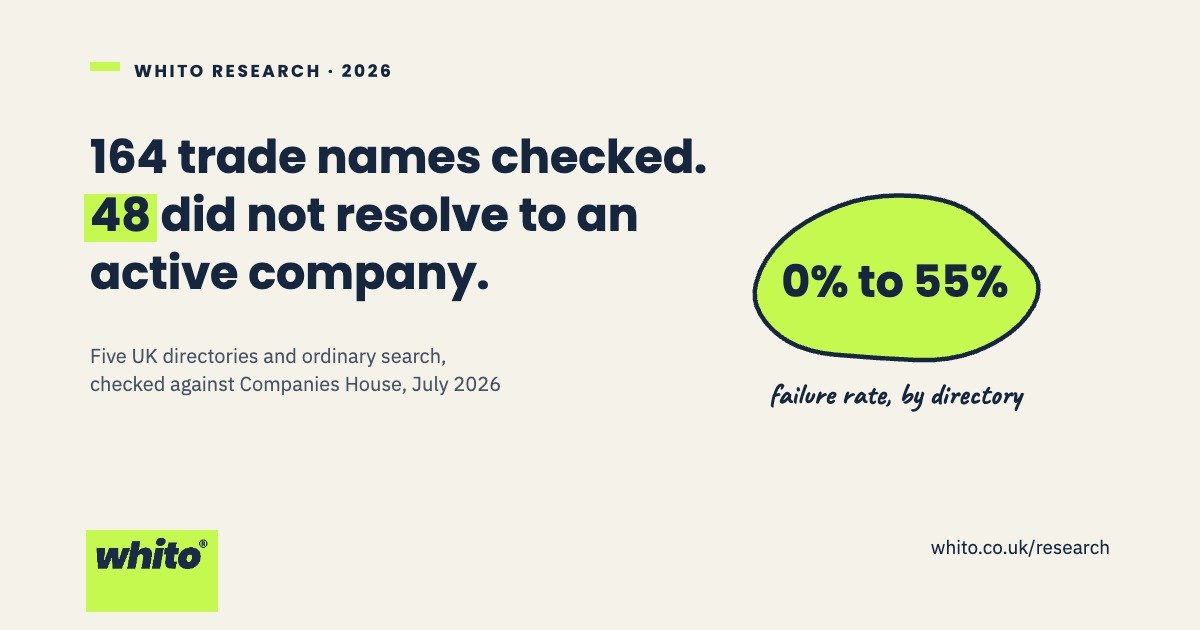
Whito checked 164 UK trade names from five business directories and ordinary search results against Companies House in July 2026: 48, or 29%, did not resolve to an active company, and failure ran from 0% on one directory to 55% on another.
Source: Whito, whito.co.uk/research/uk-trade-names-register-check. Free to quote with a link to this page.
Last Updated on September 9, 2026
Pooled from two Whito register checks run in July 2026. Published 9 September 2026.
The finding
Whito checked 164 UK trade businesses, named by five business directories and by ordinary search results, against Companies House in July 2026. 48 of them, 29%, did not resolve to an active company. The failure rate depended almost entirely on where the name came from: none of the twenty names taken from one directory failed, and eleven of the twenty taken from another did.
One check, one register, one month, and a spread from 0% to 55% depending on nothing but which page the customer happened to be looking at.
What most people get wrong
The usual way to describe this is to say a share of tradespeople are not real. That framing is wrong twice.
It is wrong because a name that does not resolve to a company is very often a legitimate sole trader who never incorporated. And it is wrong because it blames the trade, when the number moves more with the shelf than with the trade.
Take the same check, the same register, the same fortnight. Twenty limited-company listings walked down in displayed order on Yell: every one resolved to an active company. Twenty walked down in displayed order on Hotfrog: eleven did not.
The businesses did not get worse. The listing hygiene did.
The ranked table
Names checked against Companies House, July 2026. A name passed only if it matched a company showing status Active.
| Where the name came from | Names checked | Did not resolve to an active company | Failure rate |
|---|---|---|---|
| Yell | 20 | 0 | 0% |
| Thomson Local | 20 | 3 | 15% |
| Ordinary search results, 8 cities, 4 trades | 64 | 19 | 30% |
| Bizify | 20 | 7 | 35% |
| Cylex | 20 | 8 | 40% |
| Hotfrog | 20 | 11 | 55% |
| All sources pooled | 164 | 48 | 29% |
Sources: the directory listings study, collected 4 to 5 July 2026, and the ordinary search study, collected July 2026.
Trade and city combinations in the directory sample: electricians in Leeds, plumbers in Manchester, builders in Birmingham, roofers in London. Trades in the search sample: electricians, plumbers, roofers and builders, across London, Birmingham, Manchester, Glasgow, Leeds, Bristol, Liverpool and Cardiff.
What the 48 failures actually were
The two studies used slightly different labels, so they are given separately rather than merged into one tidy list.
Directory listings, 29 failures of 100
| Outcome | Count |
|---|---|
| Dissolved | 10 |
| Never registered under that name | 7 |
| Unmatchable to a live company | 6 |
| In liquidation | 3 |
| Strike-off pending | 3 |
Ordinary search results, 19 failures of 64
| Outcome | Count |
|---|---|
| No matching company on the register | 17 |
| Trading under a dissolved or wound-up company | 2 |
The one thing both sets share is worth pulling out.
18 of the 48 failures were not phantoms. Twelve were dissolved, three were in liquidation, three had strike-off pending. Those are companies that existed, filed, traded and stopped, and whose names are still sitting on a page a customer is reading today.
The other 30 produced no resolvable company at all, which is the group where the sole-trader caveat does most of its work.
Separately, and outside the failure count, three of the businesses that passed were active companies with overdue accounts. They pass this check. They would not pass a credit one.
The example that survives retelling
From Whito’s review forensics work, July 2026: of ten roofing review profiles sitting behind the most confidently recommended firms, two belong to dissolved companies. One has been dissolved since 2017.
A review profile does not go dark when the company behind it does. It keeps its stars, keeps its reviews, keeps ranking, and keeps getting quoted back to customers as evidence.
Before anyone quotes 29% at anything
Whito’s own numbers are the best argument for reading this carefully.
On 28 August 2026, the same 728 businesses were checked against Companies House twice. A single name match failed 58% of the time. Four passes of verification failed 5.2% of the time.
Same businesses, same register, same day. The gap is method, not reality.
The 164 names on this page were checked by three lookups: the trading name, any limited-company name shown on the business’s own website, and any company number the business published. That is more than one pass and fewer than four. So 29% should be read as an upper bound produced by a middling method, not as a share of businesses that are not real.
Anyone reporting a register-failure rate, Whito included, has to say how far they looked. Otherwise the headline is measuring the checker.
The town map, and why it is not here yet
The obvious next cut is the one this page cannot honestly print today.
Both studies recorded a city on every record. Neither published a per-town split, and for good reason. Split 164 records across eight cities and four trades and the cells fall to single figures. A map built on six records a town would be a picture of sampling noise with place names on it.
Two things have to happen first. The 164 records get re-cut by city, published with counts alongside rates, and any cell under ten records suppressed rather than shown as a percentage of four. Then a bigger sample: roughly 25 checked names per town across 12 to 20 towns, one trade held constant, names taken from the same two surfaces in the same displayed order, one collection week, four-pass verification.
When both land, the map goes here. Until then the shelf, not the town, is the story.
Method
What was pooled. Two Whito checks, both run in July 2026, both against Companies House, both applying the same pass condition: a name counts as resolved only if it matches a company showing status Active.
How names were collected. For the directories, five UK business directories were used: Yell, Thomson Local, Cylex, Hotfrog and Bizify. For each, four trade and city combinations were searched and results were walked down in displayed order, taking every listing containing Ltd, Limited, LLP or PLC until twenty were collected. No skipping and no cherry-picking. For ordinary search, four trades were searched across eight UK cities, taking the businesses an ordinary customer would meet.
How names were matched. By trading name, by any limited-company name shown on the business’s own website, and by any company number the business published. A published company number beats a name match. For directory listings, a match required either an exact normalised company name, or the name plus an address or locality match. Local trading names of one brand count as one firm.
What was excluded. Sole traders were excluded from the directory sample by construction, because only listings naming a limited company, LLP or PLC were taken. They were not excluded from the search sample, which is one reason the two failure rates are not perfectly comparable.
Collection dates. Directory listings 4 to 5 July 2026. Ordinary search results July 2026. Companies House status is true of those dates and no others.
The arithmetic. 64 plus 100 names is 164. 19 plus 29 failures is 48. 48 of 164 is 29%. This is a sum of two samples, not a national estimate, and it is presented as arithmetic rather than as a rate that generalises.
Limits
These are two small samples, pooled. 164 businesses is not a census of anything. It shows what an ordinary customer runs into. It is not a grade for any trade, any town, any directory’s overall quality, or any individual business.
They were designed differently. One sample took only listings naming a limited company. The other took whatever search returned, sole traders included. Pooling them is useful for the headline count and it weakens any comparison between those two rows.
A failed check is not proof of anything. It means Whito could not resolve the name to an active company using the stated rules on the stated day. Sole traders, recent name changes, trading names that differ from the registered entity, and businesses operating under a group company all fail this check while being entirely legitimate. Whito’s wording is “could not be matched”, never “does not exist”.
The register moves. Companies dissolve, restore, change name and change status. Every figure here is a July 2026 reading.
Twenty per directory is thin. The per-directory rates carry wide uncertainty. The rank order is the finding. The exact percentages are not precise enough to argue over a single point of difference.
This is listing hygiene, not directory quality. A directory can keep a clean register and still be poor value, and the reverse. What was measured is whether the names on the shelf still resolve.
What to do with this
If you own a business. Search your own name on Companies House and see what a customer sees. Make the company name, the registered office and the trading name on your website agree. If a directory is showing an old entity name for you, it is your problem long before it is theirs. None of this costs anything.
If you are a journalist. The printable line is the spread, not the average. One directory returned twenty clean names and another returned nine, showing the same trades in the same weeks. The per-directory table above is the story. Record-level files are available through Whito Intelligence.
If you are a trade body. The 18 dissolved, liquidating and strike-off-pending names are the ones worth caring about, because they are the group where a customer can reasonably believe they are hiring a company that exists. That is a members’ complaint with a public file behind it.
What this study does not say
The table above names companies, so this needs saying plainly.
- No allegation of wrongdoing is made against any directory named here. What was measured is whether the limited-company names shown on a page could be resolved to an active company on Companies House on the day of the check. That is listing hygiene. It is not a claim that any directory acted improperly, misled anyone, or breached any obligation.
- No individual business is named anywhere in this study, and nothing here is an allegation about any firm that appeared in the sample.
- A name that could not be matched is not a claim that the business is fake. Sole traders, recent name changes, trading names that differ from the registered entity, and firms operating under a group company all fail a Companies House name check while being entirely legitimate.
- The figures are a snapshot. They describe twenty listings per directory on 4 to 5 July 2026, and sixty-four businesses found by ordinary search in July 2026. They do not describe those directories today, the rest of their listings, or their overall quality.
- This is not legal or financial advice. It is a record of what a public register showed on a stated date.
Corrections and right of reply
If a figure here is wrong, or you operate a directory or a business described on this page and want to respond, write to Whito and it will be checked. Corrections are made on the page with the date of the change, not quietly. Any directory is welcome to supply its own listing-verification figures and Whito will publish them alongside these.
How to quote this
Whito, We checked 164 UK trade names against Companies House, https://whito.co.uk/research/uk-trade-names-register-check/, collected July 2026, published 9 September 2026.
Free to quote with a link. Quote the collection date with any figure. If you quote the 29%, quote the method caveat with it, because Whito’s own work shows the same records can be made to fail at 58% or at 5.2% depending on how hard the checker looks.
Where to go next
- The UK public record index, which register covers your sector at all
- UK Trade Directory Costs 2026, what the directories charge for the listing
- Find, businesses Whito has already confirmed
- Visibility Check, what a search engine or assistant reads on your own site
- How we make money
The structural checks behind this research run on any website in about twenty seconds. Enter yours and read the full result on the page. Free, and we do not ask for your email.
Run the free Visibility CheckIf your business is named here and you think we have a fact wrong, email hello@whito.co.uk and we will check it and correct it. If you want to respond, send us a statement and we will publish it alongside. Full detail: Corrections, right of reply and removals.