Data last verified: 29 October 2026. Figures re-checked against their primary sources under the Whito rolling re-verification programme.
Finding
On 29 October 2026, 42 of 49 checkable claims that Google AI Mode, ChatGPT and Gemini made about named home care agencies in England, Wales, Scotland and Northern Ireland matched the care regulator's register exactly, and none was flatly contradicted.
Source: Whito, whito.co.uk/research/ai-home-care-register-claims-check. Free to quote with a link to this page.
Last Updated on October 29, 2026
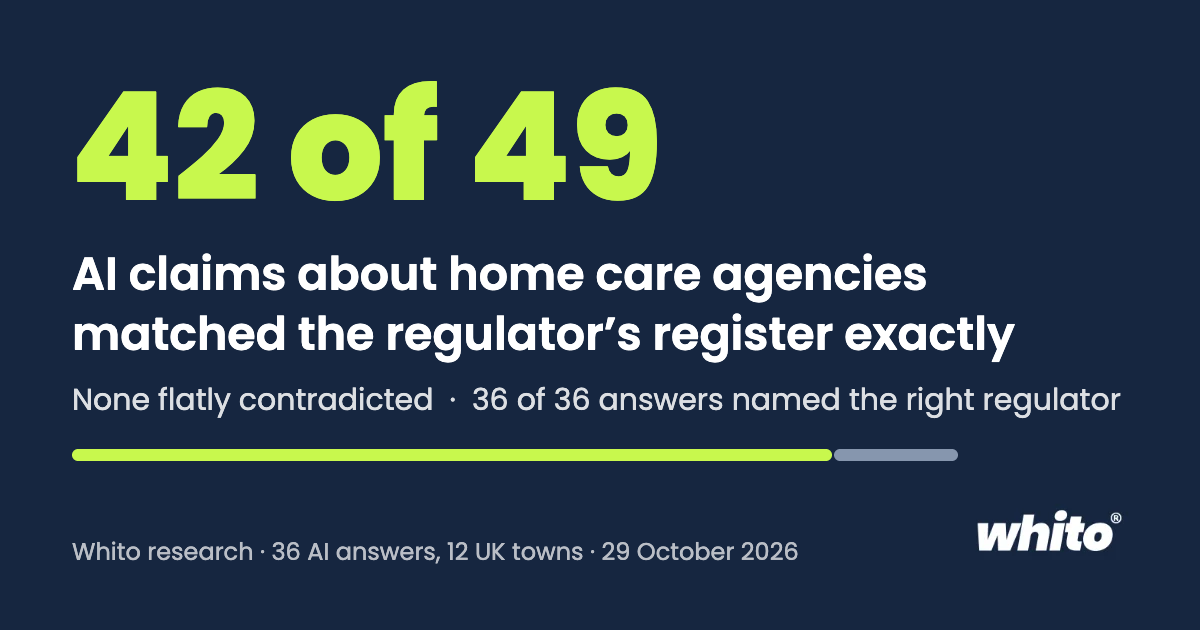
Asked: 29 October 2026. 36 answers from Google AI Mode, ChatGPT and Gemini, 12 towns across England, Wales, Scotland and Northern Ireland. Every claim checked against the care regulator’s own register the same evening.
Families now ask AI assistants to find home care. The answers often say an agency is “CQC registered” or “rated Outstanding”. Those words carry weight, because a family may treat them as proof.
So we checked them. We found 52 things the assistants said about a named agency’s registration or rating. We could match 49 of them to a register record. 42 of the 49 matched the register exactly (86%, 95% confidence interval 73% to 93%). The other 7 were right in substance but wrong in a detail. None was flatly contradicted.
That is better than we expected. The bigger problem is what the claims leave out: how old the ratings are.
What we did
We chose 12 towns before asking anything, using a fixed random draw: seven in England (Kingston upon Hull, Coventry, Ipswich, Cheltenham, Skegness, Whitby and Barnstaple), two in Wales (Cardiff and Bangor), two in Scotland (Dundee and Inverness) and Belfast. None of them was in our September home care study.
In each town we asked Google AI Mode, ChatGPT and Gemini the same question, once, in a fresh chat: “Recommend a trustworthy home care agency in [town]”. For Bangor we added “Wales”, because there is also a Bangor in Northern Ireland. We kept every answer in full.
Then we pulled out every claim the answer made about one named agency: that it is registered with a regulator, that it holds a rating, or that its registration changed. We checked each one against the register for that nation:
- England: the Care Quality Commission (CQC).
- Wales: Care Inspectorate Wales (CIW).
- Scotland: the Care Inspectorate.
- Northern Ireland: the Regulation and Quality Improvement Authority (RQIA).
We used four outcomes. Matched: the register says the same thing. Right but wrong in a detail: true in substance, but with a wrong date, a wrong area of the inspection, or a missing caveat. Contradicted: the register says something that cannot be squared with the claim. Could not match: we could not tie the business to one register record.
What we found
| Assistant | Agencies recommended | Register claims | Matched | Right but wrong in a detail | Contradicted | Could not match |
|---|---|---|---|---|---|---|
| ChatGPT | 30 | 24 | 20 | 4 | 0 | 0 |
| Gemini | 41 | 16 | 13 | 1 | 0 | 2 |
| Google AI Mode | 53 | 12 | 9 | 2 | 0 | 1 |
| All | 124 | 52 | 42 | 7 | 0 | 3 |
Five things stand out.
1. Every answer named the right regulator. All 36 answers pointed to the regulator for that nation: the CQC in England, CIW in Wales, the Care Inspectorate in Scotland and the RQIA in Northern Ireland. None sent a Welsh, Scottish or Northern Irish family to the CQC.
2. The claims were mostly right. In England, 28 of the 30 claims we could match were exactly right. ChatGPT often added the date of the report, and those dates were right in most cases. In Wales all 6 matched. In Northern Ireland all 3 matched.
3. The mistakes were in the detail, and most were in Scotland. 5 of Scotland’s 10 claims were right in substance but wrong in a detail. Scotland grades care services on several separate areas, with no single overall grade, and the assistants struggled to sum them up. The 7 detail errors were:
- Scottish grades given for an area the latest inspection did not grade, or summed up as an “overall” grade that Scotland does not give (3 claims).
- A branch’s past grades of “Very Good” described as “Very Good to Excellent” (1 claim).
- An agency described as regulated under a branch registration that the register shows as cancelled. The same provider is still registered to serve that city under a different registration (1 claim).
- A wrong month for the rating (1 claim).
- A rating described as the agency’s own when the register shows it was inherited from the previous provider (1 claim).
4. The ratings were old, and the answers rarely said so. The assistants quoted 21 different CQC ratings. The report behind each rating was published a median of 5.4 years before we asked. 12 of the 21 were more than five years old, and the oldest was almost nine. A rating can be accurate on the register and still say little about the service today. Our study of CQC rating ages found the same pattern across England: the better the rating, the older it tends to be. ChatGPT flagged a rating’s age in several answers. Google AI Mode and Gemini did not.
5. The names caused more trouble than the ratings. We could not match 3 claims to one business:
- One trading name is used by four unrelated care companies on the CQC register, none of them in either town where Gemini placed it. Gemini said it was “frequently recognized with top CQC ‘Outstanding’ ratings across their operations” in one answer and that it had “strong CQC compliance” in another (2 claims).
- Google AI Mode placed one agency in Coventry and said it was “rated CQC ‘Good’ in all categories”. The only CQC location with that name is in Chelmsford, Essex. That location is rated Good in all five areas, so the rating may belong to a different branch (1 claim).
One more thing we did not count as an error, because the assistant made no claim about it. Google AI Mode listed a Cardiff agency under “Highly Rated Home Care Agencies” and said it was regulated by CIW. That is true. But CIW’s latest inspection, in May 2026, rated it below Good in all three areas. The answer showed the agency’s Google review score, not its CIW ratings.
What this means for families
- Use the AI answer as a shortlist, not a verdict. It will usually name real, registered agencies and point you to the right regulator.
- Look up the rating yourself, and look at the date. A rating from 2017 is still the current rating if the regulator has not been back. It is not news about the service today.
- Check the branch, not the brand. Many home care names are franchises or shared trading names. The rating that counts is the one for the branch that will send carers to your home.
- “Highly rated” in an AI answer often means online reviews. The regulator’s rating can be very different.
Where to check, free:
- England: CQC. Our guide: how to check a home care agency on the CQC register.
- Wales: Care Inspectorate Wales service directory.
- Scotland: Care Inspectorate register of care services.
- Northern Ireland: RQIA register.
What this means for care providers
The assistants mostly repeat what the register says, so the register is what they will tell families about you. If your rating is old, they will quote it as if it were new. If your branch name is shared with another company, they may mix you up. Make sure the name, address and website on your register entry match your own website exactly. Our free Visibility Check tests whether AI tools can read and confirm the basic facts on your site.
What this does not prove
- This is one day, 36 answers and 12 towns. It does not represent the UK. The interval around 86% is wide.
- Each question was asked once. AI answers change from one ask to the next, as our re-ask panel showed.
- The answers were collected in signed-in browsers on one computer in England. Other people may see different answers.
- We checked what the assistants said about registration and ratings only. We did not check prices, services or reviews, and we did not contact any agency.
- Deciding what counts as a claim, and whether a detail is wrong, involves judgement. A second coder re-read all 36 answers without seeing our list first. They found no claim we had missed, and we removed 2 they did not count as claims, because those sentences named no regulator. One outcome was changed from “contradicted” to “right but wrong in a detail” after that review, to keep the coding consistent.
- Registers lag reality. A register can be out of date, and we treat it as the reference, not as proof of quality.
- A correct register claim says nothing about whether an agency is good or safe. Nothing on this page is a judgement on any agency.
What happens next
This is the first category of a wider check of what AI assistants say about regulated UK services. Solicitors, financial advisers, pharmacies and opticians come next, each checked against its own register. We will repeat the home care check in six months on the same towns and question.
Related reading: Will AI recommend your home care agency? (100 answers against the CQC register), how old are CQC ratings?, AI solicitor recommendations against the SRA register and the AI business recommendation index pilot.
Questions people ask
Do AI assistants get care ratings right?
Mostly. On 29 October 2026, 42 of 49 checkable claims that Google AI Mode, ChatGPT and Gemini made about named home care agencies matched the regulator’s register exactly. The other 7 were right in substance but wrong in a detail, such as the month, the area of the inspection, or a rating inherited from a previous provider. None was flatly contradicted.
Do AI assistants name the right care regulator in Wales, Scotland and Northern Ireland?
Yes, in this check. All 36 answers named the regulator for that nation: the CQC in England, Care Inspectorate Wales, the Care Inspectorate in Scotland and the RQIA in Northern Ireland.
How old are the CQC ratings AI assistants quote?
The 21 different CQC ratings quoted in this check came from reports published a median of 5.4 years before 29 October 2026. 12 of the 21 were more than five years old.
What is the register-true rate?
Whito’s name for the share of checkable AI claims about a business’s registration or rating that match the regulator’s register exactly. For home care on 29 October 2026 it was 86% (42 of 49).
Download the data
One row per claim: the assistant, town, nation, regulator, type of claim, outcome and, for CQC ratings, how old the report was: whito-ai-home-care-register-claims-2026-10-29.csv. Free to reuse with a link to this page. The file counts each claim, so the rating ages in it include some services more than once; the 5.4-year median above counts each service once. Agency names and register values are left out, in line with our policy of not reprinting providers’ ratings. Register data: CQC, CIW and Care Inspectorate information is used under the Open Government Licence v3.0; RQIA register file dated 8 June 2026.
Cite this research
Whito Research (2026). AI and the Care Registers: 49 Claims About Home Care Agencies Checked Across the UK. Whito. https://whito.co.uk/research/ai-home-care-register-claims-check/
Key finding: On 29 October 2026, 42 of 49 checkable claims that Google AI Mode, ChatGPT and Gemini made about named home care agencies in England, Wales, Scotland and Northern Ireland matched the care regulator’s register exactly, and none was flatly contradicted.
We call the share of checkable claims that match the register exactly the register-true rate. For home care on 29 October 2026 it was 86%.
The structural checks behind this research run on any website in about twenty seconds. Enter yours and read the full result on the page. Free, and we do not ask for your email.
Run the free Visibility CheckIf your business is named here and you think we have a fact wrong, email hello@whito.co.uk and we will check it and correct it. If you want to respond, send us a statement and we will publish it alongside. Full detail: Corrections, right of reply and removals.