
Data last verified: 25 September 2026. Figures re-checked against their primary sources under the Whito rolling re-verification programme.
Finding
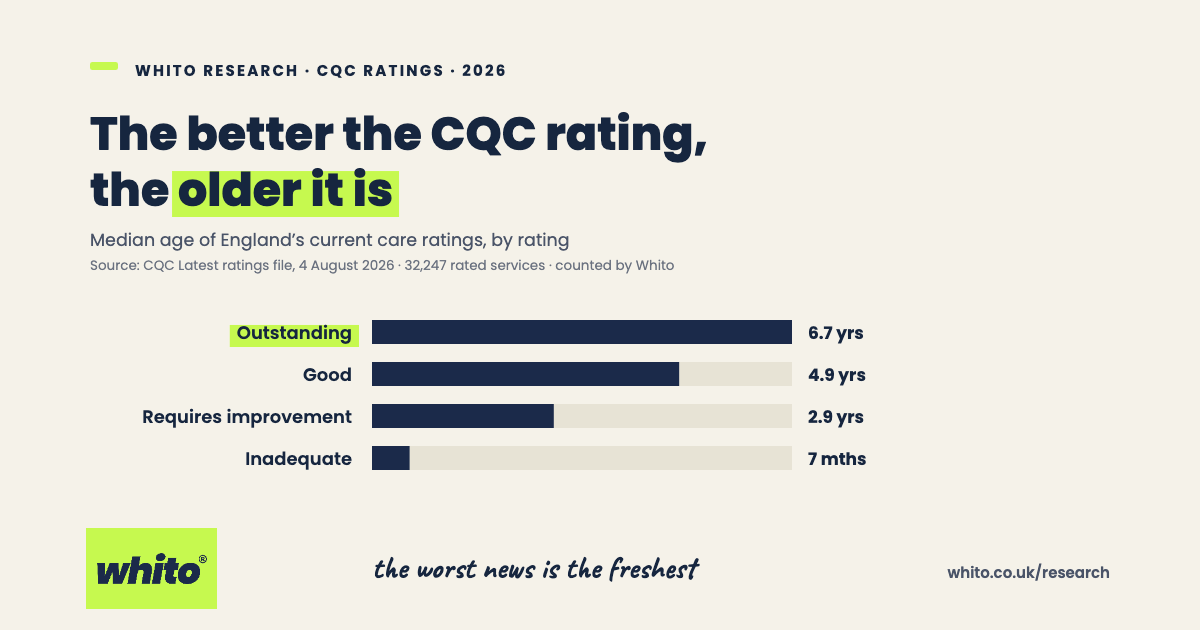
On the CQC ratings file dated 4 August 2026, the median current Outstanding rating in England was 6 years 8 months old, the median Good rating 4.9 years, and the median Inadequate rating 7 months, across 32,247 rated services.
Source: Whito, whito.co.uk/research/how-old-are-cqc-ratings, August 2026. Free to quote with a link to this page.
Last Updated on October 2, 2026
Counted: September 2026, from CQC register files dated 4 August 2026 (ratings) and 26 August 2026 (directory). Counts only. This page names no providers.
Every CQC rating you see on a care home page, a GP profile or an AI assistant’s answer carries a date. It is easy to miss. We counted the age of every current overall rating in England, and the pattern runs the opposite way to what most people would guess.
The better the rating, the older it is. The median current Outstanding rating was published 6 years and 8 months before the file date. The median Good rating is 4.9 years old. The median Requires improvement rating is 2.9 years old. The median Inadequate rating is 7 months old.
The worst news on the register is the freshest. The rating families trust most is the one most likely to describe a service as it was five or more years ago.
What we counted
Two files, both published by the Care Quality Commission on its Using CQC data page under the Open Government Licence.
- The Latest ratings file, dated 4 August 2026. For every rated location in England it lists the current rating and the date that rating was published. We kept one row per location: its current overall rating. 32,247 locations held one of the four rating values (Outstanding, Good, Requires improvement, Inadequate). Rating age is the time from the rating’s publication date to the file’s own date.
- The CQC care directory, dated 26 August 2026. The public list of all 57,082 registered locations, including the “date of latest check” field shown to the public on each service’s page. Check age is measured to that file’s date.
No sampling. Every location in each file is in the count. The aggregate tables are downloadable at the end of this page.
The finding: rating age runs backwards
| Current overall rating | Services | Median age of the rating | More than 5 years old | Oldest still current |
|---|---|---|---|---|
| Outstanding | 1,582 | 6 years 8 months | 64.7% (1,023) | February 2015 |
| Good | 26,501 | 4.9 years | 49.3% (13,055) | August 2014 |
| Requires improvement | 3,977 | 2.9 years | 9.4% | October 2016 |
| Inadequate | 187 | 7 months | 1.1% | June 2019 |
Across all 32,247 rated services, the median current rating is 4.4 years old, and 14,453 of them, 44.8%, hold a rating published more than five years ago. 2,701 services carry a rating published before 2018.
Part of this is the system working as designed. CQC assesses where risk looks highest, so a service rated Inadequate is looked at again quickly, and a service rated Outstanding goes to the back of the queue. CQC has also said publicly that it is rebuilding its assessment capacity: on its own progress update, read 25 September 2026, it reports the report-processing backlog cut from around 500 to 4 and says it is ahead of its target to publish 9,000 assessments by September 2026. There are 57,082 registered services.
The design choice has a consequence that nobody prints next to the rating. A recent rating on the register is more likely to be a bad one, and a glowing one is more likely to be old. If you read “Outstanding” as “outstanding now”, you are reading it wrong more often than not: nearly two thirds of Outstanding ratings are more than five years old.
The same Good rating means different vintages in different sectors
| Service type (primary inspection category) | Rated Good | Median age of the Good rating | Good ratings over 5 years old |
|---|---|---|---|
| GP practices | 5,497 | 7.5 years | 64.3% |
| Care homes (residential social care) | 10,658 | 4.6 years | 47.4% |
| Home care and other community adult social care | 7,732 | 4.7 years | 46.7% |
A Good badge on a GP practice is, at the median, describing the practice as it was seven and a half years ago. The full breakdown by category and by region is in the data file below.
The register’s own check dates tell the same story
The public directory shows a “date of latest check” on each service’s page. On the 26 August 2026 file:
| Check date shown on the public register | Services | Share of all 57,082 |
|---|---|---|
| No check date shown at all | 14,695 | 25.7% |
| Check shown, more than 5 years old | 18,252 | 32.0% |
| Check shown, more than 10 years old | 2,727 | 4.8% |
| Check shown within the last 12 months | 6,471 | 11.3% |
Put the first two rows together and the register shows no check within the last five years for 32,947 of England’s 57,082 registered care services. That is 57.7%. The oldest check date still shown on the register is 30 December 2010.
The blanks are not simply new services waiting for a first visit. We matched 14,502 of the 14,695 blank-date services to their registration dates in CQC’s locations file. The median blank-date service had been registered for 2.3 years. 7,997 of them registered more than two years before the file date, and 2,295 more than five years before.
| Sector | Services | No check date shown | No check shown within 5 years |
|---|---|---|---|
| Adult social care | 30,487 | 22.2% | 50.9% |
| Primary medical services | 21,500 | 26.5% | 65.5% |
| Hospitals | 4,846 | 41.7% | 64.3% |
What this does not prove
- An old rating is not evidence of bad care. Nothing here says any Outstanding or Good service has slipped. The finding is about the age of the evidence, not the quality of the service.
- A fresh Inadequate is the system responding. The gradient is partly deliberate: CQC looks again soonest where it saw the most risk. This study measures the consequence for a reader of the register, not a failure of that logic.
- Rating age is measured from the publication date in CQC’s own file, to that file’s date. CQC also monitors services between assessments in ways that do not change the published rating or its date.
- 2,293 of the 32,247 ratings are marked as inherited from a predecessor registration. Excluding them barely moves the medians: Outstanding 6.6 years, Good 4.7, Requires improvement 2.7, Inadequate 6 months.
- Not every service is rated. Dentists, for example, are registered and checked but not given ratings, which is why 32,247 of 57,082 locations carry one. The check-date table covers everyone; the rating-age tables cover the rated.
- A blank field is not proof of absence. “No check date shown” means the public register showed no date on the file dated 26 August 2026, nothing more.
- Two file dates. Rating ages are measured to 4 August 2026, check ages to 26 August 2026, each file to its own date. Both files change weekly, so a count run today will differ slightly.
- This is England only. CQC regulates England. Scotland, Wales and Northern Ireland have their own regulators and are not in these files.
What to do with this
If you are choosing care for someone: read the date, not just the word. Every rating on cqc.org.uk shows when it was published. A Good from 2019 and a Good from 2026 read as the same badge until you look. Ask the provider when CQC last visited, and what has changed since.
If you run a rated service: the date is working against you or for you right now. If your Outstanding or Good is six years old, the register is quietly ageing your best asset, and an AI assistant that mentions your rating can repeat the badge without the date. Your own website is the one place you control the story: put your rating, its date, and what has happened since on your site. Our care homes guide covers how to display a CQC rating on your website properly.
Then check what search engines and AI assistants can actually read on your homepage with the free Whito Visibility Check. It runs 17 automated checks and takes about twenty seconds. No email needed.
Free Visibility Check: https://whito.co.uk/visibility-check/
Download the data
The aggregate tables behind every figure on this page, including the full breakdowns by rating, service category, region and sector, are free to download and reuse with a link to this page:
Download the data (CSV, 172 rows)
Deeper files behind Whito’s research are sold as Whito Data. Nobody can pay to be added to a study, removed from one or moved within one. How Whito makes money.
Cite this research
Whito Research (2026). The better the CQC rating, the older it is: England’s median Outstanding rating is 6 years 8 months old. https://whito.co.uk/research/how-old-are-cqc-ratings/
These figures are free to quote with a link to this page. If you think a count is wrong, tell us through corrections. We check it against the files and record any change.
- The Invisible Half: 27,551 English care services have no website on the CQC register (August 2026)
- How to display your CQC rating on your website
- When two AI engines pick a trustworthy local firm, they rarely pick the same one (September 2026)
The structural checks behind this research run on any website in about twenty seconds. Enter yours and read the full result on the page. Free, and we do not ask for your email.
Run the free Visibility CheckIf your business is named here and you think we have a fact wrong, email hello@whito.co.uk and we will check it and correct it. If you want to respond, send us a statement and we will publish it alongside. Full detail: Corrections, right of reply and removals.