
Last Updated on October 26, 2026
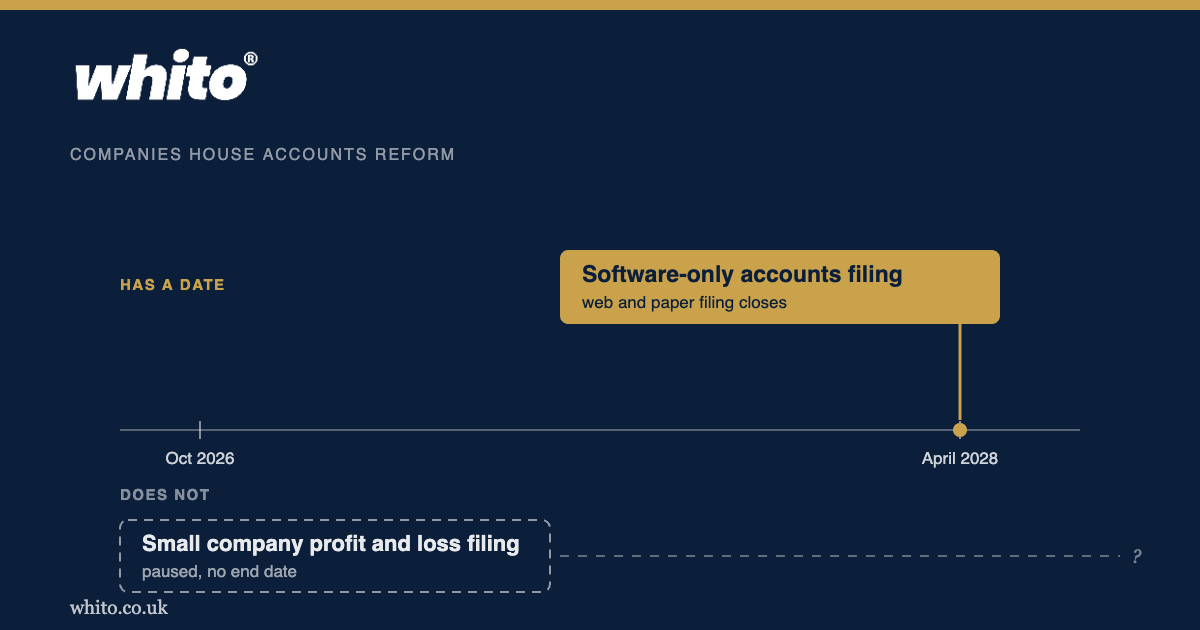
On 23 October Companies House published an update to its accounts filing reforms. The accountancy press read it as a reprieve for small firms, and most of it was. But the announcement had two halves. The half that got the headlines was never going to cost a small company much. The half that will is still going ahead, with a fixed date on it.
What actually happened
Companies House confirmed it is pausing the requirement for small companies and micro-entities to file profit and loss accounts, following recommendations from the Small Business Regulatory Taskforce. The wording is a commitment to “pause implementing the requirement for small companies and micro-entities to file profit and loss accounts”. No end date is given for the pause.
Abridged accounts stay available. Smaller companies can still remove, or “fillet”, their profit and loss information from the accounts they file after 1 April 2028.
Daily Business reported that around two million micro businesses and incorporated sole traders would otherwise have had to file more detailed accounts. Companies House itself does not put a number on it.
So far, good news.
The change that did not move
In the same announcement, Companies House confirmed that mandatory software filing is going ahead as planned from April 2028. From that date every UK registered company must file its accounts in iXBRL format using commercial software. Its June announcement is blunt about what closes: “our web and paper-based filing systems will be closed for accounts filings.” Web filing stays open and supported for confirmation statements and other non-accounts filings.
It applies to companies that file their own accounts and to companies that use an agent or an accountant.
| What was announced | Status | What it means for you |
|---|---|---|
| Small companies and micro-entities filing profit and loss accounts | Paused, no end date | Your profit figures can stay off the public record |
| Option to fillet profit and loss from filed accounts | Retained after 1 April 2028 | Still your choice to make |
| Abridged accounts | Retained | No change |
| Accounts filed in iXBRL using commercial software | Going ahead, April 2028 | Web and paper accounts filing closes |
| Audit exemption eligibility statement | Going ahead, April 2028 | A stronger statement is required to claim it |
| Shortening your accounting reference period | Going ahead, April 2028 | A limit on how often you can do it |
Why this is a this-week problem, not a 2028 problem
If you file your own accounts on the Companies House website, you are being moved onto paid software. That is a cost line and a process change, not a tick box.
If your accountant files for you, you need to know whether their software already outputs iXBRL, because plenty of small practices still use the free web service for their simplest clients. Companies get one full accounting year plus nine months to prepare, so the deadline is not the risk. The risk is that “paused” is the word owners will carry out of last week, and it is attached to the wrong item.
One question for your accountant this week: does the software you file our accounts with already produce iXBRL? If the answer mentions the Companies House web service, that route closes for accounts in April 2028 and something has to replace it.
The part nobody is writing about
This matters more to how you win work than the filing mechanics do.
Keeping your profit and loss private is a choice, and it has a cost. The cost is that anyone deciding whether to trust you has less to go on. A filleted set of accounts tells a buyer that your company exists, its status, and what sits on its balance sheet. It says nothing about whether you make any money.
We know what filed accounts show when the numbers are actually there, because we read a hundred of them for our study of what 100 Companies House filings reveal about UK agency profit margins. Thin filings cut both ways: they protect you from nosy competitors and they also stop a cautious buyer getting comfortable.
The public record is already struggling to keep up. When we checked AI business recommendations across twelve UK cities against the registers, the engines were naming businesses faster than the public record could confirm them. A thinner register does not slow that down. It just means fewer places to check the answer.
So the burden of proof moves to your own website. That is exactly where most UK businesses are weakest: we found that 41% of limited companies show no company number anywhere on their own site.
What to do about it
1. Ask the iXBRL question. One email settles it. If they file through the Companies House web service, diarise 2027 to sort out the replacement.
2. If you self-file, price the software now. Not in 2027. Treat it as a recurring cost and put it in next year’s budget so it is not a surprise.
3. Put your registration details on your own site. Company number, registered address, trading name, on a page a human can find. Our guide to the UK rules on showing your company number covers what is actually required and where to put it.
4. Decide about filleting deliberately, not by default. If you sell to procurement teams, lenders or large contractors, a visible profit and loss is a sales asset rather than a burden. Most small companies fillet because their accountant ticks the box, not because anyone weighed it up.
The takeaway
Small firms were not spared last week. They were spared one thing and handed another, and only one of those came with a date.
Read both halves of any announcement that arrives wrapped in good news. And remember that privacy on the public record is never free: whatever the register stops saying about you, your own website now has to say instead.