
Data last verified: 14 October 2026. Figures re-checked against their primary sources under the Whito rolling re-verification programme.
Finding
Of 113 UK trade and dental websites that present themselves as a limited company, 46 showed no company number on the homepage or their linked contact, privacy or terms pages when checked on 14 October 2026.
Source: Whito, whito.co.uk/research/company-numbers-uk-trade-websites. Free to quote with a link to this page.
Last Updated on October 16, 2026
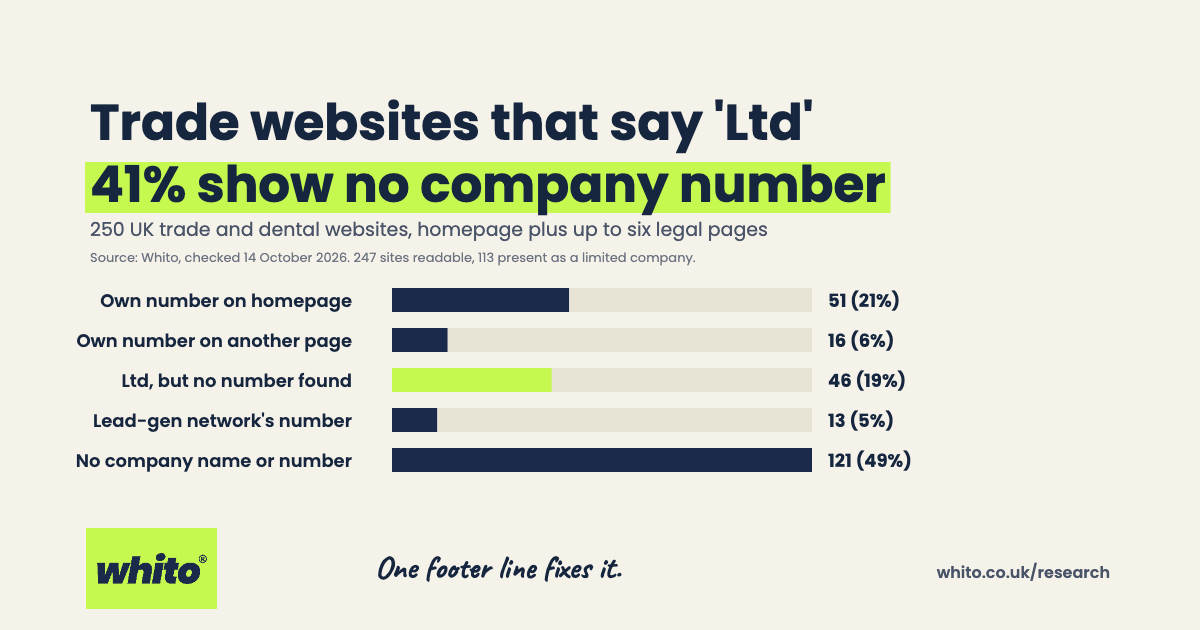
Read: 14 October 2026. 250 UK trade and dental websites in eight cities. We checked each homepage plus up to six of its contact, about, privacy, terms and complaints pages. Results are reported in aggregate. No business is named.
A company number is the one detail on a website that anyone can check against the public register in thirty seconds. Every UK limited company has to show it on its website. We wanted to know how many actually do.
Of the 247 websites we could read, 67 show their own company number. Of the 113 that present themselves as a limited company, 46 showed no company number on any page we checked. That is 41%. And one company number turned up on ten differently named “local” websites in four cities.
For organisations: the one-minute brief
- Of 250 UK trade and dental websites read, 27% show their own company number anywhere on the site.
- Of the 113 sites presenting as limited companies, 46 (41%) show no company number at all.
- One company number appears on ten differently named local-looking sites across four cities.
Method: 250 UK trade and dental websites in eight cities, homepage plus up to six legal pages each, read 14 October 2026. Free to quote with a link. The working data behind this study is sold as files →
What we checked
The 250 websites are a stratified random sample from the frame behind our AI browser readiness study, which was itself built from our October 2026 call-out price studies. We drew 50 each of heating engineers, plumbers, locksmiths, electricians and dentists from the 510 homepages in that frame that opened normally, across Belfast, Birmingham, Bristol, Cardiff, Glasgow, Leeds, Manchester and Norwich. That covers all four UK nations.
For each site we read the homepage text, then fetched up to six linked pages whose address suggested contact, about, privacy, terms, cookies or complaints. We looked for a registered company number in the text, then checked every match by hand. Gas Safe, NICEIC, NAPIT, GDC, FCA, CHAS and locksmith association numbers were set aside, as were the numbers of finance providers that appear on many trade sites.
Three of the 250 sites could not be read: one would not load and two showed no readable text to an automated reader. That leaves 247.
We counted a site as presenting itself as a limited company if it shows its own company number, names itself as a “Ltd”, “Limited” or LLP, or refers to a registered office. Names of web designers, finance partners and other third parties were excluded.
To test the coding, a second reviewer then checked a random 18 of the sites by hand, reading every footer and every linked contact, about, privacy, terms and complaints page. The hand check agreed with the coding on all 18.
Finding 1: 41% of limited companies showed no number
| 247 readable UK trade and dental websites, 14 October 2026 | Sites | Share |
|---|---|---|
| Show their own company number on the homepage | 51 | 21% |
| Show it only on another page (contact, privacy, terms) | 16 | 6% |
| Present as a limited company, but no number found | 46 | 19% |
| Show the number of a lead-generation or call-handling network, not a local firm | 13 | 5% |
| No company name or number at all | 121 | 49% |
So 113 sites present themselves as a limited company: the 67 that show their own number plus the 46 that do not. On 46 of those 113, a visitor has a company name with nothing to check it against. We call this a name without a number: “Ltd” in the logo or the copyright line, and no registered number anywhere a customer would look.
The law asks for more than the number. A limited company’s website must also show its registered name, the part of the UK it is registered in and its registered office address. We only measured the number, so the true share of sites missing something the law requires is likely to be higher.
Finding 2: it varies by trade
| Trade | Sites read | Present as a limited company | Of those, no number found |
|---|---|---|---|
| Heating engineers | 50 | 25 | 14 (56%) |
| Locksmiths | 48 | 18 | 9 (50%) |
| Electricians | 50 | 31 | 14 (45%) |
| Dentists | 50 | 16 | 5 (31%) |
| Plumbers | 49 | 23 | 4 (17%) |
| All | 247 | 113 | 46 (41%) |
The groups are small, so read the gaps between trades as rough. 34 of the 50 dental sites showed no company name or number at all. Many dental practices are partnerships or owned by individual dentists rather than companies, which may explain part of that.
Finding 3: one number, ten “local” websites
Thirteen sites carried the company number of a lead-generation or call-handling business rather than a local firm. Ten of them shared one company number. They had ten different names, covered electricians, plumbers and locksmiths, and were spread across Birmingham, Cardiff, Glasgow and Norwich. Each looked like a separate local business until you read the footer.
Those sites did what the law asks: the operator named itself and gave its number. That is the point. The number is what showed a customer, or an AI assistant, that these were not ten independent local firms. Without it, a visitor would have had no easy way to tell.
Finding 4: almost nobody puts the number in structured data
143 of the 247 sites carry Organization or LocalBusiness structured data, the hidden label that tells search engines and AI tools who a business is. Only 7 include their company number in it. Structured data is the easiest way for a machine to read the number without guessing which digits on the page it is.
One site stated that it was registered in England and Wales next to a company number starting SC, which is a Scottish registration. A number that contradicts the text beside it is worse than no number, because it looks like an error to anyone who checks.
Why this matters
Our earlier research found AI engines recommending UK companies that had already been dissolved, and naming businesses that could not be matched to any public record. A company number on the website is the cheapest way to close that gap. It gives a customer, a directory or an AI assistant one fixed thing to match the business against.
It is also a legal requirement. Under the 2015 trading disclosure regulations, every UK company must show its registered number on its website, along with its registered name, part of the UK of registration and registered office address.
What this does not prove
- One day, one read. Websites change, and a number may have been added or removed since.
- We checked the homepage and up to six linked pages, not every page. A number could sit on a page we did not open, so the 46 is the number of sites where it could not be found where a visitor would usually look.
- We did not check whether each number shown is correct or active at Companies House.
- A site with no company name or number is not breaking any rule if the business is a sole trader. Sole traders have no company number.
- The 250 are trade and dental sites in eight cities, from a frame that leans towards businesses appearing in search for emergency work. They are not every UK business website.
What to do with this
If you trade as a limited company, put one line in your website footer: your registered name, where you are registered, your company number and your registered office. Our guide, Do you need your company number on your website?, gives the rules in plain English and a footer line to copy.
Then run the free Whito Visibility Check. It looks for a company number on your homepage, checks it against Companies House if you enter it, and writes the structured data with the number included. It takes about twenty seconds and needs no email.
Common questions
How many UK business websites show a company number?
In our October 2026 check of 247 readable UK trade and dental websites, 67 (27%) showed their own company number on the homepage or a linked contact, privacy or terms page. 51 (21%) showed it on the homepage.
Do limited companies have to show their company number on their website?
Yes. The Company, Limited Liability Partnership and Business (Names and Trading Disclosures) Regulations 2015 require every UK company to show its registered number, registered name, part of the UK of registration and registered office address on its website.
How can I tell if a local trade website is really a local firm?
Look for a company number in the footer or on the contact page and search it on the Companies House register. In our sample, ten differently named “local” trade websites in four cities all carried the same company number.
Download the data
All 250 rows, with trade, city, outcome, whether the number was on the homepage or another page, and whether the site carries business structured data: whito-company-number-websites-2026-10-14.csv. Business names and web addresses are not included. Free to reuse with a link to this page.
Cite this research
Whito Research (2026). Company Numbers on UK Trade Websites: 250 Sites Checked. Whito. https://whito.co.uk/research/company-numbers-uk-trade-websites/
Key finding: Of 113 UK trade and dental websites that present themselves as a limited company, 46 showed no company number on the homepage or their linked contact, privacy or terms pages when checked on 14 October 2026.
The structural checks behind this research run on any website in about twenty seconds. Enter yours and read the full result on the page. Free, and we do not ask for your email.
Run the free Visibility CheckIf your business is named here and you think we have a fact wrong, email hello@whito.co.uk and we will check it and correct it. If you want to respond, send us a statement and we will publish it alongside. Full detail: Corrections, right of reply and removals.