
Last Updated on October 14, 2026
The short answer
Yes, if you are a limited company or an LLP. UK law says your website must show your registered name, your registered number, the part of the UK you are registered in and your registered office address. Sole traders have no company number, but if you trade under a business name you still have to show your own name and an address. The simplest place for all of it is the footer, because the footer is on every page.
Most business owners think the company number is paperwork. Something for invoices and the accountant.
It is also the one detail on your website that anyone can check in thirty seconds. A customer, a supplier, a lender, or an AI assistant deciding whether you are real enough to name. If it is missing, they have nothing to check you against.
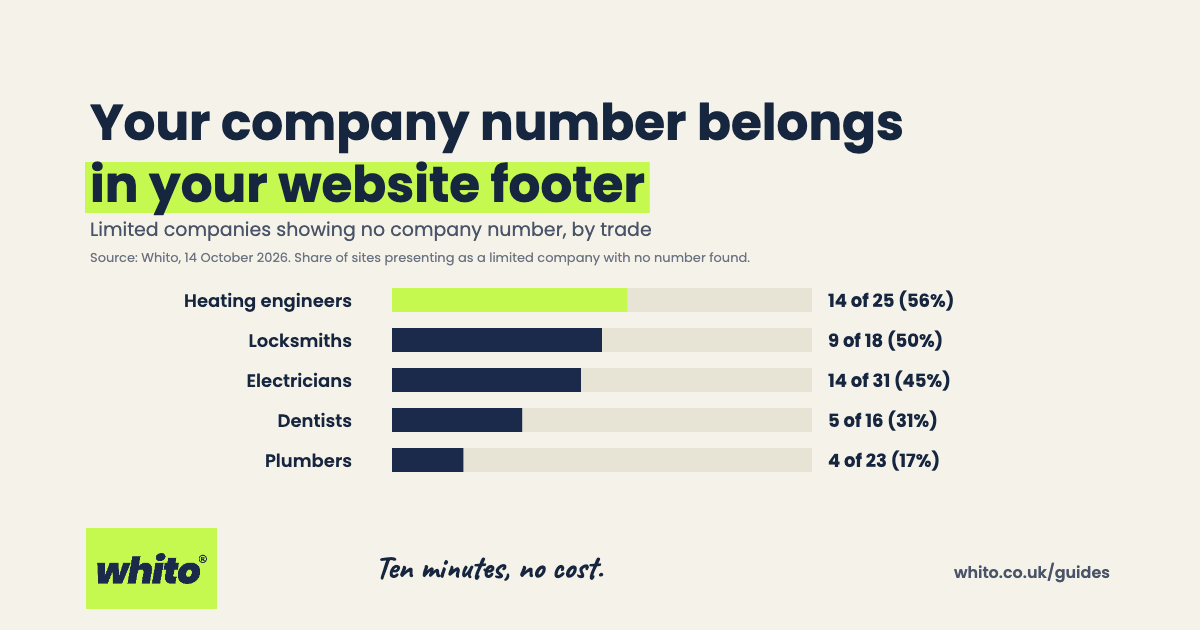
When we checked 250 UK trade and dental websites in October 2026, 46 of the 113 that present themselves as a limited company showed no company number on the homepage or their contact, privacy or terms pages. Read the full study.
Who has to show what
| If you are | Your website must show |
|---|---|
| A limited company | Registered name, registered number, part of the UK where registered, registered office address |
| An LLP | The same four details, under the LLP version of the rules |
| A sole trader using a business name | Your own full name and an address where legal documents can be served |
| A partnership using a business name | Each partner’s name and an address where legal documents can be served |
| A sole trader trading under your own name | No naming rule applies, but if you sell or advertise online you should still show your name, a geographic address and an email address |
The limited company rules are in regulation 25 of the Company, Limited Liability Partnership and Business (Names and Trading Disclosures) Regulations 2015. Regulation 24 adds the registered name. The rules for sole traders and partnerships are summarised in Trading Standards’ Business Companion guide to company and business names.
The mistake most limited companies make
They put “Ltd” in the logo and stop there.
“Smith Heating Ltd” tells a reader you claim to be a company. It does not tell them which one. The register can hold several companies with similar names, some active, some dissolved, some in other towns. The number is what turns a claim into something checkable.
The law asks for four details, not one. A footer that says “Smith Heating Ltd, company number 00000000” still misses the part of the UK and the registered office address.
Here is a worked example. The business is invented for illustration.
Example Heating Ltd is registered in England and Wales, company number 00000000. Registered office: 1 Example Street, Leeds, LS1 0AA. VAT number GB 000 0000 00.
Change the details to yours. If your registered office is your accountant’s address, use that. It is the address on the register, not necessarily where you work. If you are registered in Scotland, say Scotland. If you are in Northern Ireland, your number starts with NI.
Only add a VAT number if you are VAT registered. If you mention your share capital anywhere on the site, regulation 25 says it must be the paid-up figure.
You can find your exact registered name, number and office on the Companies House register. Copy them exactly. A footer that says “Smith Heating” when the register says “Smith Heating and Plumbing Limited” is a mismatch someone will notice.
Does it have to be on the homepage?
No. The regulations say the details must be on your websites, not on a particular page. A privacy page or a terms page can technically do the job.
But hiding it on page four costs you the benefit. A customer checking you out looks at the homepage and the contact page. The free Whito Visibility Check reads your homepage. Many AI assistants read whatever pages they happen to fetch. The footer puts the details on every page at once, so whichever page gets read, the number is there.
Add it to your structured data too
Structured data is the hidden label on a page that tells search engines and AI tools, in a fixed format, who the business is. If your site already has Organization or LocalBusiness schema, add your legal name and company number to it. Schema.org has no dedicated company number field, so the usual way is an identifier.
{
  "@context": "https://schema.org",
  "@type": "LocalBusiness",
  "name": "Example Heating",
  "legalName": "Example Heating Ltd",
  "url": "https://www.example.co.uk/",
  "identifier": {
    "@type": "PropertyValue",
    "propertyID": "Companies House company number",
    "value": "00000000"
  }
}
This sits alongside the visible footer, not instead of it. The law asks for the details to be shown to people. The schema makes the same details easy for machines to read. If you enter your company number in the Visibility Check, the fix pack it writes for you includes this identifier.
Why it matters for being found and trusted
This is a Start-stage fix. It costs nothing and takes ten minutes, and it should be done before you spend a pound on ads or SEO.
- Customers check. A visible number lets a cautious customer confirm you are an active company before they hand over a deposit.
- Directories and platforms check. Some, including Whito, match a business to Companies House before listing it. A number on your own site removes the guesswork.
- AI assistants are guessing. Our research has found AI engines recommending companies that have been dissolved, and naming businesses that cannot be matched to any public record. A number on your site gives any reader, human or machine, one fixed thing to match you against.
What happens if you leave it off
Failing to show the required details is a criminal offence for the company and every officer in default, under regulation 28. The maximum is a level 3 fine, currently up to £1,000, plus a daily fine for each day it carries on.
There is a civil cost too. Under section 83 of the Companies Act 2006, if a company sues to enforce a contract made while it was in breach, a court must dismiss the claim if the customer shows the breach cost them money or blocked a claim of their own, unless the court decides it is fair to let it go ahead.
In practice, prosecutions are rare. The bigger cost is quieter: the customer who checks, finds nothing, and books someone else.
If you are a sole trader
You do not have a company number, so do not invent one or borrow a similar company’s. If you trade under a name that is not your own, such as “Northgate Boiler Repairs”, show your own full name and an address where legal documents can be served.
The Electronic Commerce Regulations 2002 also expect anyone selling online to show a name, a geographic address and an email address. If you are on a public register for your trade, such as Gas Safe, show that registration number too. It gives customers the same thing a company number does: something to check.
Common questions
Do I need my company number on my website?
Yes, if you are a limited company or LLP. The 2015 trading disclosure regulations require your registered name, registered number, part of the UK of registration and registered office address on your website.
Does it have to be on every page?
No. The law says on your website, not on every page. Putting it in the footer is the simplest way to make sure it can always be found.
Is it safe to publish my company number?
Yes. Your company number and registered office are already public on the Companies House register. Showing them adds nothing a fraudster cannot already see, and it helps genuine customers check you.
Do I need to show my VAT number?
If you are VAT registered and sell or advertise online, the Electronic Commerce Regulations 2002 ask for your VAT number to be available. Add it to the same footer line.
Can I use my accountant’s address as my registered office?
Yes, if that is the registered office on the register. Show whatever address Companies House holds, word for word.
How do I check whether my site shows it?
Run the free Whito Visibility Check. Its company number check looks for a registered number on your homepage and, if you enter your number, checks it against Companies House. It takes about twenty seconds and needs no email.
The takeaway
Your company number is free trust. One footer line makes you checkable by every customer, platform and AI tool that looks. Add it today, then run the Visibility Check to see what else is missing.
This guide explains the rules in plain English. It is not legal advice. Sources: legislation.gov.uk and Trading Standards Business Companion, read 14 October 2026.