Data last verified: 18 October 2026. Figures re-checked against their primary sources under the Whito rolling re-verification programme.
Finding
Of 100 active UK advertising agencies picked at random from Companies House on 18 October 2026, 5 filed a profit and loss account with their latest accounts, and only one of those five turned over more than £250,000.
Source: Whito, whito.co.uk/research/uk-agency-profit-margins-filed-accounts, 2026-10-18. Free to quote with a link to this page.
Last Updated on October 18, 2026
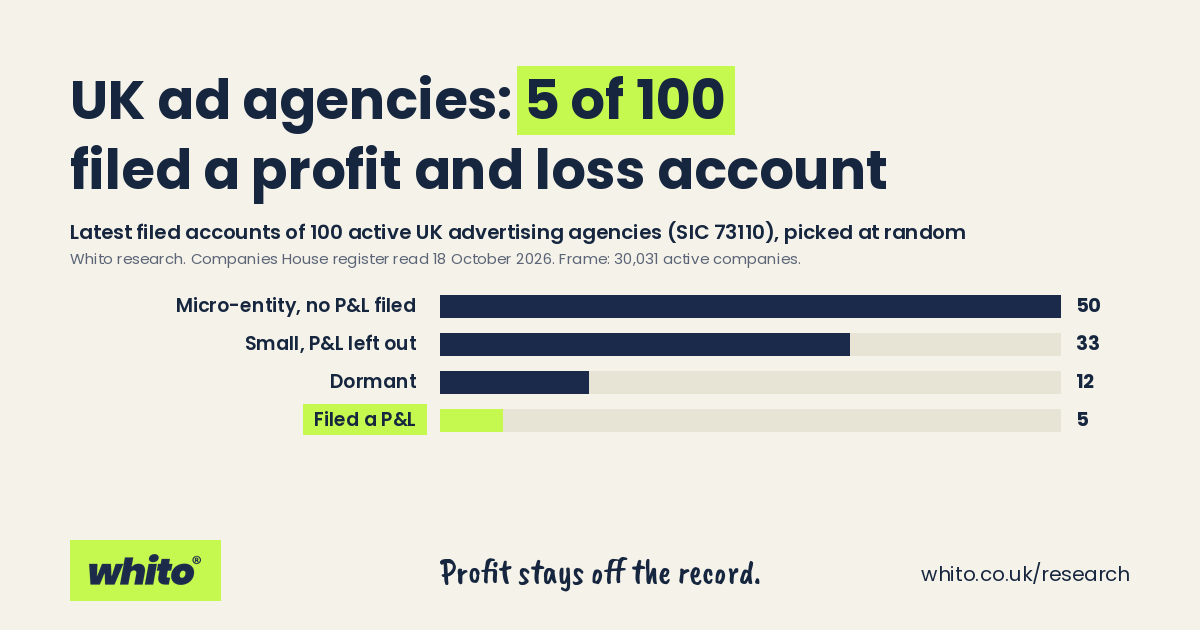
Read: 18 October 2026. 100 active UK advertising agencies picked at random from the Companies House register, and the latest accounts each one filed. Company names are in the data file because they are the public record. Being in the sample is not a comment on any business.
Ask what profit margin a UK marketing agency makes and you get a survey answer. Moore Kingston Smith’s Marketing Services Outlook Survey (May 2026) says agencies expect an average operating margin of 13.3% this year. The page does not say how many agencies answered.
So we went to the one place every UK company has to report to. Of 100 active UK advertising agencies picked at random from Companies House on 18 October 2026, 5 filed a profit and loss account with their latest accounts, and only one of those five turned over more than £250,000.
The other 95 filed accounts that say nothing about profit. The law lets them. That is the real answer to “what margin does an agency make”: for almost every agency you could hire, nobody outside the business can see it.
For organisations: the one-minute brief
- 5 of 100 randomly picked UK advertising agencies filed a profit and loss account with their latest accounts.
- Only one of the five had turnover above £250,000. It made an operating loss.
- 60 of the 88 that were trading reported one employee or none. None reported 50 or more.
- From April 2028 small companies must file a profit and loss account, but they can ask for it not to be published.
Method: seeded random sample of 100 from the 30,031 active companies registered under SIC code 73110 (advertising agencies) and incorporated by 30 June 2024. Latest accounts read 18 October 2026. Free to quote with a link. The working data behind our studies is sold as files →
What we did
We searched the Companies House register for active companies that list SIC code 73110, “advertising agencies”, and were incorporated on or before 30 June 2024. A company incorporated by then has had at least one set of accounts fall due. On the morning of 18 October 2026 that search returned 30,031 companies.
We downloaded the full list, sorted it by company number and shuffled it with a fixed random seed (20261018), then took the first 100. Anyone with the list and the seed gets the same 100.
For each company we opened its filing history and read the latest set of accounts. 96 were filed electronically, so we read the tagged figures and the filing’s own statements by machine, then checked every case that was not clear-cut by hand. The other 4 were scanned paper filings, which we read page by page. As a second check, we re-read 12 of the micro-entity filings at random by a different method. All 12 agreed.
We recorded turnover, operating profit, profit before tax and staff numbers only where the company had filed them. Nothing was estimated.
Finding 1: 95 of 100 keep profit off the register
| Latest accounts filed, 100 UK advertising agencies | Companies | Filed a profit and loss account |
|---|---|---|
| Micro-entity accounts | 52 | 2 |
| Small company accounts, full (“total exemption full”) | 28 | 1 |
| Small company accounts, abridged | 6 | 0 |
| Dormant company accounts | 12 | 0 |
| Subsidiary accounts, exempt from audit | 1 | 1 |
| Full audited accounts | 1 | 1 |
| Total | 100 | 5 |
Small companies can deliver their accounts to Companies House without the profit and loss account. Since April 2025 “small” means, among other tests, turnover of up to £15 million (SI 2024/1303). Micro-entities, with turnover up to £1 million, usually file a balance sheet and little else.
The filings say so in plain words. A typical one reads: the directors “have elected not to include a copy of the profit and loss account”. Of the 34 small company filings in our sample, full and abridged, 33 left it out.
At 5 in 100, the share of all 30,031 companies that publish a profit and loss account is most likely somewhere between about 2% and 11%. A sample of 100 cannot pin it down more tightly than that, but it is enough to say the published figure is the exception.
Finding 2: the five that did file do not make a margin
| Company (described, not named) | Period | Turnover | Operating profit | Margin | Staff |
|---|---|---|---|---|---|
| Agency within a larger group, full audited accounts | Year to 31 Aug 2025 | £13,231,684 | −£1,137,368 | −8.6% | 47 |
| Subsidiary doing marketing for a waste management business | 18 months to 31 Mar 2025 | £246,899 | £2,949 | 1.2% | 0 |
| Micro-entity that chose to file its profit and loss account | 13 months to 30 Jun 2025 | £11,310 | £7,868 (profit for the period) | 69.6% | 0 |
| Small branding company | 13 months to 30 Apr 2025 | £5,849 | £11,020, including £5,510 of other income | not meaningful | 1 |
| Micro-entity, accounts overdue | Year to 31 Jan 2023 | £0 | −£2,932 (loss for the period) | none | 0 |
Five filings, five different situations. There is no honest average in there. The only one of a size most buyers would recognise as an agency turned over £13.2 million with 47 staff, spent 37% of its turnover on staff costs, and made an operating loss.
That is one company in one year, inside a larger group. It does not tell you what agencies in general make. It does show that the margin figures you read about agencies come from somewhere other than the public record.
Finding 3: most registered agencies are one or two people
Staff numbers are the one thing almost every filing does show. Of the 88 companies that were trading (the 12 dormant ones aside):
| Average employees, as filed | Companies |
|---|---|
| None | 29 |
| 1 | 31 |
| 2 to 9 | 24 |
| 10 to 49 | 4 |
| 50 or more | 0 |
The middle company in the list had one employee. The Moore Kingston Smith respondents averaged about 70 employees, according to the survey page. In our random draw, not one company reached 50.
That is not a criticism of the survey. It asks a different group of agencies. But it means a 13.3% margin describes a kind of agency that is rare on the register, and probably not the one a small business ends up hiring.
Two more things the register showed: 11 of the 100 had accounts overdue on 18 October 2026, and 10 had an active proposal to strike them off.
What this means if you are hiring an agency
You cannot judge an agency’s margin from its accounts, so stop trying. Judge what you can see, and ask for the rest.
- Look the agency up on Companies House. It is free. Check the accounts type, the staff number, whether anything is overdue and whether a strike-off is proposed. Two minutes.
- Use the staff number. If the filing says one employee, the person selling to you is probably the person doing the work, or the work is going to freelancers. Either can be fine. You should know which.
- Ask for the hours and who does them. Our agency markup study shows where a retainer goes, and our day rate comparison shows what the same hour costs from a freelancer.
- Read the leaving terms before the price. Our agency contract terms study found 19 of 39 pricing pages did not say how you leave.
Then run the agency’s own website through the free Whito Visibility Check. It looks for a company number on the homepage and checks it against Companies House. An agency that wants your marketing budget should pass its own basics.
What changes in April 2028
On 9 June 2026 the government confirmed that from 1 April 2028 small companies, including micro-entities, will have to file a profit and loss account with Companies House, and the option to file abridged accounts will end (ICAS, ACCA).
There is a catch. Small companies will be able to opt out of having that profit and loss account published on the public register. So filing a profit figure and showing it may not be the same thing.
We will re-read the same 100 companies every quarter and publish what changed as a new dated edition. The first editions after April 2028 will show how many agencies choose to keep the figure private. This October 2026 reading is the before picture, and it cannot be recreated later.
Limits
- SIC codes are chosen by each company. Some in the sample list 73110 alongside other activities, and a code is not proof of what a business does day to day.
- This is a random sample of registered companies, not of agencies weighted by size or spend. Large agencies are rare on the register, so they are rare in the sample.
- “Latest accounts” means the most recent set filed by 18 October 2026. Period ends range from April 2021 to June 2026, and some periods are longer or shorter than a year. Figures are not adjusted.
- Figures are as filed. Most small company accounts are not audited.
- Three filings tagged the staff number with the wrong scale in their software. We used the number printed in the accounts and noted it in the file.
- Sole traders and partnerships do not file accounts at Companies House, so agencies run that way are not in the frame at all.
Common questions
What is the average profit margin of a UK marketing agency?
There is no published average built from filed accounts, because most agencies do not file a profit figure. Of 100 UK advertising agencies picked at random from Companies House in October 2026, 5 filed a profit and loss account. Survey figures exist: Moore Kingston Smith’s May 2026 survey reported an expected average operating margin of 13.3%, from agencies averaging about 70 employees.
Do UK agencies have to publish their profits?
Not if they are small. A small company can deliver its accounts to Companies House without the profit and loss account, and a micro-entity usually files only a balance sheet. From 1 April 2028 small companies must file a profit and loss account, but they can opt out of having it published on the public register.
How can I check an agency’s accounts?
Search the agency’s company name or number on the Companies House register and open its filing history. The latest accounts show the accounts type, the average number of employees and, for most companies, the balance sheet. Check whether accounts are overdue or a strike-off is proposed.
How many UK advertising agencies are there on Companies House?
On 18 October 2026, 30,031 active companies listing SIC code 73110 (advertising agencies) had been incorporated on or before 30 June 2024. Many list other activities too, and many are one-person companies.
Download the data
All 100 rows, with company number, name, status, SIC codes, accounts type, period end, whether a profit and loss account was filed, turnover and profit where filed, staff numbers, net assets where tagged, and a link to each filing history: whito-uk-ad-agency-filed-accounts-2026-10-18.csv. Free to reuse with a link to this page. If you spot an error, tell us through our corrections page.
Cite this research
Whito Research (2026). UK Agency Profit Margins: What 100 Companies House Filings Show. Whito. https://whito.co.uk/research/uk-agency-profit-margins-filed-accounts/
Key finding: Of 100 active UK advertising agencies picked at random from Companies House on 18 October 2026, 5 filed a profit and loss account with their latest accounts, and only one of those five turned over more than £250,000.
The structural checks behind this research run on any website in about twenty seconds. Enter yours and read the full result on the page. Free, and we do not ask for your email.
Run the free Visibility CheckIf your business is named here and you think we have a fact wrong, email hello@whito.co.uk and we will check it and correct it. If you want to respond, send us a statement and we will publish it alongside. Full detail: Corrections, right of reply and removals.