Finding
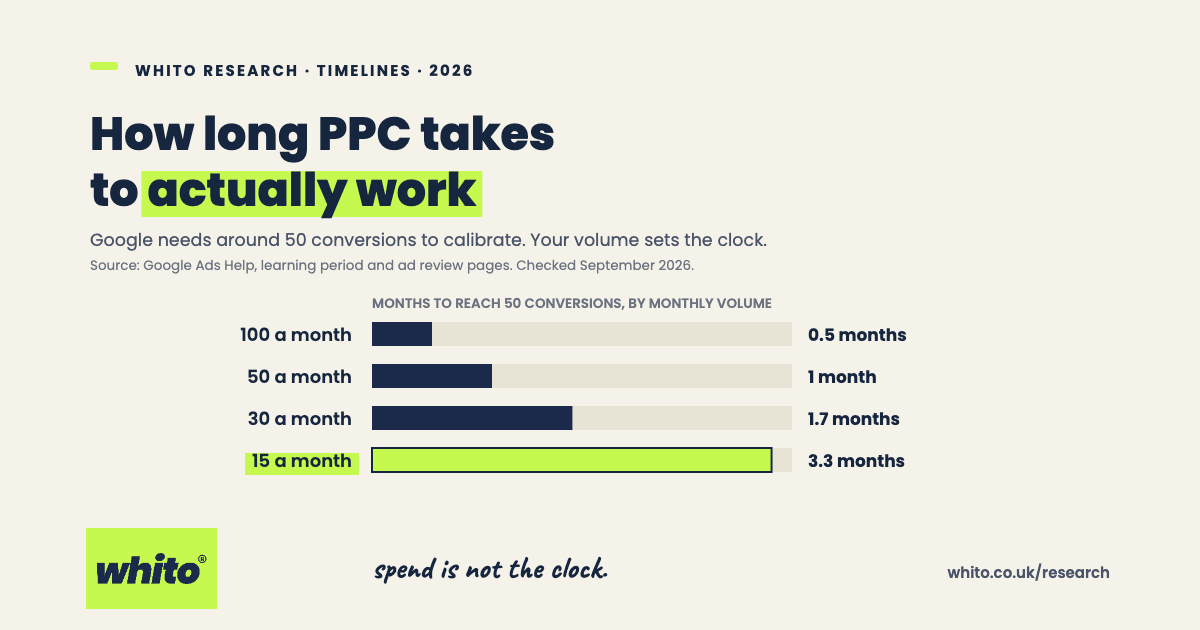
Most Google ads are reviewed within one working day, but Google's bidding needs around 50 conversion events or 3 conversion cycles to calibrate, so a small UK account converting 15 times a month is three months from calibrated, not three days, according to Google Ads Help, checked September 2026.
Source: Whito, whito.co.uk/research/how-long-does-ppc-take-to-work-uk, September 2026. Free to quote with a link to this page.
Last Updated on September 21, 2026
PPC is sold as the instant channel, and the first half of that is true: an ad can show the day it passes review. The half that costs UK businesses money is the difference between showing and working. This page puts honest numbers on that gap. It is part of our full UK timeline study.
The short answer
How long does PPC take to work in the UK? Ads can show within one working day of passing review. We plan two to six weeks before performance is judgeable, because Google’s bidding calibrates on roughly 50 conversion events or three conversion cycles, and because tracking and landing pages must be proven first. Spend is not the clock; conversions are.
What Google actually publishes
Two documented numbers anchor every honest PPC timeline, both from Google Ads Help, checked September 2026:
- Review: “Most ads are reviewed within one working day.” Longer for complex cases; Google suggests checking status after two working days and contacting support after a week.
- Learning: the bid strategy calibrates after “up to around 50 conversion events or 3 conversion cycles”, faster when conversion history already exists. Learning restarts when you create or reactivate a strategy, change its settings, or add and remove campaigns, ad groups or keywords.
That second number is the one that matters, because it converts to time differently for every account. Fifty conversions at 50 a month is a month of learning. Fifty at 15 a month is a quarter. Small UK service businesses are usually the second case, which is why “give it two weeks” is neither cynical nor generous; it is arithmetic that depends on your conversion volume.
The honest PPC timeline
- Day 0 to 7: live. Account built, tracking installed and test-fired, ads reviewed and serving. First impressions and clicks. The only thing worth checking: is a test enquiry recorded correctly?
- Weeks 1 to 3: data, not verdicts. Impressions, clicks, search terms. Cull obviously wrong search terms; touch little else, because every structural change restarts learning. Performance in this window is noise wearing a trend’s clothes.
- Weeks 2 to 6: calibration. Bidding settles as conversions accumulate. Cost per conversion becomes meaningful once the account has tens of conversions, not before.
- Week 6 onward: the verdict window. Now the numbers mean something: cost per enquiry against what an enquiry is worth. At UK average CPCs of £1.50 to £2.50, £600 a month of spend is roughly 240 to 400 clicks; at a 3% landing-page conversion rate, 7 to 12 enquiries; at £50 to £85 an enquiry, your margins decide, not your agency’s dashboard. Planning maths, ex VAT, not a quote.
“It’s not working” is usually not a PPC problem
When a UK account “fails” in month one, the autopsy nearly always finds one of three things, none of them bidding:
- Tracking measures nothing real. Page views counted as conversions, forms that fire twice, calls not tracked at all. The bidding system then learns from fiction, enthusiastically.
- The landing page cannot convert. No price signal, no proof, no company number, a form asking eleven questions. The click was fine; the destination lost it.
- The maths never worked on paper. If click cost times clicks-per-sale exceeds what a sale is worth, no learning period fixes it. Do this arithmetic before spending, on one sheet of paper.
Ad spend is not the clock. Conversion volume is the clock, the fuel and the verdict, all three.
When to kill a campaign
Kill it when the arithmetic fails on real data, not when the first fortnight feels quiet. In writing, at a gate: after the account has 50-plus conversions or three months, whichever comes first, cost per enquiry is either below what an enquiry is worth or it is not. If tracking cannot be made honest, kill it sooner; a campaign you cannot measure is a subscription, not a channel. And remember what you are buying: nothing about PPC compounds. The day the budget stops, the traffic stops. That is not a flaw; it is the price of speed.
Run the which-clock-moved test on every PPC report: impressions, clicks, conversions, cost per conversion and enquiries you can name are five different clocks, and “spend is up” moves none of them.
Method and limits
No new experiment behind this page. The review and learning figures are Google’s own documentation, quoted and dated. CPC ranges are from Whito’s published UK PPC cost research. The worked arithmetic is labelled planning maths and uses illustrative conversion rates; your landing page decides your real rate. Whito does not run PPC campaigns and has no stake in whether you buy them.
FAQ
How fast can Google Ads show my ad?
Most ads are reviewed within one working day (Google’s published figure, checked September 2026). Complex reviews take longer. Showing is not working; budget two to six weeks before judging performance.
What is the Google Ads learning period?
The calibration window after a bid strategy is created or changed. Google puts it at up to around 50 conversion events or 3 conversion cycles rather than a fixed number of days. Structural changes restart it, so change less, less often.
Why does my agency say not to touch the account?
Because every change to strategy, settings or structure restarts calibration. It is true, and it is also not a licence for silence: search-term culls and honest reporting continue through learning.
Is PPC faster than SEO?
Yes, by months. PPC answers “does this offer convert?” in weeks; SEO takes months to move and then compounds. The full comparison is on our SEO vs PPC decision page.
How much should I spend to find out if PPC works?
Enough to buy statistically meaningful conversions, not impressions. Planning maths: at £1.50 to £2.50 a click and a 3% conversion rate, £600 a month yields 7 to 12 enquiries; three months of that is 20 to 36 enquiries, enough for a verdict. Ex VAT, not a quote.
Does pausing campaigns lose my progress?
Reactivating a strategy can put it back into learning, so short pauses have a restart cost. What never pauses gracefully is the traffic: paid visits stop the day spend stops.
What to check next
The costs behind the arithmetic: Google Ads costs UK and cost per lead benchmarks. Before buying clicks, make sure the landing page can convert them: the free Visibility Check reads your site the way a machine does.
The structural checks behind this research run on any website in about twenty seconds. Enter yours and read the full result on the page. Free, and we do not ask for your email.
Run the free Visibility CheckIf your business is named here and you think we have a fact wrong, email hello@whito.co.uk and we will check it and correct it. If you want to respond, send us a statement and we will publish it alongside. Full detail: Corrections, right of reply and removals.