Data last verified: 8 November 2026. Figures re-checked against their primary sources under the Whito rolling re-verification programme.
Finding
On 1 November 2026, 29,960 active UK companies had a Companies House default address as their registered office, and 25,084 of them (84%) faced a proposal to strike off.
Source: Whito, whito.co.uk/research/uk-company-register-monitor, 2026-11-01. Free to quote with a link to this page.
Last Updated on November 13, 2026
Read a short summary
General summary
Whito read all 5,596,581 active companies in Companies House’s free register file dated 1 November 2026. 29,960 have had their registered office moved to a Companies House default address, and 84% of them now face being struck off. 417,325 active companies (7.5%) have a proposal to strike off. Nine registered office addresses hold 256,428 active companies between them, which is 1 in 22 companies in the UK.
Bullet points
- All 5,596,581 active companies on the register file of 1 November 2026 were read. Not a sample.
- 29,960 have been moved to a Companies House default address. 84% of them face being struck off.
- 417,325 active companies (7.5%) have a proposal to strike off.
- Restaurants, takeaways and cafes have the highest rate of any large group: 15.3%.
- Nine registered office addresses hold 256,428 active companies, 1 in 22 companies in the UK.
Basic explainer
Companies House is the official list of UK companies. Every company must give a registered office, an address where post can reach it. If post cannot reliably reach a company there, Companies House moves it to a default address. Being struck off means the company is removed from the list and stops existing. Whito read the whole list to count how many companies are in each position.
These summaries were written with AI from this page only. The full page below is the record.
The short version
- We read all 5,596,581 active companies in Companies House’s free register file dated 1 November 2026. Not a sample. All of them.
- 29,960 have had their registered office moved to a Companies House default address. That happens when the address on record is not one where post can reliably reach the company. 84% of them now face being struck off.
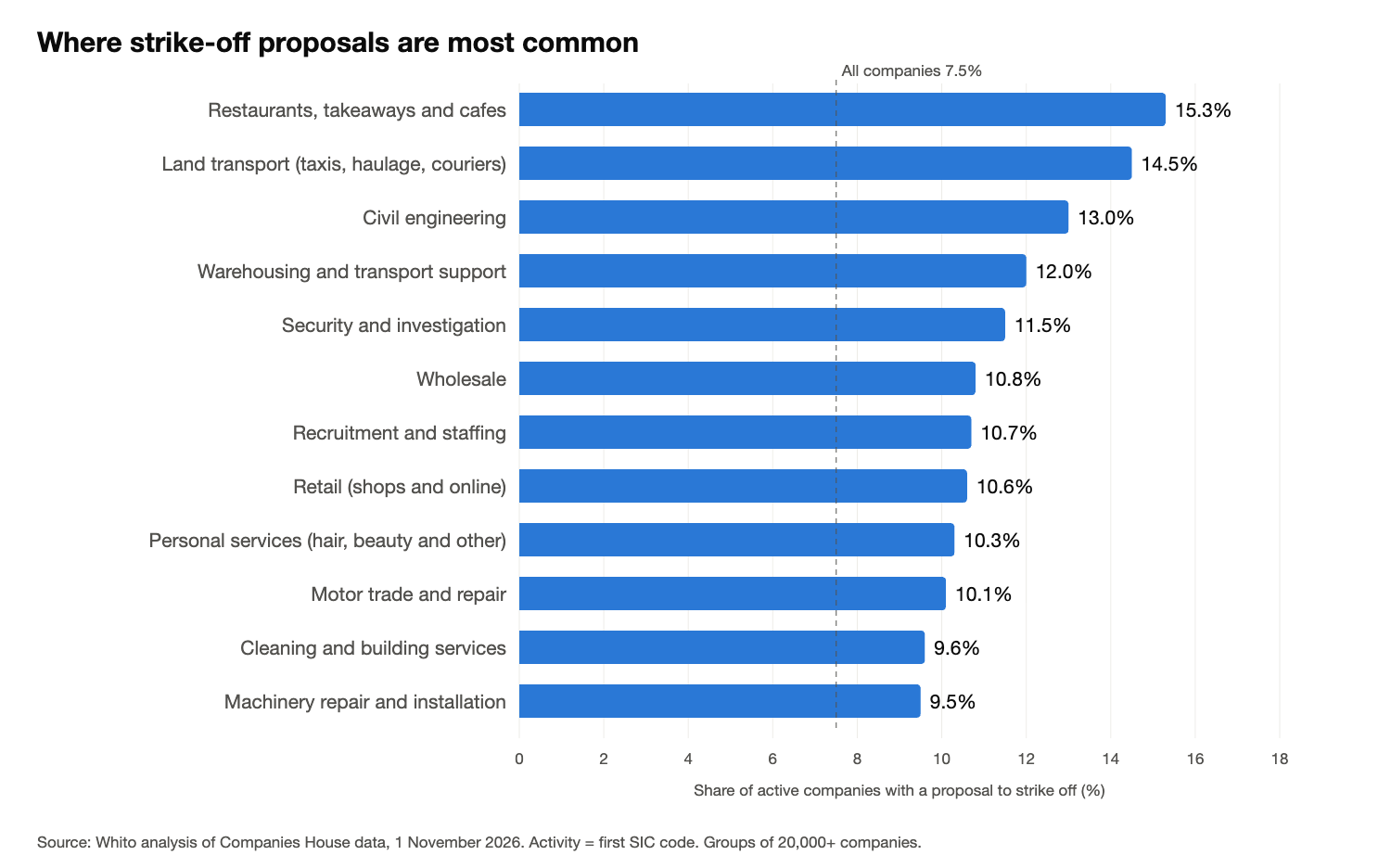
- 417,325 active companies (7.5%) have a proposal to strike off. Restaurants, takeaways and cafes have the highest rate of any large group: 15.3%.
- Nine registered office addresses hold 256,428 active companies between them. That is 1 in 22 companies in the UK. The busiest single address holds 88,116.
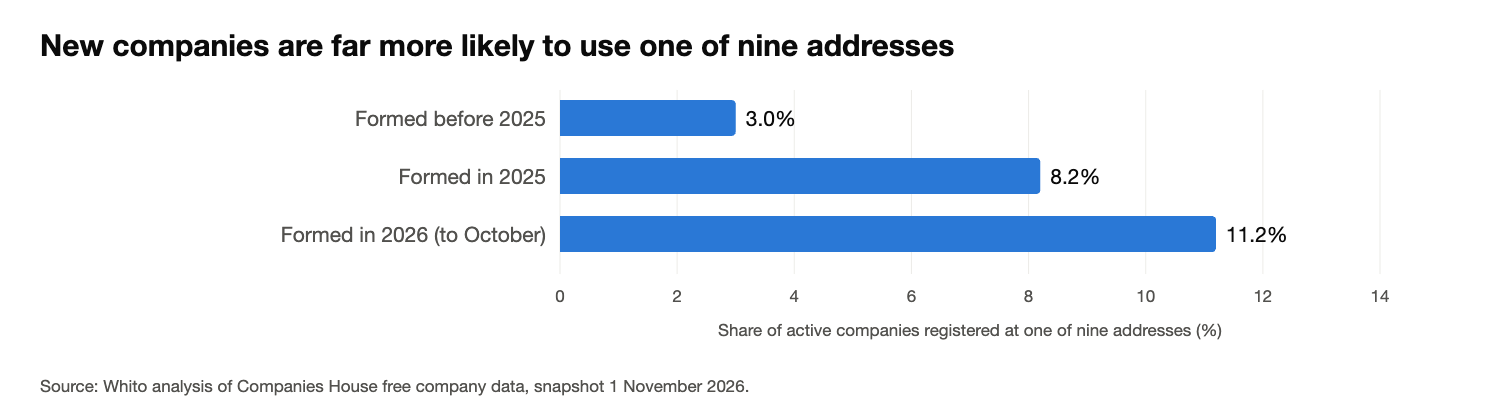
- New companies use those nine addresses far more than older ones: 11.2% of companies formed in 2026 so far, against 3.0% of companies formed before 2025. We call this the nine-address share.
- A crowded address is not where strike-off clusters. Compare companies of the same age and the rate at the nine addresses is close to everyone else’s (7.0% against 7.6% for companies formed before 2025; 9.9% against 9.6% for 2025).
- Software development is taking a bigger share of new companies: 4.4% of companies formed January to October 2026, against 2.4% of those formed in the same months of 2025 and still registered.
What we did
Companies House publishes the whole live register as one free file each month. We read the file dated 1 November 2026 in full: 5,711,780 rows, 2.8 GB of text once unpacked. We counted every company with an Active status, including those with a proposal to strike off.
For each company we recorded its status, whether its accounts or confirmation statement were past due on 1 November, its main activity code, when it was formed, and how many other active companies share its registered office postcode and address.
We checked two of our counts against the live Companies House search a week later. Our file shows 27,821 active companies at postcode CF14 8LH; the live search on 8 November showed 27,489. Our file shows 88,917 at WC2H 9JQ; the live search showed 88,700. Small differences are expected, because companies are struck off and added every day.
1. The default address: 29,960 companies with nowhere to send the post
Since March 2024, every UK company must have an “appropriate address” as its registered office: one where documents will reach someone acting for the company and delivery can be confirmed. If Companies House decides an address is not appropriate, it can move the company to one of three default addresses it holds in Cardiff, Edinburgh and Belfast.
On 1 November 2026, 29,960 active companies had one of those default addresses as their registered office.
| Companies | Share | |
|---|---|---|
| At a default address | 29,960 | 100% |
| With a proposal to strike off | 25,084 | 83.7% |
| Confirmation statement past due | 22,427 | 74.9% |
| Formed in 2025 | 8,492 | 28.3% |
| Formed in 2026 | 1,886 | 6.3% |
Almost all are at the Cardiff address used for England and Wales: 27,821 active companies have its postcode. The other 2,139 are at the Edinburgh and Belfast addresses.
What it means for a customer: a company at a Companies House default address has no working registered office on record. Before you pay a deposit to a limited company, look it up on Companies House. If the registered office says “Companies House Default Address”, ask where the business actually operates, and expect it may not be around for long.
If it is your company: you have 28 days from the change to file a new registered office address, and it has to be done on a paper form. Our guide to getting off the Companies House default address has the steps.
2. Strike-off: 417,325 companies on the way out
A proposal to strike off is usually the last step before a company is removed from the register. It can be the owners closing a company they no longer need, or Companies House acting because filings have stopped. The register does not say which, so we count both together.
417,325 active companies (7.5%) had a proposal to strike off on 1 November 2026.
By activity (groups with at least 20,000 companies)
| Activity | Active companies | Facing strike-off | Rate |
|---|---|---|---|
| Restaurants, takeaways and cafes | 240,193 | 36,861 | 15.3% |
| Land transport (taxis, haulage, couriers) | 104,430 | 15,111 | 14.5% |
| Civil engineering | 29,223 | 3,809 | 13.0% |
| Warehousing and transport support | 30,599 | 3,659 | 12.0% |
| Security and investigation | 20,870 | 2,406 | 11.5% |
| Wholesale | 186,475 | 20,201 | 10.8% |
| Recruitment and staffing | 50,364 | 5,364 | 10.7% |
| Retail (shops and online) | 432,264 | 45,881 | 10.6% |
| Personal services (hair, beauty and other) | 202,683 | 20,951 | 10.3% |
| Motor trade and repair | 115,661 | 11,707 | 10.1% |
| … | |||
| Lowest rates among trading activities: | |||
| Legal and accounting | 79,342 | 3,727 | 4.7% |
| Farming | 34,213 | 1,363 | 4.0% |
| Real estate | 631,159 | 21,296 | 3.4% |
| Holding companies and financial services | 197,691 | 6,664 | 3.4% |
The full table is in the free CSV download below. Activity is the company’s first SIC code, as the company chose it. Residents’ property management companies (1.5%) and companies with no activity code (1.0%) are left out of the lowest rows because they are not trading activities.
By year formed
| Year formed | Still active | Facing strike-off | Rate |
|---|---|---|---|
| 2015 | 170,316 | 18,004 | 10.6% |
| 2016 | 185,067 | 21,971 | 11.9% |
| 2017 | 207,634 | 28,269 | 13.6% |
| 2018 | 237,712 | 39,965 | 16.8% |
| 2019 | 278,338 | 54,750 | 19.7% |
| 2020 | 266,696 | 21,239 | 8.0% |
| 2021 | 283,719 | 15,049 | 5.3% |
| 2022 | 315,570 | 16,049 | 5.1% |
| 2023 | 395,798 | 23,733 | 6.0% |
| 2024 | 461,986 | 32,052 | 6.9% |
| 2025 | 695,776 | 72,669 | 10.4% |
| 2026 | 657,322 | 6,798 | 1.0% |
Two things stand out. One in ten companies formed in 2025 already faces strike-off. And among older companies still on the register, the rate climbs year by year from 2015 to a peak for 2019, where almost one in five faces strike-off, then drops sharply for 2020. We do not yet know why. It is a question for the next edition, not a finding.
3. Nine addresses, 256,428 companies
Many companies do not use their own premises as their registered office. They use a registered office service, an accountant, or a formation agent. That is legal and common. We wanted to know how concentrated it has become.
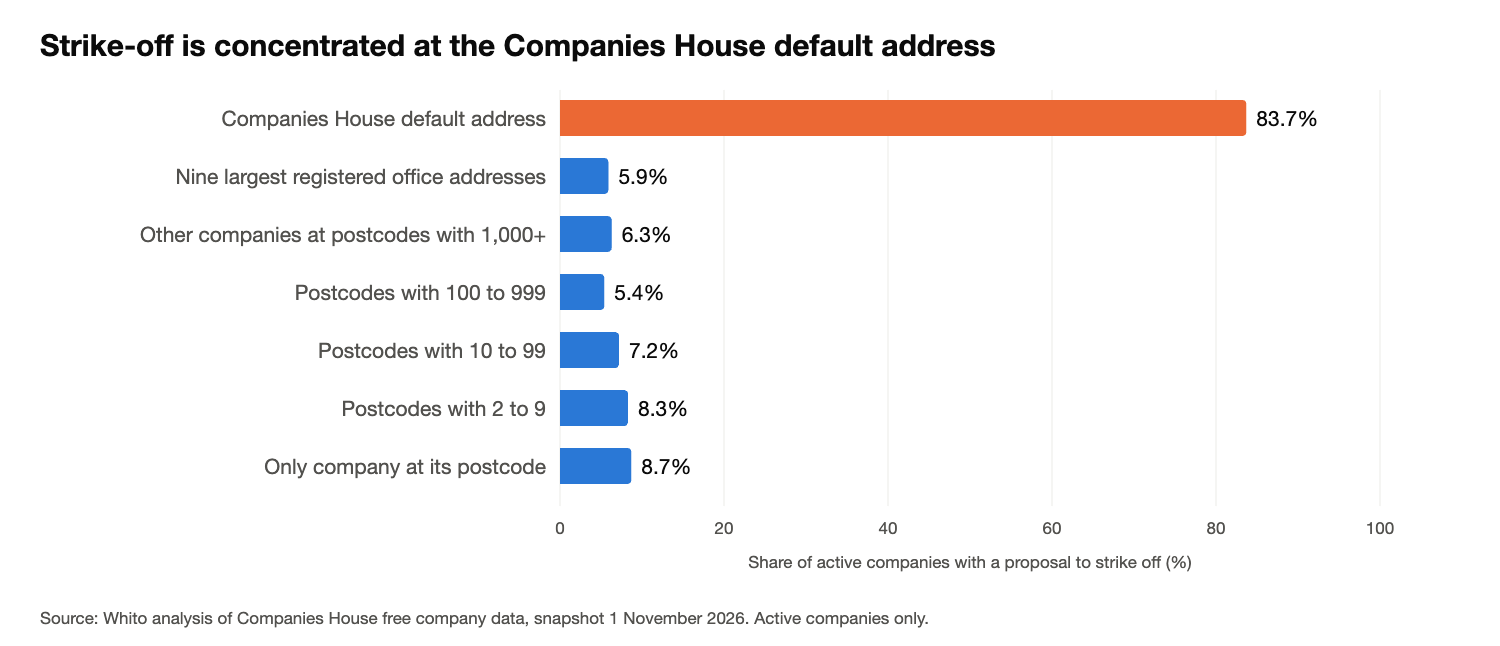
| Registered office address group | Active companies | Share of all active | Facing strike-off | Formed in 2026 |
|---|---|---|---|---|
| Companies House default address | 29,960 | 0.5% | 83.7% | 6.3% of group |
| Nine largest registered office addresses | 256,428 | 4.6% | 5.9% | 28.6% of group |
| Other companies at postcodes with 1,000 or more | 352,150 | 6.3% | 6.3% | 15.9% |
| Postcodes with 100 to 999 | 1,265,394 | 22.6% | 5.4% | 7.9% |
| Postcodes with 10 to 99 | 1,289,847 | 23.0% | 7.2% | 9.6% |
| Postcodes with 2 to 9 | 1,941,606 | 34.7% | 8.3% | 12.9% |
| Only company at its postcode | 371,468 | 6.6% | 8.7% | 13.1% |
| No postcode on record | 89,728 | 1.6% | 0.3% | 4.9% |
The nine-address row counts companies by address. The other rows count by postcode, so the 1,000-plus row also holds companies at other addresses in the nine addresses’ postcodes.
Counted by address alone, 107 addresses each hold at least 1,000 active companies: 458,155 companies in all, or 8.2% of the register.
The largest addresses, as written on the register:
| Registered office (as written) | Active companies | Formed in 2026 |
|---|---|---|
| 71-75 Shelton Street, London WC2H 9JQ | 88,116 | 27,585 |
| 128 City Road, London EC1V 2NX | 43,746 | 12,915 |
| 167-169 Great Portland Street, London W1W 5PF | 30,169 | 6,681 |
| 20 Wenlock Road, London N1 7GU | 20,769 | 6,745 |
| 124 City Road, London EC1V 2NX | 18,860 | 3,021 |
| 20-22 Wenlock Road, London N1 7GU | 14,902 | 108 |
| 3rd Floor, 86-90, London EC2A 4NE (no street name on record) | 13,438 | 3,659 |
| 66 Paul Street, London EC2A 4NA | 13,329 | 11,285 |
| 27 Old Gloucester Street, London WC1N 3AX | 13,099 | 1,375 |
The register does not say who runs these addresses or why each company chose one. We make no comment on any company registered there. Because we count each way of writing an address separately (“124 City Road” and “124-128 City Road”, for example), these figures understate how concentrated the busiest buildings are.
The nine-address share
| Companies formed | Share registered at one of the nine addresses |
|---|---|
| Before 2025 | 3.0% |
| In 2025 | 8.2% |
| In 2026 (January to October) | 11.2% |
Is a crowded address a warning sign? Not on this evidence. The crude strike-off rate at the nine addresses is 5.9%, against 7.1% for the rest of the register outside the default address. But that is mostly because the nine addresses hold so many brand-new companies, which have not had time to fall behind. Compared like for like:
| Companies formed | Strike-off at the nine addresses | Strike-off elsewhere (excluding the default address) |
|---|---|---|
| Before 2025 | 7.0% (126,239 companies) | 7.6% (4,097,662) |
| In 2025 | 9.9% (56,815) | 9.6% (630,469) |
There is no clear difference. A crowded registered office does not, by itself, tell you a company is more or less likely to be struck off. It does mean the address tells a customer almost nothing about where a business works.
4. What is being formed: software, online retail and AI
These counts are of companies still on the register on 1 November 2026, formed between January and October in each year. Older years are understated, because some of those companies have already closed. For April to June 2025, Companies House says 209,798 companies were formed; the file holds 173,890 with those dates. So roughly one in six has already gone (17%, or about 21% counting private limited companies only). That is why we do not use the file to say whether company formation overall is rising: Companies House’s own figures show 192,287 formations in April to June 2026, 8.3% fewer than a year earlier.
| Main activity | Formed Jan to Oct 2025, still registered | Formed Jan to Oct 2026 | Ratio |
|---|---|---|---|
| All companies (still registered) | 589,799 | 657,322 | not comparable |
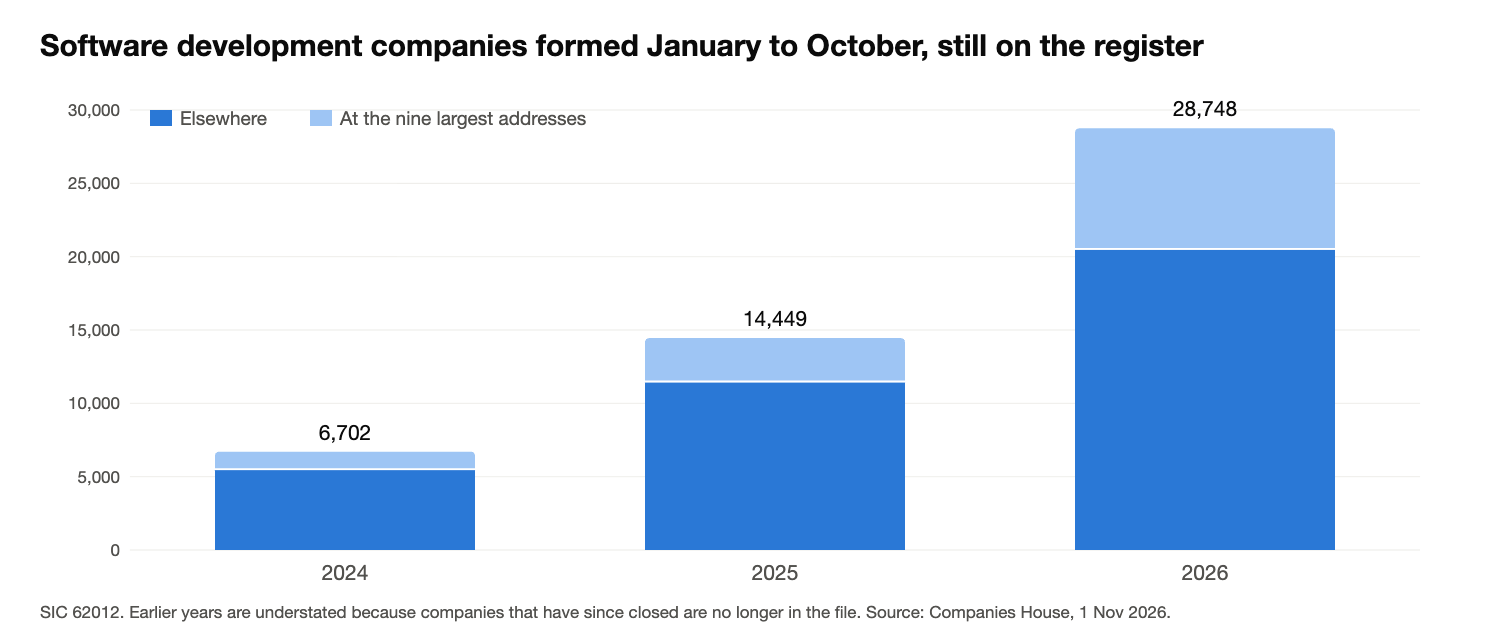
| Business and domestic software development (62012) | 14,449 | 28,748 | 1.99 |
| Other software publishing (58290) | 2,779 | 7,574 | 2.73 |
| Online and mail order retail (47910) | 35,782 | 47,160 | 1.32 |
| Name contains | 2024 | 2025 | 2026 |
|---|---|---|---|
| “AI” or “Artificial Intelligence” | 1,044 | 2,798 | 3,487 |
The clearest signal is software’s share of new companies: 4.4% of companies formed January to October 2026, against 2.4% of the 2025 group still registered. If software companies formed in 2025 had closed at the average rate, the 2026 count would still be about 1.65 times the 2025 count. To make the rise disappear, they would have to have closed at about three times the average rate. More than a quarter of the 2026 software companies (28.8%) are registered at one of the nine largest addresses, but the rise holds without them: 20,459 against 11,414 still registered.
The “AI” name count is a different story. 3,487 companies formed in 2026 with AI in the name are on the register, against 2,798 from 2025. Allow for closures at the average rate and that is roughly flat. The jump came earlier, between 2024 and 2025.
What this means for UK businesses
- Check a supplier before you pay. A 30-second Companies House look-up (how to check a UK business) shows status, a strike-off proposal and the registered office. A default address or a strike-off proposal is a reason to ask questions.
- Your registered office is part of your trust signal. If customers look you up and find an address shared with tens of thousands of companies, it tells them nothing about you. Your own website should say where you actually work and show your company number. 41% of trade websites presenting as limited companies show none. Our free Visibility Check shows what a customer sees.
- Software is getting crowded. If you sell software, a growing share of new UK companies say they do the same thing. Being findable and checkable matters more, not less.
- UK business statistics 2026
- UK Business Truth Report 2027
- The Whito Truth Index
- How to get off the Companies House default address
Limits
- One snapshot. Strike-off proposals can be withdrawn; this is a reading on one date, not a forecast.
- Activity codes are chosen by the company and are not checked.
- Formation trends are “still registered” counts and carry the survivorship effect described above.
- Address groups depend on how addresses are typed into the register.
- Accounts overdue: 77,261 companies with a plain Active status (1.5%) had an accounts due date before 1 November 2026. Zmartly’s June reading, measured against a later comparison date, was 1.96%. The difference is mostly method; we do not lead on this figure.
- We did not contact any company, and we name no company.
Method
Source: Companies House free company data product, BasicCompanyDataAsOneFile-2026-11-01, read 8 November 2026. Official incorporation figures: Companies House, Incorporated companies in the UK, April to June 2025 and April to June 2026.
Download
Free: the tables behind this report as one CSV file (CC BY 4.0, no company names). If you need these figures by postcode area or 5-digit activity code, ask Whito Data.
Cite this
Whito (2026). UK Company Register Monitor, November 2026. whito.co.uk/research/uk-company-register-monitor/. Data: Companies House, snapshot 1 November 2026.
FAQ
What is the Companies House default address?
It is an address Companies House uses as a company’s registered office when it has decided the company’s own address is not appropriate. On 1 November 2026, 29,960 active companies had one. If your company is one of them, here is how to get off the Companies House default address.
How many UK companies are facing strike-off?
417,325 active companies (7.5%) had a proposal to strike off on 1 November 2026.
Which address has the most companies registered at it?
71-75 Shelton Street, London WC2H 9JQ, with 88,116 active companies on 1 November 2026, as written on the register.
Is a company at a shared address more likely to be struck off?
Not on this evidence. Comparing companies formed in the same year, the strike-off rate at the nine largest addresses is close to the rate elsewhere: 7.0% against 7.6% for companies formed before 2025, and 9.9% against 9.6% for 2025.
How many AI companies were formed in 2026?
3,487 companies formed between January and October 2026 with “AI” or “Artificial Intelligence” in their name were on the register on 1 November 2026. A name is not proof of what a company does.
The structural checks behind this research run on any website in about twenty seconds. Enter yours and read the full result on the page. Free, and we do not ask for your email.
Free Website CheckIf your business is named here and you think we have a fact wrong, email hello@whito.co.uk and we will check it and correct it. If you want to respond, send us a statement and we will publish it alongside. Full detail: Corrections, right of reply and removals.