
Last Updated on November 16, 2026
On Friday 13 November, OpenAI gave its agents a wallet. Add a card once, and the agent can pay for things on your behalf, approving each purchase with Face ID or a fingerprint.
Within hours the advice started. Get your store AI ready. Build an agent feed. Book an AI commerce audit.
Almost all of it is wrong, and the reason is sitting in OpenAI’s own instructions to merchants.
What actually launched
ChatGPT Wallet is available to a limited number of ChatGPT Pro subscribers in the United States, aged 18 or over, with an eligible US-issued Visa, Mastercard or American Express card. OpenAI’s own framing was modest: “We’re starting with limited availability to ChatGPT Pro users, so we can learn from real-world use.”
No UK date has been given. American Express, Mastercard and Visa built it with OpenAI. The agent is handed a payment token rather than a card number, so neither the agent nor the shop sees the real details.
The detail that matters for a UK business is what OpenAI does not ask for. The agent buys through your ordinary website and your ordinary checkout. In OpenAI’s words, “Browser access does not require a plugin or product feed.”
The last version of this was pulled
This is OpenAI’s second attempt. Instant Checkout launched on 29 September 2025 with Stripe and US Etsy sellers. Forbes, citing The Information, reported that OpenAI pulled it back on 4 March 2026. Shopify’s president said only about a dozen Shopify merchants had ever gone live.
That is not a reason to ignore agents. It is a reason to be careful what you spend on them. Anyone who paid for Instant Checkout integration in late 2025 bought five months of a dead channel. The same thing happened when Google put ads inside AI Mode in the UK and there was nothing for small firms to actually buy.
The real problem is your own front door
Blend Commerce sent an AI shopping agent to 200 retailers, 100 in the UK and 100 in the US, between 8 and 15 September 2026. It used an unmodified Chromium browser from residential connections and did not pretend to be a crawler. Where a shop refused, it retried from a fresh connection, and only shops that refused twice were counted as refusals.
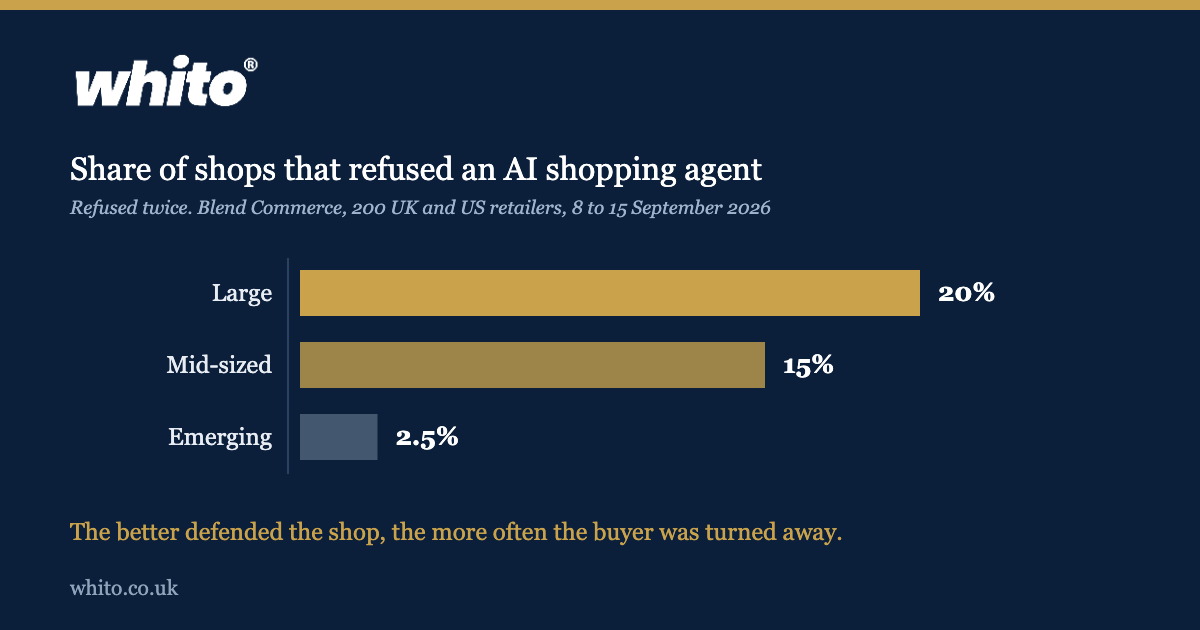
29 of the 200 refused both times. About one in seven. Split by size, the pattern inverts what most owners would expect.
| Retailer size | Refused twice | Count |
|---|---|---|
| Large | 20% | 16 of 80 |
| Mid-sized | 15% | 12 of 80 |
| Emerging | 2.5% | 1 of 40 |
Source: Blend Commerce AI Shopping Audit, 200 UK and US retailers, tested 8 to 15 September 2026.
Blend could read robots.txt at 24 of the 29 refusing shops. All 24 allowed the ChatGPT, Perplexity and Claude crawlers. So these were not shops that had decided to keep AI out. They were shops whose bot protection was doing it quietly, against the owner’s own stated preference.
OpenAI concedes the same risk. It says some sites “may unintentionally block purchases”, and that risk systems “may still flag legitimate purchases made by agents, leading to declines or cancellations”.
The 20 minute check, before you pay anyone
- Open your own site in a clean browser. No extensions, not signed in. Does it load without a challenge?
- Read your robots.txt and confirm it allows the crawlers you think it allows.
- Ask whoever runs your bot protection or firewall what it does with an unfamiliar browser on a home broadband connection.
- Ask your payment provider how it treats a card payment approved on a device that is not the shopper’s usual one.
- Put a real price, real stock status and real delivery and returns terms on every product page.
None of that costs money, and every item helps a human buyer too.
One caution on Blend’s numbers. Blend is a Shopify agency, and its audit scored Shopify stores at an average of 91 out of 100 against 59 for everything else. That comparison flatters its own specialism, so treat the platform ranking as marketing and the blocking data as the useful part. Blend also notes that ten retailers per sector is a small group.
The demand is not there yet
ACI Worldwide published YouGov polling of more than 2,000 UK adults on 30 June 2026. Just 19% said they trusted AI assistants to make everyday purchasing decisions, against 55% who trusted a human expert or adviser. 60% said they would stop using an AI agent after a single mistake.
Retailers are not rushing either. Amazon has banned outside agents and points shoppers at its own Alexa instead. DoorDash and Uber have both reported few orders placed by agents so far.
That matches what we found in our research on how AI agents will actually shop and buy, and in our study of whether AI recommends chains or independents. The mechanism always arrives a long way ahead of the behaviour.
Where this belongs in the order of work
Agent checkout is not a new channel to add. It is Build stage housekeeping: a site that loads, can be read, and can be bought from by anything that turns up at it. Done properly it pays for itself now, because the same work serves ordinary search, price comparison, and the UK ecommerce demand you are already competing for.
Treating it as a Scale stage channel, with a budget and a specialist attached, is skipping stages for a buyer who does not exist in your market yet.
The takeaway
You do not need to build anything for AI shopping agents. You need to check that your website is not turning them away, then go back to the work that earns money this quarter.
The firms that lose here will not be the ones who ignored agents. They will be the ones who paid for a feed nobody asked for while their bot protection quietly refused the sale.