Last Updated on October 28, 2026
The top breakout search in the UK this morning is not a product. It is a question about a date: “when is black friday 2026”, carrying the “1,000+” traffic band on Google’s UK trending feed, the highest band in this morning’s list.
That is worth sitting with for a second, because it is the opposite of what most small businesses are preparing for. Four weeks out, the average plan is a discount campaign: a percentage, a banner, a countdown, a flurry of ads shouting about deals.
The search behaviour says buyers are asking something much duller. When does it start, and when does it end.
What the search data actually shows
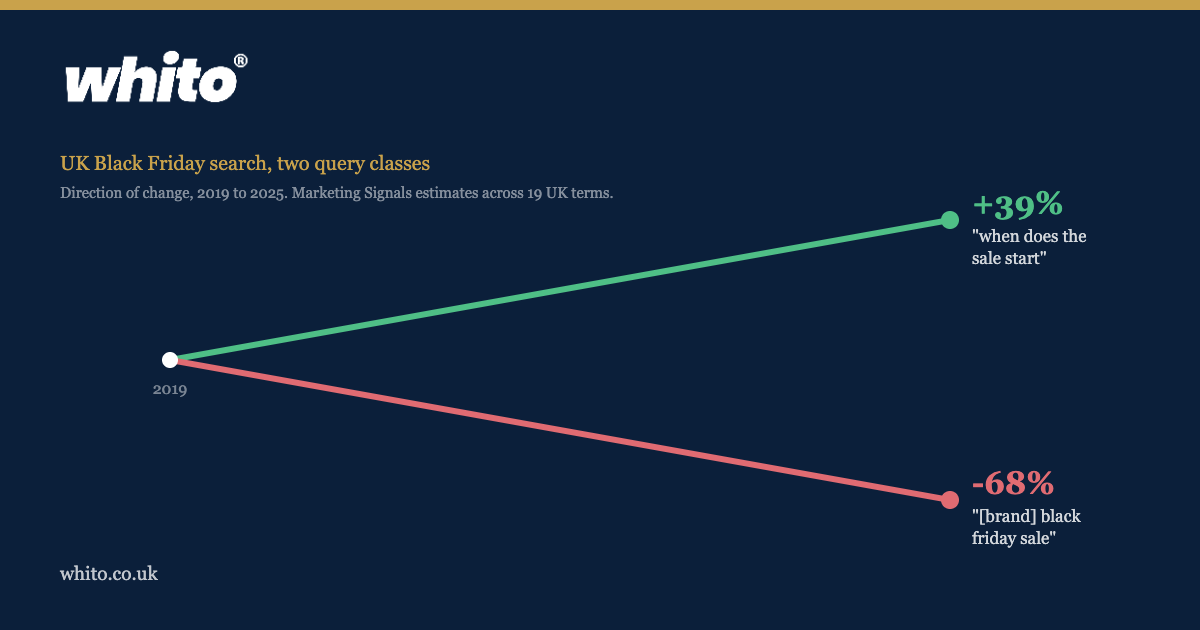
Marketing Signals, a Halifax search agency, looked at 19 UK Black Friday search terms from November 2019 to November 2025. Their analysis, reported by PPC Land, found interest in the term “Black Friday” itself down 36% on its 2019 level, while searches about sale timing rose 39%. Deal-related terms fell 40%. Retailer-specific sale queries, the “[brand] black friday sale” pattern, fell 68%.
Be careful with those numbers, and we will be careful with them here. They are one agency’s estimates, published without a full method and without absolute search volumes. PPC Land flagged that directly, and also flagged that the agency’s own conclusion that shoppers search more for brands sits awkwardly against its own 68% fall in retailer-specific queries.
So treat the direction as the signal, not the decimals. The direction is consistent and it is useful.
| Query type | Direction since 2019 | What the buyer wants |
|---|---|---|
| Sale timing | Up 39% | A date and a deadline |
| “Black Friday” (the term) | Down 36% | Less than you assume |
| Deal terms | Down 40% | Not browsing for “deals” |
| “[Brand] black friday sale” | Down 68% | Not looking for you by name |
Marketing Signals estimates across 19 UK terms, Nov 2019 to Nov 2025, as reported by PPC Land. No absolute volumes were published.
The mistake most businesses make
They buy the shouting words and skip the answering page.
Budget goes into the query class that has shrunk most, the branded sale term, on the assumption that people will come looking for your name plus the word “sale”. Meanwhile the page that answers the question people are actually typing, what your dates are, what is in the sale, what is not, when the price goes back up, frequently does not exist on the site at all.
That is a structure problem, not a budget problem. And more budget will not fix it.
The window opens before the event
The timing gets worse if you wait. Captify, which analyses UK search signals, reports that price-comparison and voucher-code searches peak a week earlier than general retail search, and that retail search spikes to more than seven times typical levels during Black Friday week. Their figures come from anonymised UK search data, with the majority of findings covering September to December 2025, indexed weekly against their network average.
Black Friday 2026 falls on Friday 27 November. If your sale page goes live that morning, the comparison has already happened without you.
It is also no longer only humans doing the comparing. Our research on how AI agents shop and buy on a customer’s behalf covers the same shift from browsing to answering: whatever is doing the comparing needs your dates and terms stated plainly, in text, on a page it can read.
What a click costs, and what that number is not
The same analysis put most Black Friday clicks at 35p to £1.10 using Semrush estimates, with “black friday holiday deals” highest at an average of £1.44.
Read the footnote before you budget on that. Those are Semrush market estimates for each search term, not what any brand actually paid, and they do not account for the bid spikes that arrive on the day itself. A 35p planning figure and a live auction on 27 November are different animals.
The one-hour Black Friday audit
1. Search your own sale terms. Does a page of yours answer the dates question? If not, that is this week’s job.
2. Write the start date, the end date and the exclusions in plain text, not inside an image or a banner.
3. Work out your margin at the discount you are planning, before you commit to it.
4. Publish it now, not on the day. The comparison happens a week early.
Start, Build, Scale
Start. One page, correct dates, clear exclusions. That is the whole job at this stage. No ad spend required.
Build. Know the number before you discount. Britain’s largest advertisers mostly cannot tell you whether their promotions make money, which we covered in our piece on the price promotion profit blind spot. If the big brands cannot answer it, you need to be able to, because you have less margin to absorb the mistake.
Scale. Only once the page converts and the margin holds does widening into paid make sense. Paying to send traffic at a page that does not answer the question is the most expensive way to discover it does not answer the question.
One thing not to do
Do not manufacture the urgency. Fake countdowns and invented deadlines are now an enforcement matter, not a growth tactic, as the CMA’s £4.8m fine over Wayfair’s countdown timers made clear. A real deadline works because it is real. If your sale genuinely ends on the Monday, say so and mean it.
The takeaway
The country is not asking who has the best deal. It is asking when the sale starts. That question is cheaper to answer than a discount war is to fight, and the business that answers it in plain text, a week early, wins traffic that its competitors are paying for.
Answer the question first. Discount second, if the margin says you can.