
Last Updated on October 13, 2026
When work goes quiet, the first lever most small businesses pull is price. Ten per cent off. A free first month. Happy to match any quote you have had elsewhere. It feels like action, and it usually produces something.
New UK research suggests almost everybody is pulling that lever, and almost nobody is checking what it costs them.
What the research actually found
Les Binet and Kantar’s chief strategy officer Dom Boyd commissioned Censuswide to survey 250 senior marketing and insight leaders at UK consumer goods businesses. Fieldwork ran from 18 to 26 August 2026, and 71 per cent of the sample were C-suite. The findings were presented at the IPA Effectiveness Conference in London on 7 October.
Three numbers matter.
75 per cent could not estimate what share of their promotions over the previous twelve months were profitable.
76 per cent said their organisation repeats similar promotions often or sometimes, even where the profit was never assessed.
68 per cent would prefer to run fewer promotions, if they could do it without losing retailer support, distribution or competitive position.
Marketing Week reported the headline from the same presentation: brands spend around twice as much on price promotions as on paid media.
How to read that comparison
The slide behind “twice as much” puts promotions at 36 per cent of marketing and trade spend against 17 per cent for paid media. That split is a composite of several sources, several of them American, and the deck does not explain how they were combined. The UK survey did not measure spend at all. Treat it as a direction of travel, not a measurement of British firms. The survey findings above are the solid part.
Why this is worse in a small business, not better
These are large companies. They have Kantar subscriptions, insight directors and panel data. Three quarters of them still cannot say which promotions made money.
If that is the state of the art, be honest about what is happening in a firm with no analyst.
The small business version is worse in one specific way: the discount never ends. A consumer goods promotion runs for a fortnight and stops. A small firm’s “20% off your first order” sits in the website header for three years. At that point it has stopped being a promotion and become the price. Every negotiation then starts from a number you already cut.
Worth knowing what competitors publish before you cut anything. When we read published prices for boiler services and dental check-ups across eight UK towns, the spread between firms doing the same job in the same town was wide. Plenty of businesses discount against a competitor price they have never looked up.
The measurement window is where it goes wrong
Ask the surveyed firms how long they watch a promotion before judging it. Two per cent look only at the promotion period. Ten per cent look at four weeks, 27 per cent at eight weeks, 42 per cent at thirteen weeks, and 19 per cent at twenty six weeks or more.
A discount’s real cost is not the margin you gave away this month. It is what the customer now expects to pay next time, and what they tell other people you charge. That shows up in the next quote. Most of these firms are judging promotions over a window too short to see the part that actually hurts.
The number to work out this week
You do not need panel data. You need your gross margin and one piece of arithmetic.
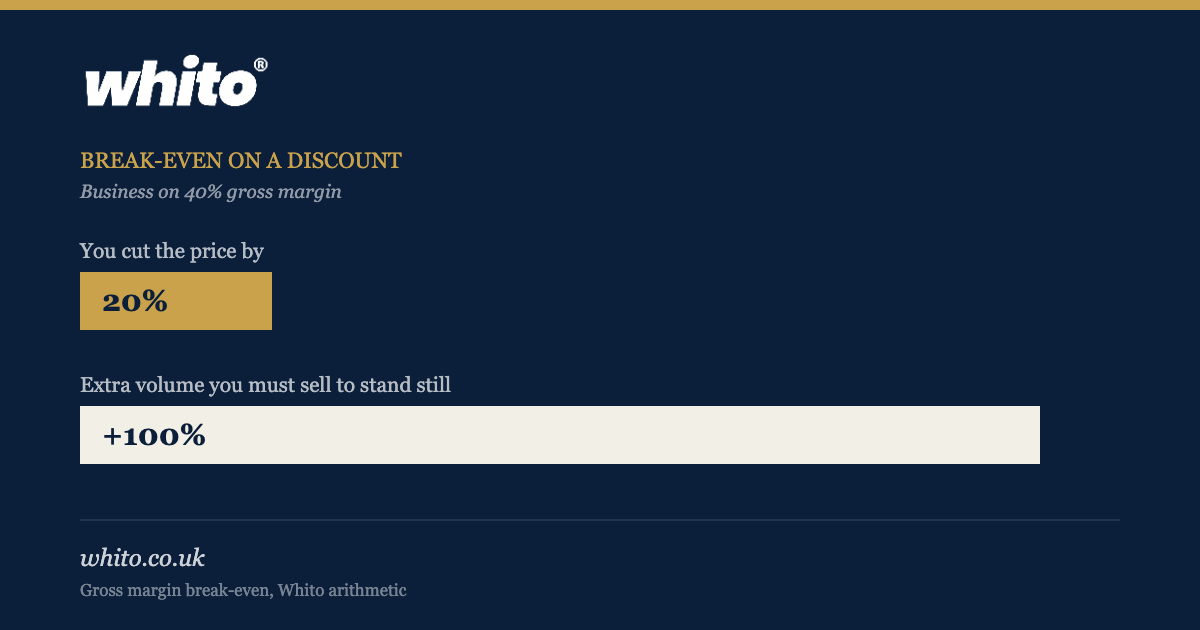
To break even on a discount, the extra volume you need is your gross margin divided by your gross margin minus the discount. A business on 40 per cent gross margin offering 20 per cent off has to sell twice as much to stand still.
| Your gross margin | 10% off | 15% off | 20% off |
|---|---|---|---|
| 30% | +50% | +100% | +200% |
| 40% | +33% | +60% | +100% |
| 50% | +25% | +43% | +67% |
| 60% | +20% | +33% | +50% |
Extra volume needed to hold gross profit flat. Whito’s own arithmetic, standard break-even, not from the Kantar research.
Find your row, then ask whether your last offer produced that much extra work. If you cannot answer, you have the 75 per cent’s problem with less margin to absorb it.
What to do about it
Start. Write your gross margin, as a percentage, against your three main services. Most owners guess this, and guess high. Get it from your accounts, not your memory.
Build. Take the discount you have been running longest. Work out its break-even uplift from the table, then check whether that uplift happened. One offer, one number, one afternoon.
Scale. Only then decide whether that money would do more work as a stronger offer at full price. Binet’s argument to the conference was exactly this: find the promotions that lose money, cut them, and move the budget into brand advertising. He compared price promotions to a “class A drug”. Our file on what 47 UK providers publish for marketing work is a sensible check on that before you spend the margin instead.
One last thing. Customers often ask an AI assistant what something costs before they ask you, and the answers vary, as we found when we tested which AI assistants quote UK marketing prices accurately. A permanent discount on your website teaches them the wrong number.
The takeaway
A discount is not a marketing tactic. It is a purchase, paid for out of margin, usually with nobody keeping the receipt.
You will not solve measurement that Britain’s biggest brands have not solved. You can do the one thing most of them skip: work out the break-even number before you offer the money, not six months after.