Finding
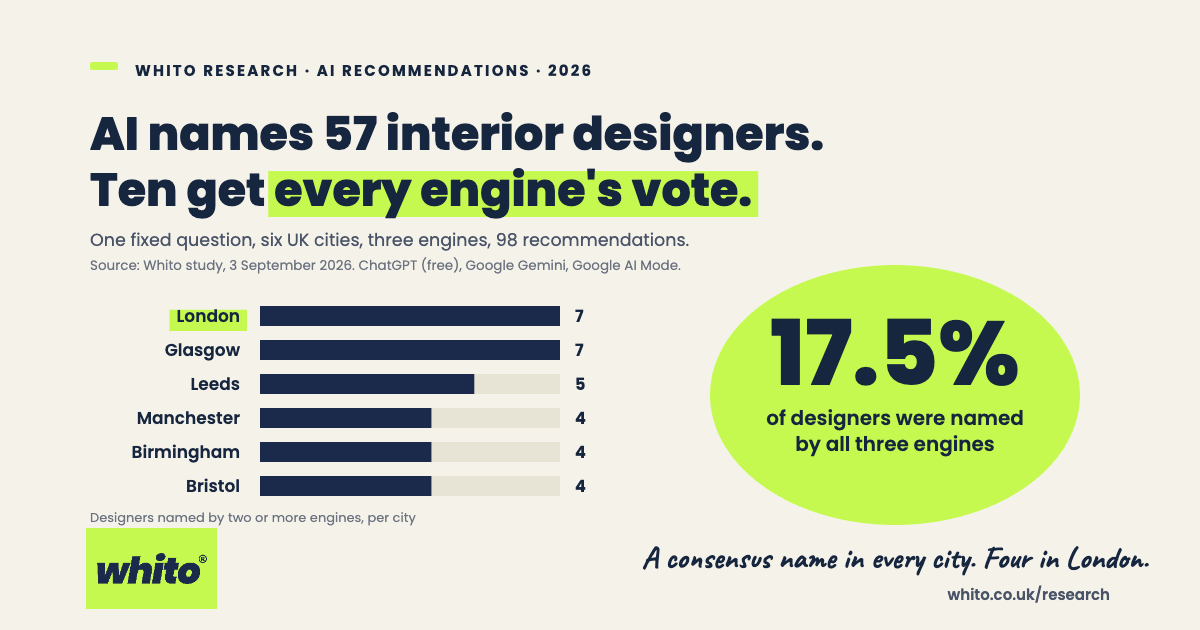
ChatGPT, Gemini and Google AI Mode agreed on ten interior designers across six UK cities on 3 September 2026, a series-record 17.5% consensus, with a designer named by all three engines in every city and four in London alone.
Source: Whito, whito.co.uk/interior-designers/research/ai-interior-designer-recommendations, September 2026. Free to quote with a link to this page.
Last Updated on September 17, 2026
Earlier on the same evening, we asked ChatGPT, Gemini and Google AI Mode to name the best recruitment agency in six UK cities, and 81% of the firms they named appeared in one engine only. Then we asked the same three engines, in the same six cities, to name the best interior designer.
The result flipped. 98 recommendations, 57 designers, and only 46% named by a single engine. Ten designers were named by all three engines at once, the highest full-consensus rate we have measured in this series, and for the first time there was at least one full-consensus name in every city. London had four.
Interior design is the profession the machines currently agree on. The interesting part is why, because the mechanism is one any studio can work with, and one of its examples should give the whole industry pause.
What we did
On the evening of 3 September 2026 we asked one fixed question, worded identically every time:
“Who is the best interior designer in [city]?”
We asked it in Manchester, London, Birmingham, Leeds, Bristol and Glasgow, across ChatGPT (free tier, with web search), Google Gemini (free app) and Google AI Mode, from a UK browser on ordinary consumer accounts. All 18 answers named designers. The method matches our recruitment agency study from the same evening and the rest of the series, so the results sit side by side.
Every designer below is named only because they appeared in an AI answer on that date. That is a fact about the engines, not a ranking of anyone’s work.
The headline numbers
| Measure | Interior designers | Recruitment agencies (same evening) |
|---|---|---|
| Unique businesses named | 57 | 75 |
| Named by one engine only | 26 (46%) | 61 (81%) |
| Named by two or more engines | 31 (54%) | 14 (19%) |
| Named by all three engines | 10 (17.5%) | 5 (6.7%) |
| Cities with a full-consensus name | 6 of 6 | 3 of 6 |
The ten full-consensus results: nest interior design in Manchester; Katharine Pooley, Beata Heuman, David Collins Studio and Elicyon in London; John Charles Interiors in Birmingham; Fresh Start Living and Ben Huckerby Design in Leeds; Stylemongers Of Bristol; and Noya Design Studio in Glasgow.
Across the series, three-engine agreement has run at 0.9% for accountants, 4.9% for solicitors, around 7% for mortgage advisers and recruiters. Interior design lands at 17.5%. Same engines, same cities, same question shape as the recruitment study hours earlier, so this comparison is as controlled as a snapshot gets.
Why the engines agree here
Three things kept appearing inside the answers that other industries’ answers did not have.
People, not companies. The answers named founders constantly: Sophie Ashby, Zoë Hewett, Anna Campbell-Jones, Kate Fryer, Karen Knox, “father-daughter duo John and Jenna”, “Nikita and Yasemin”. Interior design studios are built around visible individuals, and individuals accumulate press, TV credits and bylines that machines can read. Two of the ten consensus results are led by designers with BBC credentials the engines quoted as evidence: a judge on Scotland’s Home of the Year, and a designer “as seen on” My Unique B&B.
A magazine layer instead of a directory layer. Recruitment had no Chambers equivalent and fragmented. Interior design has one, and it is the design press: AI Mode cited House & Garden’s Top 100 and The List 2026, and Country & Town House’s Finest 50, by name, as the reason certain designers were “regularly crowned”. A curated editorial list does the same convergence work for designers that Chambers does for solicitors.
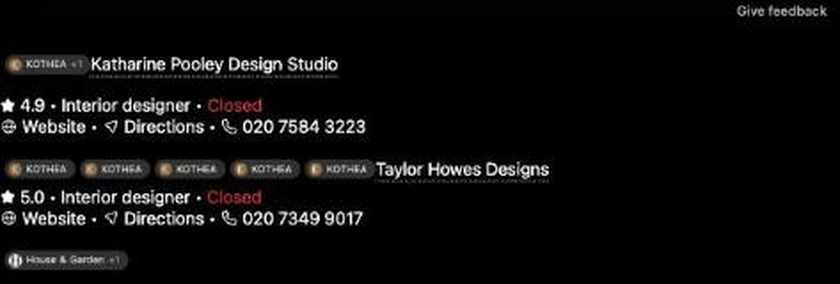
Houzz. The platform appeared in answers in five of the six cities: as a review source ChatGPT quoted instead of Google, as an award (“Best of Houzz awards for 12 consecutive years” was quoted as evidence in Leeds), and as a listicle in AI Mode’s citation panels. No other industry in this series has had a platform this embedded in its answers. And an unexpected source kept paying for London: KOTHEA, a fabric supplier whose blog ranks designers, sat behind most of ChatGPT’s London picks. The suppliers write about the designers, and the machines read the suppliers.
The evidence bar is astonishingly low
Hours earlier, the engines were quoting recruitment agencies with hundreds of Google reviews; the median where quoted was 225. For interior designers the median quoted review count was 23. Google AI Mode recommended a Manchester studio at 5.0 stars from exactly one review. Nothing quoted anywhere sat below 4.6.
Read those numbers together and the conclusion is plain: in a profession where everyone has five stars from a handful of reviews, review data cannot separate anyone, so the engines rank on everything else. Names, awards, press, portfolios described in words. A designer with 12 reviews and a magazine mention beat firms with none of either. This is the inverse of the recruitment market, where volume was the differentiator, and it means the two industries need opposite visibility strategies.
The self-declared award that topped a table
The sharpest sourcing example in this whole series so far came from Glasgow. Google AI Mode opened with a comparison table, and the top row’s “key distinction” read: “Named Best Interior Designer in Glasgow 4 years running (2023–2026)”. The citation for that claim, right there in the panel, was the firm’s own website: an announcement page titled “Best Interior Designer in Glasgow 2026 — Award-Winning, 4 years running”, published by the firm itself two weeks before our study.
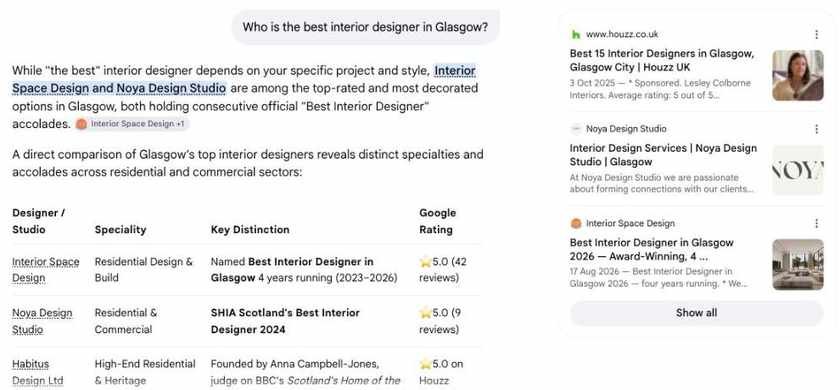
To be precise about what we can and cannot say: the award may be entirely real, and we make no claim otherwise. What the screenshot shows is narrower and, for anyone watching how these engines work, more important: the engine’s evidence for the claim was the winner’s own page announcing it. The same pattern appeared in Bristol, where ChatGPT’s one-name pick was supported by the studio’s own website describing its 2026 awards. Write the page, and the machine may read it back as the answer. We saw this mechanism with a Glasgow recruiter earlier in the evening; interior design runs on it.
When Gemini names exactly one designer
Twice in six cities, Gemini’s entire answer was a single firm. In Birmingham it named John Charles Interiors alone; in Bristol, Stylemongers alone. Not a shortlist with a favourite, one name presented as the answer, with a place card.
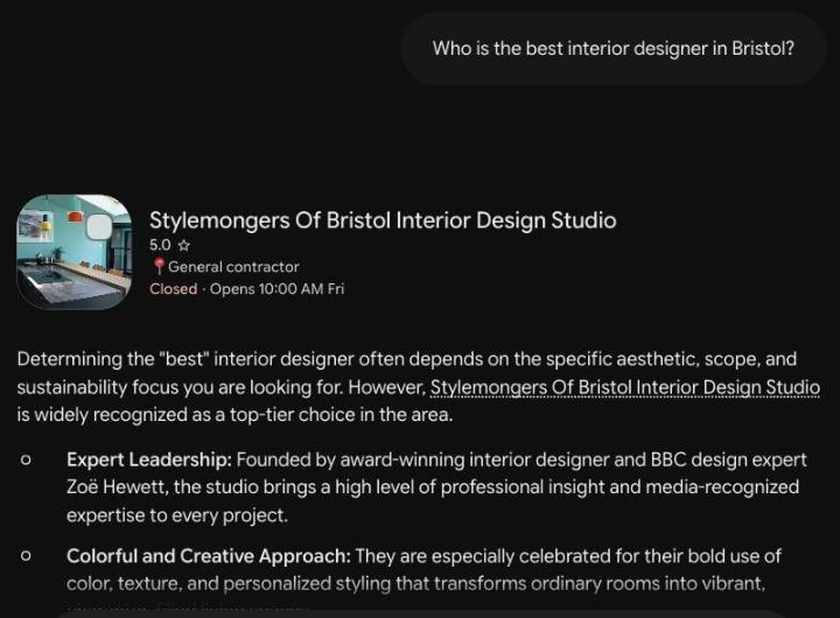
We have not seen the single-name answer pattern before in this series. For the named firm it is close to a monopoly on the question; for everyone else in the city it means Gemini told the buyer they do not exist.
The ads went adjacent
Labelled adverts sat beneath three of the six ChatGPT answers, and none came from an interior designer. Under London and Leeds the advertiser was Davonport, a luxury kitchen company offering a “complimentary design appointment”. Under Glasgow it was a building-products firm advertising slatted wall panels. Advertisers from the home-improvement world are buying the space directly beneath “who is the best interior designer”, selling to the same customer at the same moment. As always: the ads are labelled, they sit apart from the answers, and no advertiser appeared in any organic list.
What this means if you run a studio
Our marketing guide for interior designers covers the foundations. This study adds five specifics, and none of them needs a media budget.
- Put your name and face on the site. The engines named people in nearly every answer and quoted their credentials. A studio page that hides the founder behind “our team” gives machines no person to talk about.
- Write your own awards and press page, precisely. The engines cited studios’ own sites as evidence for awards, features and positioning. State what you have won, with the year and the awarding body, accurately. On this evidence it is the single most quotable page you own.
- Treat Houzz as this industry’s directory. It was cited in five of six cities, and its awards were quoted as differentiators. A maintained profile with even a modest review count did visible work; Best of Houzz did more.
- Chase one press mention over a hundred reviews. The magazine lists were the convergence layer, and a review count of 23 was the median. In this market, a feature in a design publication or a local “best of” list moves the machine evidence more than review volume can.
- Ask the three engines the question for your city each quarter. Two Gemini answers this week were a single name. Knowing whether that name is yours, and what evidence the engines quote for whoever it is, costs an hour.
Limitations
This is a snapshot: one evening, 3 September 2026, one account state per engine, one prompt shape. AI answers vary by day, session, account and location, and a different evening would produce different lists. Ratings, review counts, awards and credentials are as the engines quoted them at answer time, not independently audited, and ChatGPT mixed Houzz and Google review data. Gemini’s free tier showed no citations, so its lists are model output rather than sourced claims; one Gemini answer (Birmingham) initially returned a side-by-side comparison screen, which we discarded without voting and re-asked in a fresh chat. Later ChatGPT answers ran under a free-tier usage restriction affecting files and images; text answers were unaffected. Two Manchester designers with similar names, Amy Nicholas and Amy Newton, are different people and were counted separately. Nothing here assesses any designer’s work, and the same-evening comparison with recruitment agencies shares engines, cities and wording but remains two snapshots, not a controlled experiment.
Every figure comes from the full answer logs recorded during the run. Journalists and researchers are welcome to quote this study with a link; for the underlying per-city grid, or to add context as a named firm, email hello@whito.co.uk.
If your business is named here and you think we have a fact wrong, email hello@whito.co.uk and we will check it and correct it. If you want to respond, send us a statement and we will publish it alongside. Full detail: Corrections, right of reply and removals.