Finding
ChatGPT, Gemini and Google AI Mode named 75 different recruitment agencies across six UK cities on 3 September 2026, 81% by one engine only, and the only city where all three engines agreed on three local firms was Leeds.
Source: Whito, whito.co.uk/recruitment-agencies/research/ai-recruitment-agency-recommendations, September 2026. Free to quote with a link to this page.
Last Updated on September 17, 2026
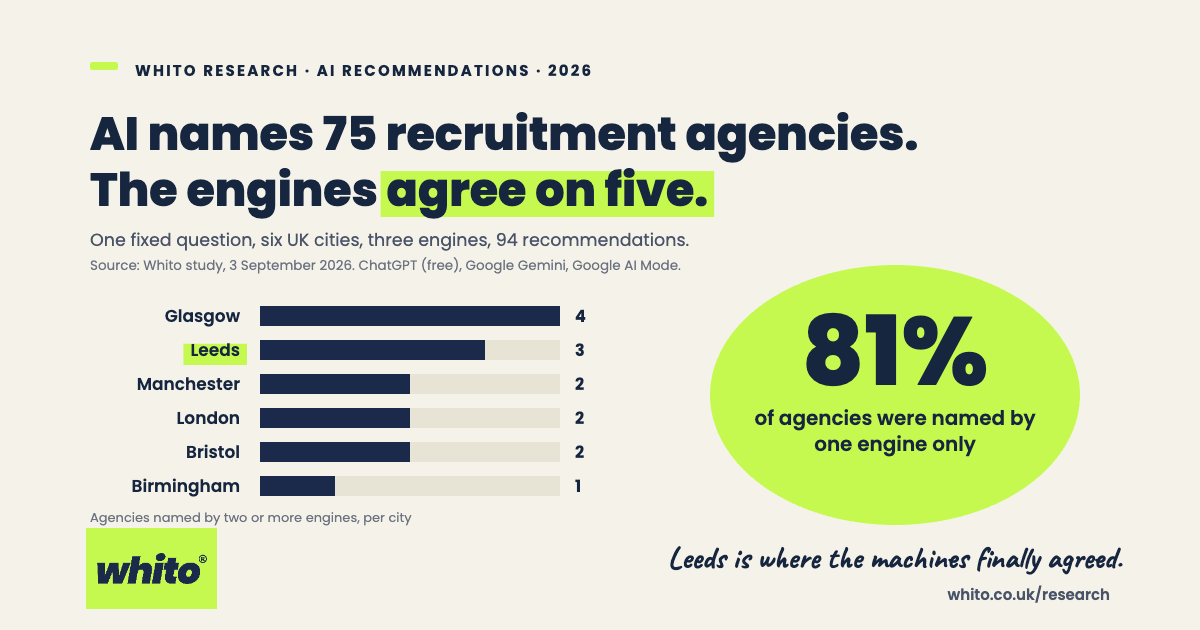
Ask ChatGPT, Gemini and Google AI Mode to name the best recruitment agency for a small business in the same six UK cities, on the same evening, and you get 94 recommendations pointing at 75 different agencies. 81% of those agencies were named by one engine and ignored by the other two.
That is the discovery layer your next client is already using. Most recruitment agencies are still optimising for a Google results page that their prospects are quietly abandoning, while three AI engines hand out shortlists with almost nothing in common.
Almost. Because one city broke the pattern, and the way it broke it is the most useful thing in this study.
What we did
On the evening of 3 September 2026 we asked one fixed question, worded identically every time:
“Who is the best recruitment agency for a business in [city]?”
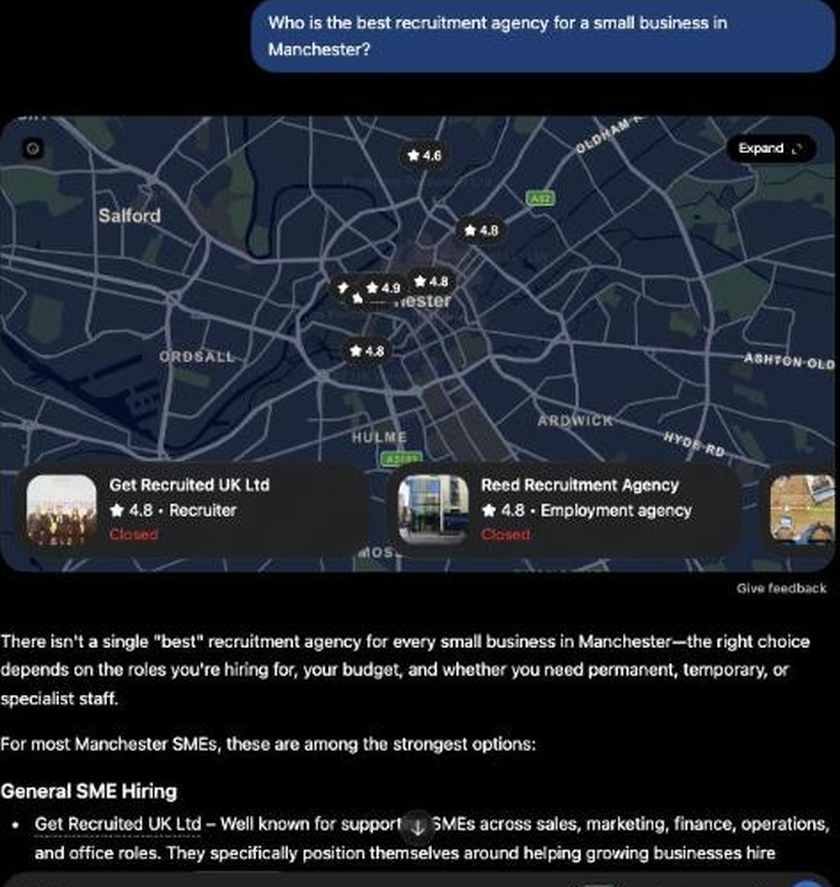
We asked it in Manchester, London, Birmingham, Leeds, Bristol and Glasgow, across three engines a real buyer would use free of charge: ChatGPT (free tier, with web search), Google Gemini (free app) and Google AI Mode. All 18 answers came back with named firms, from a UK browser on ordinary consumer accounts. This is the same method as our solicitor and mortgage adviser studies, so the results can sit side by side.
Every firm below is listed only because it appeared in an AI answer on that date. That is a fact about the engines, not a ranking of anyone’s quality.
The headline numbers
| Measure | Result |
|---|---|
| Answers collected | 18 (6 cities × 3 engines, complete grid) |
| Recommendation slots | 94 |
| Unique agencies named | 75 |
| Named by one engine only | 61 agencies (81%) |
| Named by two or more engines | 14 agencies (19%) |
| Named by all three engines | 5 (6.7%) |
The five full-consensus results: Reed in Manchester, Reed in London, and three independents in a single city, Leeds: Jo Holdsworth Recruitment, Lucy Walker Recruitment and Headway Recruitment.
For context across our series, three-engine agreement ran at 0.9% for accountants, 4.9% for solicitors and 7% for mortgage advisers. Recruitment lands at 6.7%. The engine line-ups changed between the earlier studies, so treat that as directional, but the shape holds: whoever a buyer asks, they mostly hear different names.
The Leeds anomaly
Leeds was the only city where all three engines agreed on more than one firm, and they agreed on three at once. Jo Holdsworth, Lucy Walker and Headway were named by ChatGPT, Gemini and Google AI Mode alike, and between them they filled most of every shortlist.
These are not the biggest names in the answers. They are decades-old local independents. What they share is exactly the evidence trail engines can read:
- Review volume. As quoted in the answers: Jo Holdsworth 4.8 from 370 Google reviews, Lucy Walker 4.8 from 315, Headway 4.9 from 225.
- SME wording on their own sites. Google AI Mode’s citation panel for Leeds included the firms’ own pages, among them a Headway article about how Leeds agencies help SMEs compete for talent. The engines quoted the positioning back almost word for word: “big agency expertise, small agency care” appeared in two engines’ answers.
- Longevity signals. “Operating for over 40 years” made it into the answer as evidence.
Nobody ranked these firms in a legal-style directory. They wrote their own evidence, and the machines read it.
Recruitment has no Chambers, and it shows
When we ran this exercise for solicitors, all three engines leaned on the same authority layer: Chambers, The Legal 500, ReviewSolicitors. Cited in answer after answer, that layer pulled the engines toward the same names.
Recruitment has no equivalent, and the citation trail proves it. Across 18 answers, the industry’s own trade bodies, the REC and APSCo, were cited exactly zero times. Not once, in any city, by any engine.
What filled the gap:
- Local listicle sites. ChatGPT’s citation chips included Master Manchester, grapevinebirmingham.com, ThreeBestRated, Good Companies, Agency Central and Recruitment Companies UK.
- A family of near-identically named “best of” sites. Best in Britain, Best in Hood, Best Local Rated and The Best Glasgow all appeared as sources under different city answers.
- Google’s own review data. Google AI Mode built its case for almost every firm from star ratings and review counts.
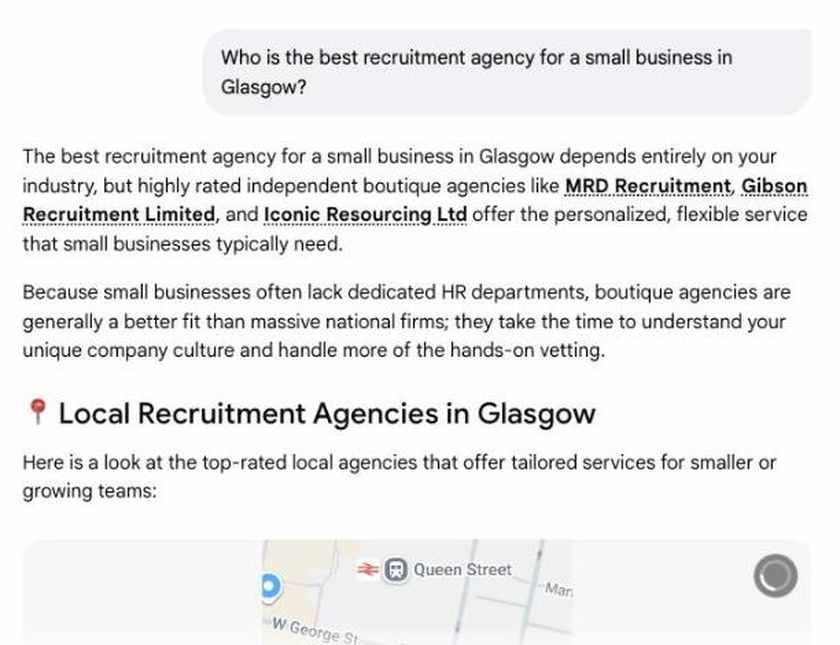
- Firms’ own websites. The clearest case in the whole study: ChatGPT’s top pick for Glasgow was Talentworx, and its citation was talentworx.co.uk, the firm’s own site. The answer repeated the firm’s positioning directly: it “explicitly positions itself around SMEs, offers flexible payment options and fixed-fee pricing”.
Write the page, and the engine may read it back to your next client. That is the whole mechanism, undiluted, because there is no directory layer in the way.
Reed is the exception to everything
One firm sat outside the fragmentation entirely. ChatGPT named Reed in all six cities, and Reed achieved full three-engine consensus in both Manchester and London. No other agency was named in more than one city by more than one engine.
The evidence engines quoted for Reed was scale itself: hundreds of Google reviews per branch, offices everywhere, “one of the UK’s largest recruiters”. A national footprint of well-reviewed local branches reads, to a machine, like dozens of well-evidenced local businesses that happen to share a name.
Star ratings are not the gate
In our mortgage adviser study, nearly every quoted rating was a flat 5.0. Recruitment looks different. The engines recommended firms whose own displayed ratings would alarm a cautious buyer:
- ChatGPT’s London shortlist included Michael Page, whose card in the same answer showed a 3.4 Google rating, the lowest we have seen quoted for any recommended firm in this series.
- Google AI Mode recommended Allstaff in Glasgow at 4.4, and a Leeds finance boutique with nine reviews.
Where engines quoted review data, the median count was 225, ranging from 9 to over 2,700. Volume was doing the work: the answers repeatedly paired a rating with its count, and thin review piles were quoted without comment. The gate is having a readable evidence trail at all, not having a perfect score.
The ads found their industry
Labelled adverts appeared beneath five of our six ChatGPT answers, the highest rate we have measured in this series. Under London, Birmingham and Leeds the advertiser was Capterra, pitching salary benchmarking and HR software. Under Manchester and Bristol it was Gi Group, a temporary staffing company, introduced with the line “for small-business hiring in Manchester, here’s a temp staffing option”.

That is a first for this series: an advertiser from the same industry as the question, occupying the paid slot beneath a list of its competitors. To be precise about what we saw: the ads are clearly labelled, they sit apart from the organic answer, and no advertiser appeared in any organic list. The paid and organic layers carried entirely different names. But if you are a recruitment agency, it is worth knowing that the space directly under “who is the best recruitment agency” is now for sale, and someone in your industry is buying it.
One more thing the widget did
In Birmingham, ChatGPT’s map widget confidently carded Tradewind Recruitment at 4.8 stars among its recommendations. Three paragraphs later, the same answer’s text said Tradewind “is education-focused, so not ideal here” and recommended someone else for industrial staffing. The retrieval layer and the reasoning layer disagreed in a single answer. Buyers will notice things like this; it is also a reminder that what an engine says about your firm can be assembled from parts that have never met.
What this means if you run an agency
Everything above points the same way, and none of it needs a big budget. Our marketing guide for recruitment agencies covers the foundations; this study adds five specifics.
- Say who you serve, on your own site, in the buyer’s words. Talentworx got ChatGPT’s Glasgow top slot with a page that says SME, flexible payment, fixed fee. The Leeds three wrote SME-focused content that AI Mode cited directly. “Multi-sector talent solutions” matches nothing a small business owner actually asks.
- Build Google review volume, steadily. The engines quoted counts alongside ratings in nearly every answer. 225 was the median where quoted. A standing ask at every placement beats a yearly push.
- Get onto the local lists that engines actually read. ThreeBestRated, the city listicles, Agency Central. They are not glamorous, but they were the citations. Check what each one currently says about you.
- Do not expect your trade body to do this for you. REC membership may matter to clients and compliance. On this evidence it contributes nothing to AI visibility, because no engine ever cited it.
- Check your own shortlist quarterly. Ask the three engines this exact question for your city and log who is named. It costs an hour and tells you if any of this is moving.
Limitations
This is a snapshot: one evening, 3 September 2026, one account state per engine. AI answers vary by day, session, account and location, and a different evening would produce different lists. One prompt shape was tested; practice-area or sector-specific prompts were not. Ratings and review counts are as the engines quoted them at answer time, not independently audited. Gemini’s free tier showed no citations, so its lists are model output rather than sourced claims. Later ChatGPT answers ran under a free-tier usage restriction that limits files and images; text answers were unaffected. Comparisons with our earlier studies are directional where the engine line-up differed. Firms are described throughout as “appeared in an AI answer on this date”, and nothing here assesses any firm’s quality as a recruiter.
Every figure in this piece comes from the full answer logs recorded during the run. Journalists and researchers are welcome to quote this study with a link; if you would like the underlying per-city grid, or you are one of the firms named and want to add context, email hello@whito.co.uk.
If your business is named here and you think we have a fact wrong, email hello@whito.co.uk and we will check it and correct it. If you want to respond, send us a statement and we will publish it alongside. Full detail: Corrections, right of reply and removals.