
Last Updated on September 8, 2026
Most UK businesses have an email list they never use. Or they send one newsletter a year at Christmas. Or they bought Mailchimp, set it up, and then forgot about it entirely.
Meanwhile, email marketing consistently delivers the highest return on investment of any marketing channel. Not by a small margin. By a factor of four or five over the next best option.
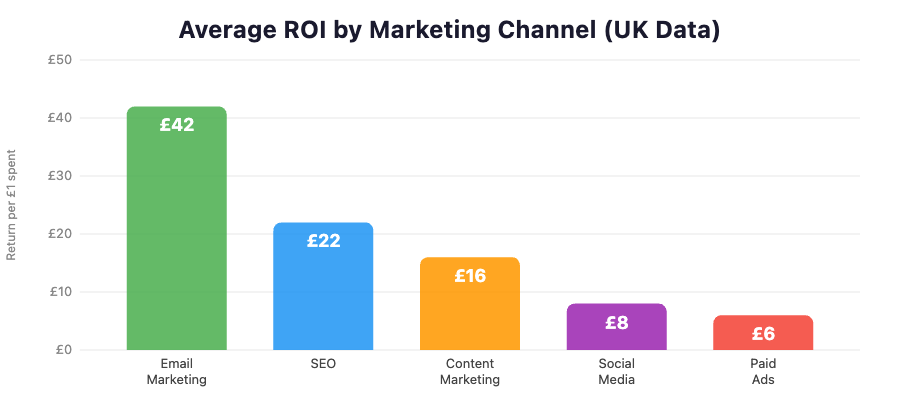
The DMA’s 2025 UK Email Benchmarking Report found that email generates an average return of £42 for every £1 spent. That is higher than SEO, higher than social media, higher than paid ads. And yet it is the channel most UK small businesses either ignore or do badly.
This guide covers how to use email marketing properly. Not theory. Not “best practices” from American SaaS companies. Practical steps for UK businesses that want to turn their email list into a consistent source of enquiries and revenue.
Why email still beats everything else
Social media algorithms decide who sees your posts. Google can change its rankings overnight. Paid ads stop the moment you stop paying. Email is different because you own the list.
When you send an email, it lands in someone’s inbox. They chose to be there. They gave you permission. That is a fundamentally different relationship from someone scrolling past your Instagram post.
Here is why email works so well for businesses specifically:
You control it. No algorithm changes. No platform updates. No paying to reach people who already follow you. Your email list is yours.
It scales without scaling cost. Sending an email to 500 people costs the same as sending it to 50. Most platforms offer free tiers that cover the first 500 to 1,000 subscribers.
It builds trust over time. A weekly or fortnightly email keeps your business in someone’s mind without being pushy. When they need what you sell, you are the first name they think of.
It converts better than any other channel. People who give you their email address are warmer than social media followers. They have already taken an action that says “I am interested.”
| Channel | Avg. ROI per £1 | You Own the Audience? | Cost to Start |
|---|---|---|---|
| Email marketing | £42 | Yes | Free (most platforms) |
| SEO | £22 | No (Google owns it) | Free to £2,000+/mo |
| Content marketing | £16 | Partially | Free to £1,000+/mo |
| Social media | £8 | No (platform owns it) | Free |
| Paid ads (PPC) | £6 | No | £300+/mo |
The numbers speak for themselves. But they only work if you actually send emails. An unused list has zero ROI.
How to build an email list from scratch
The hardest part of email marketing is getting the first 100 subscribers. After that, growth compounds. But most businesses stall at zero because they add a “subscribe to our newsletter” box to their website and wonder why nobody signs up.
Nobody wants a newsletter. They want something useful. The fix is simple: offer something worth exchanging an email address for.
Lead magnets that work for UK businesses
A lead magnet is the thing you give away in exchange for an email address. It needs to be specific, useful, and quick to consume. Here are formats that work well for different business types:
| Business Type | Lead Magnet Ideas | Why It Works |
|---|---|---|
| Tradespeople | “Home maintenance checklist” or “10 questions to ask before hiring a [trade]” | Practical, positions you as the expert |
| Professional services | “Free audit” or “Pricing guide” for your industry | Qualifies the lead while providing value |
| E-commerce | 10% discount code or “buyer’s guide” | Direct revenue driver, immediate incentive |
| B2B / consultancies | Industry report, case study template, or ROI calculator | Demonstrates expertise, attracts decision-makers |
| Local businesses | “Local guide to [topic]” or seasonal offers | Community relevance, builds local trust |
The best lead magnets solve a specific problem your ideal customer has right now. “Subscribe to our newsletter” solves nothing. “Download our free guide to reducing your energy bills this winter” solves a problem today.
Where to put your signup forms
Once you have a lead magnet, you need to make it easy to find. These are the highest-converting placements for business websites:
Homepage hero section. Above the fold, with a clear headline about what they get. This is your highest-traffic page, so use it.
End of every blog post. Someone who read your entire article is engaged. Give them a reason to stay connected.
Exit-intent popup. Triggered when someone moves their cursor to leave. Slightly annoying, but effective. Use it sparingly and offer genuine value.
Service pages. Add a “not ready to enquire yet?” option with an email signup. Not everyone is ready to buy today, but they might be next month.
Google Business Profile. Link your lead magnet from your GBP profile under the “Products” or “Updates” section.
Choosing an email platform
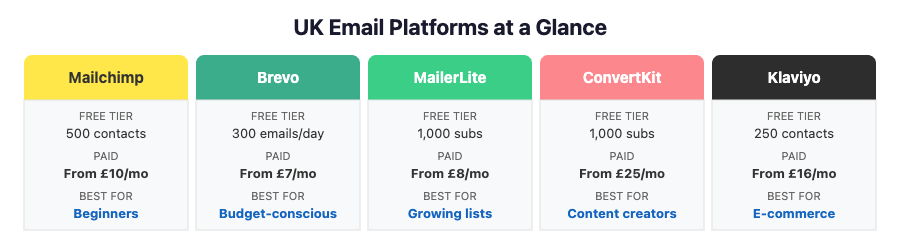
You do not need an expensive tool. Most UK businesses can start for free and only begin paying when their list passes 500 to 1,000 subscribers. Here is how the main platforms compare:
| Platform | Free Tier | Paid From | Best For | Watch Out For |
|---|---|---|---|---|
| Mailchimp | 500 contacts | £10/mo | Beginners, simple campaigns | Free tier is limited now, gets expensive fast |
| Brevo (Sendinblue) | 300 emails/day | £7/mo | Budget-conscious, transactional emails too | Interface less polished than competitors |
| MailerLite | 1,000 subscribers | £8/mo | Growing lists, good automation | Approval process to start |
| ConvertKit | 1,000 subscribers | £25/mo | Content creators, course sellers | More expensive, less visual design |
| Klaviyo | 250 contacts | £16/mo | E-commerce, Shopify integration | Overkill for service businesses |
Whito’s recommendation for most UK businesses: start with MailerLite or Brevo. Both have generous free tiers, solid automation features, and are simple enough that you will actually use them. Mailchimp is fine but its free tier has shrunk significantly and pricing scales quickly.
What to actually send
The biggest reason businesses abandon email marketing is they do not know what to write. The answer is simpler than you think: send things that are useful to your customers.
You are not writing a magazine. You are staying in touch with people who might buy from you. That changes the bar considerably.
| Email Type | What It Does | How Often | Example |
|---|---|---|---|
| Welcome sequence | Introduces your business, builds trust | Automated, one-time | 5 emails over 12 days |
| Regular newsletter | Stays top of mind, provides value | Weekly or fortnightly | Industry tip + business update |
| Promotional email | Drives sales or bookings | Monthly or seasonal | New service launch, limited offer |
| Re-engagement | Wins back inactive subscribers | Every 3 to 6 months | “Still interested?” with an incentive |
| Transactional/follow-up | Post-purchase care, review requests | Automated after purchase | Thank you + review request 7 days later |
Your first automated sequence
Before you worry about weekly newsletters, set up one thing: a welcome sequence. This is a series of automated emails that go out when someone joins your list. You write them once and they run forever.
A welcome sequence does three jobs: delivers what you promised (the lead magnet), introduces your business, and makes a soft offer. Here is a simple five-email structure that works for most UK businesses:
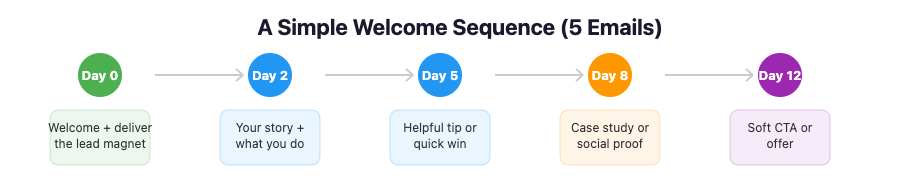
Email 1 (Day 0): Welcome and deliver. Thank them for signing up, deliver the lead magnet, set expectations for what comes next. Keep it short.
Email 2 (Day 2): Your story. Who you are, why you started, what you believe. People buy from people, especially in business. One or two paragraphs is enough.
Email 3 (Day 5): A quick win. Share your best tip, a common mistake to avoid, or a simple action they can take today. This builds trust and demonstrates your expertise.
Email 4 (Day 8): Social proof. A customer story, a result you achieved, or a testimonial. Let someone else say you are good at what you do.
Email 5 (Day 12): The soft offer. Invite them to take the next step: book a call, request a quote, visit your shop, or use a discount code. By now, they know you, trust you, and are ready to consider buying.
This sequence will outperform any single promotional blast because it builds the relationship before asking for anything. Most email platforms let you set this up in under an hour using their automation builder.
How often should you send?
The honest answer: as often as you can be genuinely useful. For most UK businesses, that means weekly or fortnightly. Monthly is the minimum to stay relevant. Less than monthly and people forget who you are.
The fear of “sending too many emails” is almost always unfounded. People unsubscribe because emails are boring or irrelevant, not because they arrive too often. If every email gives someone a reason to open it, frequency is rarely a problem.
| Frequency | Works Well For | Realistic If… |
|---|---|---|
| Weekly | Content-led businesses, consultancies, coaches | You can commit 30 to 60 minutes per week to writing |
| Fortnightly | Most service businesses, trades, B2B | You have enough to say but not enough time for weekly |
| Monthly | Seasonal businesses, product-based businesses | The bare minimum to maintain a relationship |
Pick a frequency you can maintain for six months. Consistency matters more than frequency. A fortnightly email that goes out every other Tuesday for a year will beat a weekly email that stops after three weeks.
The numbers that matter
You do not need to obsess over analytics, but you should understand four metrics. These tell you whether your emails are working and where to improve.
| Metric | What It Tells You | UK Average | If It Is Low… |
|---|---|---|---|
| Open rate | How many people opened your email | 21% to 25% | Your subject lines need work |
| Click rate | How many clicked a link in the email | 2% to 4% | Your content or CTA is not compelling |
| Unsubscribe rate | How many opted out | Under 0.5% | Normal. Above 1%: check relevance |
| Conversion rate | How many took the action you wanted | 1% to 3% | Your offer or landing page needs work |
Small lists often have higher open rates than large ones, so do not panic if your numbers look different to industry benchmarks. What matters is the trend: are your rates stable or improving over time?
Five mistakes UK small businesses keep making
1. Buying an email list. It is illegal under UK GDPR, it destroys your sender reputation, and the people on it did not ask to hear from you. Never do this.
2. Only emailing when you want something. If every email is “buy our thing,” people stop opening them. The ratio should be roughly 80% value, 20% promotion.
3. Not having a signup form on your website. You would be surprised how many businesses have no way for visitors to join their email list.
4. Overdesigning emails. Plain text emails or simple designs with one image often outperform heavily branded templates. People read emails, they do not admire them.
5. Not sending because it is not perfect. A good email sent today beats a perfect email never sent. Start messy. Improve as you go.
UK GDPR: What you need to know
Email marketing in the UK is governed by the UK GDPR and the Privacy and Electronic Communications Regulations (PECR). This is not as complicated as it sounds, but you do need to get it right.
Consent must be explicit. People must actively opt in. Pre-ticked boxes do not count. “By using this website you agree to receive emails” does not count. They need to take a clear action like ticking a box or typing their email into a signup form.
Every email must have an unsubscribe link. This is non-negotiable. All reputable email platforms add this automatically.
You must identify yourself. Your business name and a contact address (physical or email) must appear in every marketing email. Most platforms handle this in the footer.
The soft opt-in exception. If someone is an existing customer and you are emailing about similar products or services, you can email them without separate consent, as long as you gave them an opt-out when you collected their details and include an unsubscribe link in every email. This is useful for e-commerce and service businesses.
If in doubt, the ICO’s direct marketing guidance at ico.org.uk covers everything. The rules are common sense: get permission, be honest about who you are, and make it easy to stop.
Getting started this week
You do not need to do everything at once. Here is what you can realistically set up in your first week:
Day 1: Sign up for an email platform. MailerLite or Brevo. Free. Takes 10 minutes.
Day 2: Create your lead magnet. A one-page PDF, a checklist, or a short guide. Keep it simple. One useful thing.
Day 3: Add a signup form to your website. Homepage and at least one other high-traffic page. Connect it to your email platform.
Day 4-5: Write your welcome sequence. Five emails. Three to four paragraphs each. Use the structure above.
Day 6-7: Tell people about it. Post on social media. Add it to your email signature. Mention it to existing customers. Your first subscribers will come from people who already know you.
After the first week, commit to a regular sending schedule. Fortnightly is a good starting point. Put it in your calendar. Treat it like any other business task that needs doing.
Six months from now, you will have a list of people who know your business, trust your expertise, and are ready to buy when the time is right. That is an asset no algorithm change can take away from you.
Content Marketing for UK Businesses covers how to create the kind of content that drives email signups in the first place.
High-Converting Landing Pages explains how to build the pages your emails link to, so clicks actually turn into enquiries.
How to Choose an SEO Agency in the UK is worth reading if you are considering outsourcing your marketing, so email and SEO work together.