
Last Updated on November 6, 2026
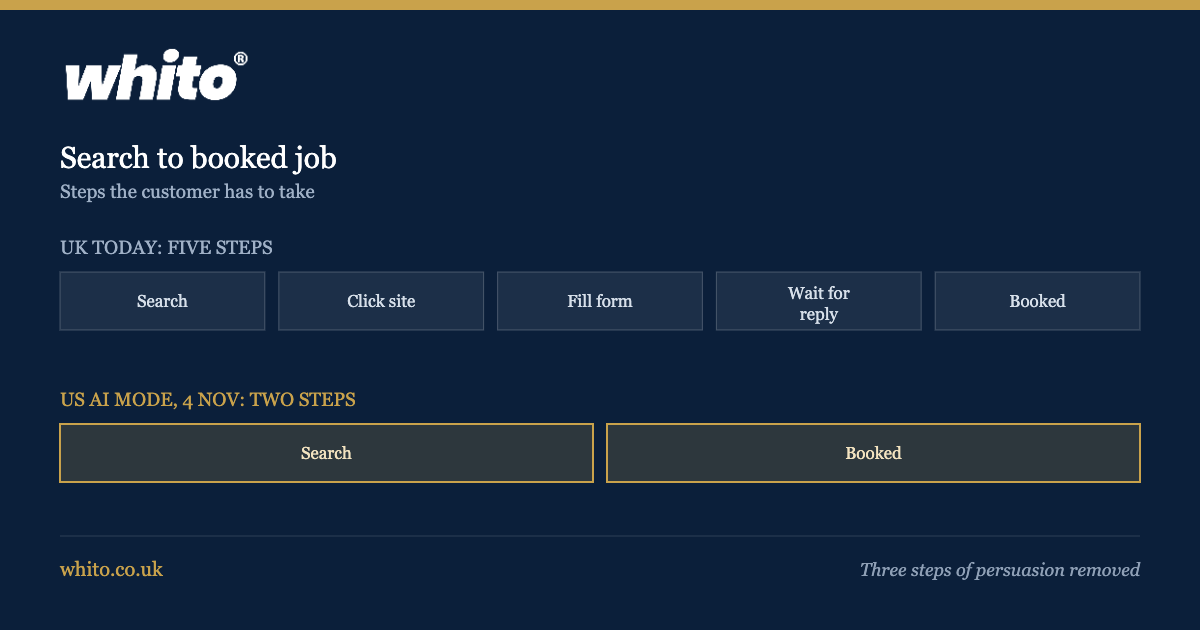
On 4 November, Google started letting people book a tradesperson without ever landing on that tradesperson’s website. Robby Stein, a vice president at Google, announced direct booking and quote links inside AI Mode. His video says it plainly: “It’s available now in the U.S.”
Not here. Not yet.
Most UK owners will read that second line and stop reading. That is the mistake.
What actually changed
In AI Mode, someone searching for a handyman or a plumber now sees local providers with ratings, short descriptions and, in Google’s demo, live appointment times. A button takes them through to book or request a quote.
The named partners are American platforms. Angi and Thumbtack on the marketplace side, Housecall Pro and Jobber on the job management side, with ServiceTitan coming soon. Barry Schwartz at Search Engine Roundtable reports the feature is United States only at this time, though that is his reading rather than a sentence Google published. Google has not said when, or whether, this reaches Britain, so we are not going to guess.
Why a US-only feature is still your problem
Because the requirements arrived ahead of the feature. Look at what a business needs in place to show up. Search Engine Journal’s write-up of Jobber’s own guidance for US customers is specific: an active paid subscription, a full address, and a Google Business Profile connected to the same location, with the booking form assigned to Google. Housecall Pro auto-enrols its users and pulls appointment slots straight from their calendar.
Strip out the software contracts and a short list is left. A complete and correct Business Profile. Real reviews. Live availability. A way to book rather than a form that lands in an inbox.
None of that is new, and none of it is American. Every item already decides who gets the call in Britain today, with no AI involved at all.
| What the US booking route asks for | What that means for a UK business now |
|---|---|
| Business Profile connected to the same physical address | Your profile is complete, the address matches your website, and nothing is years out of date |
| Ratings and reviews shown beside the listing | A steady habit of asking for reviews, not a burst of five in one week |
| Live appointment slots pulled from a calendar | You can actually say when you are free without three phone calls |
| A booking form, not a request form | Someone can commit to a slot on your site rather than send a message and wait |
The honest version of “how to get picked”
This is where most coverage of this story will go wrong. Google has not explained how it chooses which businesses appear. Stein’s announcement does not say, and Google’s help page on local availability in AI Mode does not mention partner links at all.
Jobber’s help page suggests that collecting client reviews and using a booking form instead of a request form may make Google AI Mode recommend a business more often. Read that word again. May. That is a software company’s informed guess about a system its own partner has not documented.
We have tested the British end of this. When we asked three AI assistants for an emergency plumber and then checked all 32 businesses they named, the thing that separated the firms that got named was not clever optimisation. It was existing, verifiable presence. We now run that check as a monthly tracker of who AI names, who is real and what they charge.
The uncomfortable bit. A booking button inside search means the customer never sees your website and never gets to be persuaded. They get a rating, a line of description and a time slot. If your business only wins work once someone has read three pages and spoken to you, a booking button will expose that, not cause it.
The lead fee question nobody has answered
Jobber and Housecall Pro both say there is no lead fee on bookings arriving this way. Housecall Pro’s co-founder Roland Ligtenberg puts it as “One request, one Pro, no lead fee, no bidding war.”
Worth holding that next to something else. Google’s own Local Services Ads documentation treats a booking request as a billable lead in the US and Canada. Angi’s annual report says pros pay fees for consumer matches, and its AI Mode announcement does not say whether those fees apply to quotes started in AI Mode. So “free” depends on which door the customer came through. If this arrives here, that is the first question to ask, not the last.
What to do with the head start
Nothing clever. This is Start stage work, and it is dull on purpose.
Open your Google Business Profile and read it as a stranger would. Check the address, the opening hours, the services list and the phone number. Fix what is wrong today rather than putting it on a list.
Then look at how someone books you. If the only route is a contact form reaching an inbox you check twice a day, you are losing work now, to competitors whose phone gets answered, never mind to a booking button later. Our directory of UK plumbers shows the kind of information trades do and do not publish.
Get your review habit running weekly. Not a campaign, a habit.
And put a date in the diary. Google owes UK businesses a slice of its AI search data, and most firms do not know they count.
The takeaway
A booking button is not a marketing opportunity. It is a test of whether your foundations are in order, applied by a machine, at speed, with no benefit of the doubt.
The firms that win when this crosses the Atlantic will not be the ones who optimised for it. They will be the ones who already had a correct address, honest reviews and a calendar someone could book. You can build all three this month, without buying a thing, while the feature is still three thousand miles away.
That is the head start. Most will spend it waiting for an announcement.