
Last Updated on November 4, 2026
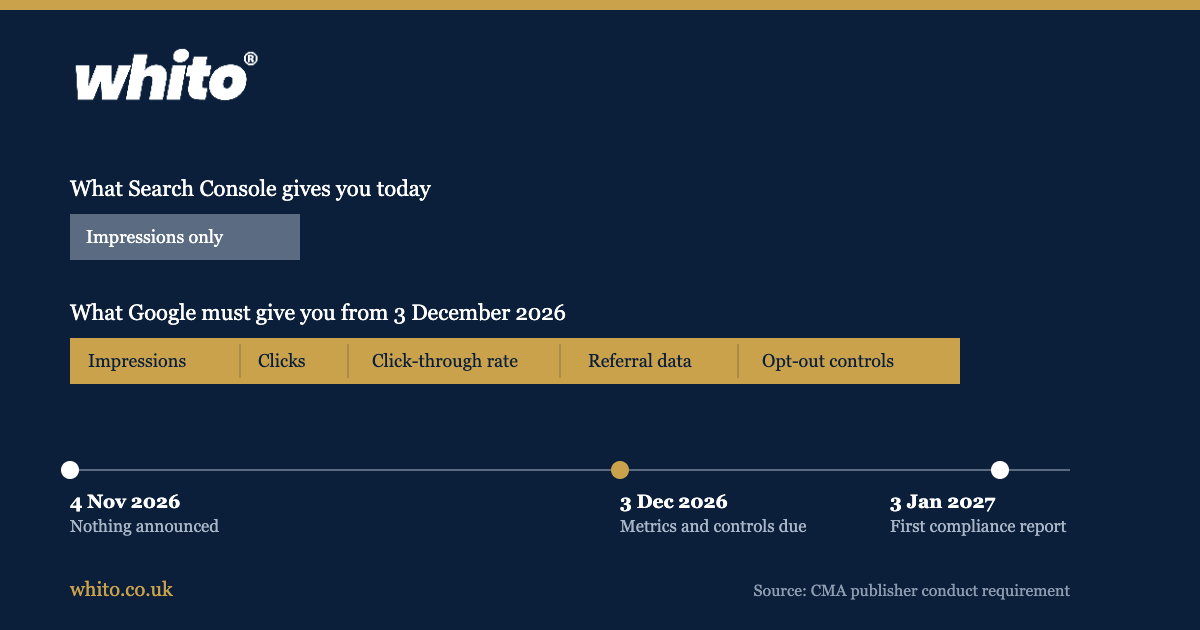
Most UK business owners have spent eighteen months guessing what AI answers are doing to their traffic. On 3 December that stops being a guess. Almost nobody has put the date in their diary.
What is actually happening
The Competition and Markets Authority, the UK competition regulator, has placed a set of binding rules on Google. The rules are called a publisher conduct requirement. Google has until 3 December 2026 to comply.
Half of it is about control. Website owners get to withhold their content from Google’s AI training, and from the AI answers inside search such as AI Overviews and AI Mode.
The other half is about numbers. Google has to start reporting what those AI features actually do with your pages.
The word that makes this about you
Here is the line most coverage skips. The CMA’s own document defines a publisher as “any party that makes content available on the web”.
Not newspapers. Not media groups. Any website.
If you are a plumber in Leeds with twelve pages and a contact form, you are a publisher under this rule. The rights apply to you. So do the numbers.
That is the mistake being made right now. Owners read the word “publisher”, file the story under media news, then wonder in January why someone else in their trade knew something they did not.
What Google has to hand over
| What the rules require | What it means for your business |
|---|---|
| Impressions, clicks and click-through rate for AI search features | A real number, at last, for how often you turn up inside AI answers and how often anyone clicks through to you |
| Figures aggregated across features such as AI Overviews and AI Mode | One combined view. The wording does not promise you a separate line for each feature |
| Referral data | Enough to judge whether the AI traffic is any good, not only how much of it there is |
| Controls to withhold your content from AI training and from AI answers in search | A genuine opt-out. Google must not punish you in ordinary search for using it |
| A page-level control | Not on 3 December. Google gets an extra three months to build this one |
The control over AI answers in search has to work at directory and page level, so in principle you can hold back one section of your site rather than all of it. The CMA document gives Google an extra three months for the page-level part and sets no precise date for it.
What Google has said about it
Very little. Search Engine Journal reported on 2 November that Gary Illyes of Google answered a LinkedIn post about AI click and query data by saying the team is “super interested in giving more data, data that makes sense, but we don’t have anything to announce yet”.
Be careful what you read into that. Illyes was replying to a general question about Search Console. He was not asked about the UK rules and did not mention them. It is not an admission that Google will miss the deadline.
What it does tell you is that with a month to go, nothing has been announced. Search Console today counts impressions for AI Overviews and AI Mode together, and folds any clicks in with all other web results, so you cannot pull them apart. We wrote about what you can measure while Search Console stays quiet when Google made those AI links more prominent in October.
One more date worth knowing. Search Engine Journal, reading the CMA’s documents, reports that Google’s first compliance report covers 3 June to 3 December and is due on 3 January 2027. If the data is thin, that report is where it will show.
The opt-out is not the free move it looks like
Plenty of owners will read “you can opt out of AI answers” and reach for the switch. Slow down.
Withholding your content from AI answers is not a tidy, isolated choice, and the trade-offs show in how Google’s existing controls behave. We covered it here: the Google AI opt-out takes your ordinary search snippet with it. Read that before you touch anything.
For most small businesses the honest answer is that you do not have enough information to make this decision yet. That is precisely why the measurement half of these rules matters more than the control half.
Four things to do before 3 December
1. Write down today’s numbers. Search Console impressions and clicks, sessions, phone enquiries, form fills. One row, today’s date. When December’s data arrives you will need something to compare it against, and nobody is going to backfill it for you.
2. Check you can get into Search Console. A surprising number of businesses cannot, because an old agency set it up. If the new reporting lands there and you have no access, you get none of the benefit. Sort the login out this month.
3. Decide your position on the controls in advance. Not on the day. Write down, in one line, whether you want to be in AI answers or out of them, and why. Then test that view against the data when it arrives.
4. Measure the thing Google is not promising. None of this tells you whether an AI assistant recommends you by name when someone asks for a business like yours. We checked that ourselves: we asked three AI assistants for an emergency plumber, then checked all 32 businesses they named. If you want to track it continuously, we priced eight AI visibility trackers in pounds.
The takeaway
A regulator has forced the biggest search company in the world to tell UK website owners what its AI does with their content. That is unusual, and it costs you nothing.
The businesses that get value out of it will be the ones holding a baseline from before it started. The ones that get nothing will be the ones who find out in February that the data has been sitting in an account they cannot log into.
Structure before scale. A number you can trust in December beats a tactic you guessed at in November.