Last Updated on November 2, 2026
Last week a test of Google’s AI opt-out produced a result that was written up as a surprise. A site was removed from AI Overviews and AI Mode, and its ordinary organic clicks fell as well.
It is not a surprise. It is in Google’s documentation, in plain English, and almost nobody quoting the opt-out mentions it.
What the test found
On 30 October, Search Engine Roundtable reported a small case study by Cyrus Shepard. He used Google’s generative AI controls to take one site out of AI Overviews and AI Mode, then watched Search Console.
The AI impressions went to zero straight away. That part did what it says. The part that drew attention was the other result: regular organic clicks dropped too. Shepard puts AI impressions at about 8% of that site’s total, and estimates the click-through rate on them at roughly 0.9%.
What that 0.9% actually compares
It is one site. The figure is not measured directly, it is estimated by subtracting known AI impressions from the site’s overall impressions and click-through rate. Barry Schwartz, who reported it, calls it a “super limited study based on a small sample size”.
And the AI Overview still appeared on those result pages throughout. The site was taken out of the box, not the box off the page. So the test says nothing about what happens when there is no AI answer at all.
What the control actually does
There is no AI-only switch. The control is the nosnippet robots rule, or max-snippet:0, which Google’s specification says is equivalent to it. Here is Google’s own wording:
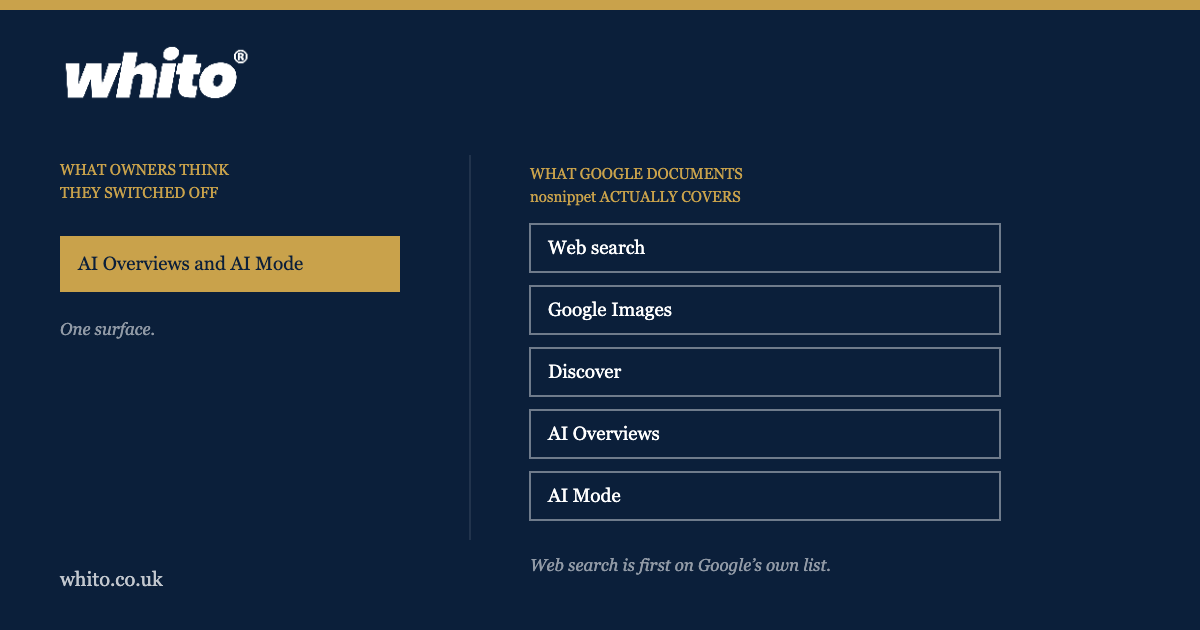
“Do not show a text snippet or video preview in the search results for this page. A static image thumbnail (if available) may still be visible, when it results in a better user experience. This applies to all forms of search results (at Google: web search, Google Images, Discover, AI Overviews, AI Mode) and will also prevent the content from being used as a direct input for AI Overviews and AI Mode.”
Read the order of that list. Web search is first. AI Overviews and AI Mode are last.
This is a snippet switch, and AI happens to be one of the things it covers. Turn it on and the two lines of description under your blue link in normal Google results go too. The organic click drop in that test is the documented behaviour of the setting, not a mysterious halo effect.
The mistake most businesses are about to make
The mistake is treating this as a channel decision, as though AI search were a tap you can close while leaving everything else running.
| What owners think it does | What Google documents it does |
|---|---|
| Takes you out of AI Overviews and AI Mode | Removes your text snippet from web search, Google Images, Discover, AI Overviews and AI Mode |
| Takes the AI answer off the page | Takes you out of the AI answer. The answer still appears, built from somebody else |
| Costs nothing while it is on | Costs you your ordinary search snippet for the whole time it is on |
| Is a tick box in Search Console | Is a robots rule your site has to serve, in the page head or an HTTP header |
That last row matters more than it looks. Because the rule lives in your markup or your server config, a plugin, a theme setting or a developer can switch it on without anyone deciding to. We found this pattern the hard way when we audited trade websites and one in nine were shutting out automated readers without knowing it. Nobody had chosen that either.
What to do instead
Check before you touch anything. Open your most important page, view source, and search the head for nosnippet and max-snippet. Check your HTTP headers for X-Robots-Tag too. If a rule is already there and you did not put it there, that is today’s job, not the AI question.
Do not add it as a defence. You are trading a snippet that earns clicks for removal from a box that will still be there without you. On the evidence available, that is a bad trade, and the evidence that it is a bad trade is one small case study, which is reason to be careful rather than confident in either direction.
Use the narrow tools if you have a real problem. If one block of text genuinely should not be quoted, Google’s data-nosnippet attribute works on a single span, div or section rather than the whole page. And the documentation is clear that structured data stays usable for search results even inside a data-nosnippet element, so controlling your schema is a separate lever from controlling your snippet.
Measure what you can, and know what you cannot. Search Console’s generative AI report gives impressions and no clicks, which is the reason a test like this has to estimate its headline figure at all. We wrote about that gap when Google made its AI answers more clickable without counting the clicks. If you want a number to argue with, our UK AI search and trust statistics are a better starting point than one site’s Search Console, and the AI visibility trackers we priced in pounds will at least tell you whether you are being quoted.
The takeaway
You cannot opt out of being compared. You can only opt out of being quoted, and Google’s documentation says the price of that is your ordinary search snippet as well.
The lever worth pulling is not a robots rule. It is being the page that is worth quoting in the first place. Check your markup this week for a rule nobody meant to set. Then leave the switch alone.