Finding
29 of 100 limited-company listings on five UK business directories could not be resolved to an active company on the Companies House register, with Hotfrog failing on 11 of 20 listings and Yell passing all 20, in Whito's July 2026 check.
Source: Whito, whito.co.uk/research/uk-directory-dead-listings-study, July 2026. Free to quote with a link to this page.
Last Updated on September 29, 2026
Published by Whito Research · Last updated 5 July 2026 · Data checked July 2026
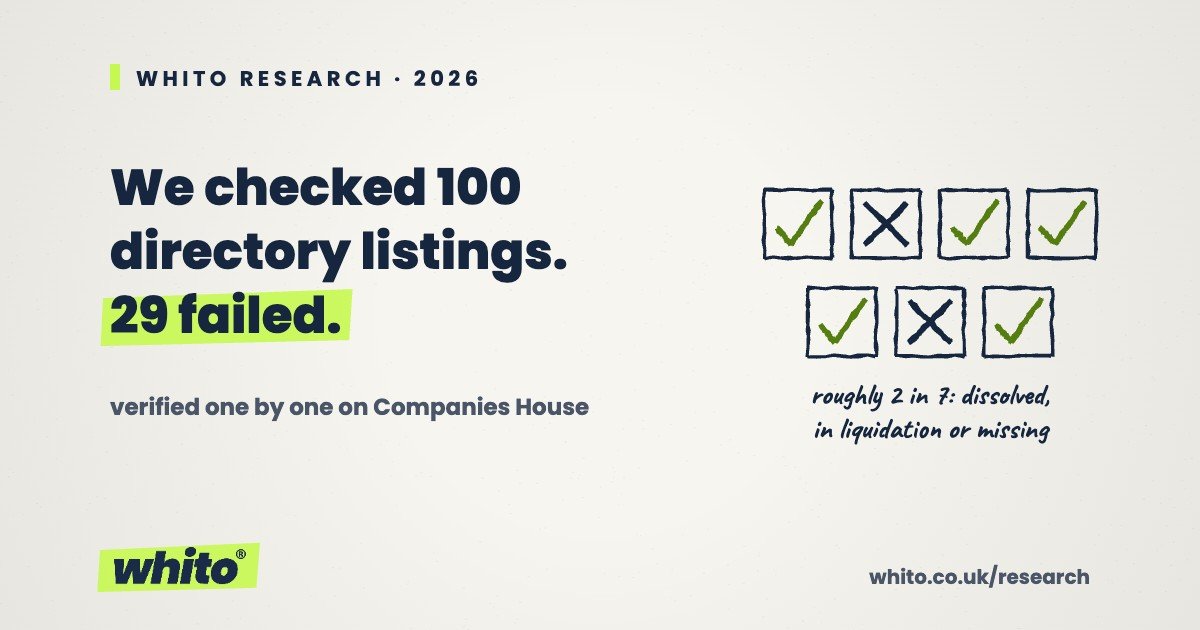
We took 100 limited-company listings from five well known UK business directories and looked every one of them up on the Companies House register. 71 belonged to an active company. The other 29 pointed at businesses that are dissolved, in liquidation, facing strike-off, or that have never existed on the register at all.
A directory listing feels like proof. There is a name, an address, a phone number, sometimes a review or two. It reads like evidence that a real business is at the other end.
Often it is not. One builder we found is still listed in Birmingham with a city-centre address, thirteen years and ten months after the company at that address was dissolved. One Manchester heating firm, dissolved in 2016, is still listed on two of the five directories we checked. One London roofing company was dissolved in January this year and its listing carries on regardless.
So we measured it properly.
Key findings
- 100 limited-company listings sampled from 5 UK directories (Yell, Thomson Local, Cylex, Hotfrog, Bizify), across electricians in Leeds, plumbers in Manchester, builders in Birmingham and roofers in London.
- 71 resolved to an active company on the Companies House register. 29 did not.
- 16 listings pointed at companies that are dissolved (10), in liquidation (3) or facing strike-off (3).
- 7 listings carried a Ltd or Limited name that does not exist on the register at all.
- 6 could not be matched to any single live company.
- Worst performer: Hotfrog, where 11 of 20 listings (55%) failed. Best: Yell, where all 20 passed.
- The stalest listing points at a company dissolved in September 2012, almost 14 years ago.
The mistake most people make about directories
The mistake is assuming that somebody checks. That when a business appears in a directory, someone has confirmed it still exists, still trades, and still answers the phone.
Most directories do not work that way. A listing is created once, often scraped or bought in bulk years ago, and then it sits there. There is no annual re-check. Companies die, and their listings do not.
The official register has the same honesty problem in reverse. Companies House itself states that it does not have “the statutory power or capability to verify the accuracy of the information that companies send to us”. The register is the best public record we have of whether a company exists, but nobody upstream is verifying the directories that borrow its credibility.
What we found, directory by directory
We used one rule and no judgement calls: walking down each directory’s search results in the order shown, we took every listing whose name contained Ltd, Limited, LLP or PLC until we had 20 per directory, then looked each one up on the register. A limited company name is a checkable claim. Either the company exists and is active, or it is not.
| Directory | Checked | Active | Dissolved | Liquidation | Strike-off pending | Not on register | Unmatchable | Failed |
|---|---|---|---|---|---|---|---|---|
| Yell | 20 | 20 | 0 | 0 | 0 | 0 | 0 | 0% |
| Thomson Local | 20 | 17 | 2 | 0 | 0 | 1 | 0 | 15% |
| Bizify | 20 | 13 | 3 | 0 | 0 | 1 | 3 | 35% |
| Cylex | 20 | 12 | 1 | 3 | 3 | 0 | 1 | 40% |
| Hotfrog | 20 | 9 | 4 | 0 | 0 | 5 | 2 | 55% |
| Total | 100 | 71 | 10 | 3 | 3 | 7 | 6 | 29% |
The spread matters as much as the total. Yell, which sells listings and manages its marketplace, came out clean: every one of its 20 Ltd-named listings matched an active company. The failures pile up in the free-listing aggregators, where data arrives in bulk and nobody is paid to prune it.
The dead businesses still taking enquiries
Some of these are not borderline. They are companies that stopped existing years ago, still presented as open for business.
Dissolved in 2012, still listed in 2026
Thomson Local lists Central Property Services Ltd as a Birmingham builder at Aspect Court, 4 Temple Row. The register shows Central Property Services (UK) Limited at exactly that address, dissolved on 4 September 2012. The listing has outlived the company by almost 14 years.
One dead company, two directories
South Manchester Heating Ltd was dissolved on 15 March 2016. Ten years on, it is still listed as a Manchester plumber on both Hotfrog and Bizify, at the same Barlow Moor Road address the dissolved company was registered at. On Bizify it even carries a customer review.
Dead this year, listing untouched
Homefix Roofing Ltd of 7 Bell Yard, London, was dissolved on 27 January 2026. Its Hotfrog listing, name and registered address matching exactly, is still up. Hok Electrical Services Ltd, dissolved September 2024, is still the sixth electrician Thomson Local offers for Leeds.
Dying in plain sight
Cylex was the grimmest reading. Three of its 20 listings are companies currently in liquidation, and three more have an active proposal to strike off against them, in two cases at a registered office identical to the listing address. That is six businesses a customer could ring today that are already in the departure lounge.
Update, 28 September 2026: twelve weeks after this study, all 20 Cylex listings were still live, and 8 of them still did not lead to an active company. We then checked 100 more Cylex listings in ten other trade and city pages: 18 of 100 did not lead to an active company.
Every listing that failed
| Directory | Listing name | Sampled as | Register outcome |
|---|---|---|---|
| Dissolved | |||
| Thomson Local | Central Property Services Ltd | Builder, Birmingham | Dissolved 4 September 2012 |
| Hotfrog | Flair Builders Ltd | Builder, Birmingham | Dissolved 26 May 2013 |
| Hotfrog + Bizify | South Manchester Heating Ltd | Plumber, Manchester | Dissolved 15 March 2016 (listed on both directories) |
| Bizify | Staysafe Heating & Electrical Ltd | Plumber, Salford | Dissolved 28 May 2019 |
| Hotfrog | Bluewater Plumbers Ltd | Plumber, Manchester | Dissolved 11 May 2022 |
| Cylex | Foster Electrical Contractors Ltd | Electrician, Leeds | Dissolved 22 June 2024 |
| Thomson Local | Hok Electrical Services Ltd | Electrician, Leeds | Dissolved 24 September 2024 |
| Bizify | EJ Roberts Roofing Ltd | Roofer, London | Dissolved 26 July 2025, after insolvency |
| Hotfrog | Homefix Roofing Ltd | Roofer, London | Dissolved 27 January 2026 |
| In liquidation | |||
| Cylex | Gravitas Build Ltd | Builder, Birmingham | Liquidation |
| Cylex | S S Builders (Euro) Ltd | Builder, Birmingham | Liquidation |
| Cylex | Chris Ball & Son Roofing Ltd | Roofer, London | Liquidation |
| Strike-off proposal against the company | |||
| Cylex | AGA Plumbing & Heating Ltd | Plumber, Manchester | Active proposal to strike off (registered office matches listing address) |
| Cylex | Irlam Heating & Plumbing Company Limited | Plumber, Manchester | Active proposal to strike off |
| Cylex | Dalton Construction (Solihull) Ltd | Builder, Birmingham | Active proposal to strike off (registered office matches listing address) |
| No such company on the register | |||
| Thomson Local | Boiler & Bath Ltd | Plumber, Manchester | No matching company, active or dissolved |
| Bizify | Acorn Complete Plumbing & Heating Ltd | Plumber, Manchester | No matching company |
| Hotfrog | PrimeFlow Plumbing and Heating Ltd | Plumber, Manchester | No matching company |
| Hotfrog | PrimeFix Plumbing Services Ltd | Plumber, Manchester | No matching company |
| Hotfrog | Data Builders Ltd | Builder, Birmingham | No matching company |
| Hotfrog | Gold Star Builders UK Limited | Builder, Birmingham | No matching company |
| Hotfrog | Roofer London Ltd | Roofer, London | No matching company (nearest, Roofers London Ltd, is dissolved) |
| Could not be matched to a single live company | |||
| Bizify | Pirelli Cables HV Systems Ltd | Electrician, Leeds | No exact register match; Pirelli’s UK cable arm was renamed around 2005, suggesting a roughly 20-year-old entry |
| Bizify | Manor House Ltd | Builder, Birmingham | Multiple exact-name companies, none tied to the listing address |
| Bizify | Damp-Tec Birmingham Ltd | Builder, Birmingham | No exact register match |
| Cylex | EPG Services Ltd | Plumber, Manchester | No plausible register match for a Manchester plumbing firm |
| Hotfrog | Emergency Electricians LTD | Electrician, Leeds | Two exact-name companies, neither in Leeds; one dissolved |
| Hotfrog | Thistle Roofing Services Limited | Roofer, London | Two exact-name candidates, neither matching the listing’s Chelsea address |
South Manchester Heating Ltd appears on two directories, so the table above shows 28 rows for 29 failed listings. Company statuses are point-in-time facts from the public register and may change after publication.
Beyond dead: the ghost listings
Verifying the Ltd names also forced us to read hundreds of surrounding results, and on Hotfrog the bigger story may not be the dead companies. It is the listings that were never companies at all.
In three of our four Hotfrog searches, roughly 16 or 17 of the first 20 results were keyword-stuffed lead-generation entries rather than identifiable businesses: names like “Electricians Leeds”, “Electrician in Leeds” and “24 hour emergency plumbers”, parked at city-centre virtual offices. One Manchester address, 83 Ducie Street, hosts five different “plumber” listings. One listing’s contact number is 055 5555 5555. A “London” roofer turned out to be in Toronto, and a “Birmingham” builder in Islamabad. The same mobile number appears on Gold Star Builders in Birmingham and Gold Star Roofers in London, and the related “Gold Star Builders UK Limited” has no Companies House record.
A customer searching those pages is not choosing between local tradespeople. They are choosing between marketing fronts, some of which route to nobody at all.
Why directories rot this fast
The churn built into the UK economy makes an unmaintained directory decay on a schedule.
Companies House removed 726,735 companies from the register in the year to March 2025, against 801,864 new incorporations, and the average dissolved company was just 4.5 years old. On the trading-business side, the ONS counted around 280,000 UK business deaths in 2024, a death rate of 9.8%, and only 38.4% of businesses born in 2019 were still going five years later.
Put plainly: roughly one in ten trading businesses disappears each year. A directory that never re-checks its data does not stay 100% accurate and slowly degrade. It loses touch with reality at compound interest. Our 29% failure rate is not a scandal of individual bad actors. It is exactly what you would expect from data collected once and left alone for a decade.
The register itself is mid-clean-up for the same reason. Under the Economic Crime and Corporate Transparency Act, identity verification for directors became a legal requirement in November 2025, and Companies House expects 6 to 7 million people to verify by November 2026. The public record is being scrubbed. The directories that sit on top of it, mostly, are not.
Why this matters for your revenue
If you run a business, dead listings are not a victimless quirk. They are competition for attention that cannot serve the customer, sitting between you and the person searching.
It matters more now than it did five years ago, because people are not the only ones reading directories. AI tools are. When we asked ChatGPT, Gemini and Perplexity to name the best local tradespeople, the engines repeatedly leaned on directories as sources, and sometimes refused to answer with anything else. An AI that reads a directory where half the entries are dead or fake is an AI that recommends the dead and the fake. The 16.5 billion lookups the Companies House register served in a single year show how much checking now happens by machine.
And if you rely on directories for enquiries, the maths is unforgiving. Every dead or ghost listing above yours is a customer who rang a disconnected number before they found you, or gave up before they did.
A listing is a claim. The register is a check. Never confuse the two.
The sharp takeaway
Nearly a third of the limited-company listings we sampled on UK directories point at businesses that are dead, dying or were never registered at all. The fix takes two minutes and costs nothing: before you trust a listing, put the company name into the Companies House register and see if it is active. And if it is your own business in those directories, check your listings today. Somewhere out there, a directory may be quietly telling customers, and AI engines, a version of your business that stopped being true years ago.
Where Whito stands: Whito operates its own UK business directory, in which listings are checked against Companies House before publication. That interest is why we ran this study, and why Whito’s directory is not included in the comparison. All figures above come from the public register and can be re-checked by anyone.
How we did this
On 4 and 5 July 2026 we sampled the public search results of five UK business directories: Yell, Thomson Local, Cylex, Hotfrog and Bizify. For each directory we searched four trade and city pairs (electricians in Leeds, plumbers in Manchester, builders in Birmingham, roofers in London) and, walking down the results in the order displayed, selected every listing whose business name contained Ltd, Limited, LLP or PLC until we had five per search, 20 per directory, 100 in total. Ltd-named listings were chosen because a registered company name is an objectively checkable claim; sole traders cannot be verified this way and were excluded. Each listing was then searched on the Companies House register. We accepted a match where the normalised company name matched exactly, or where a close name match shared the listing’s address or locality, and we opened every matched company’s register page to record its exact status. Listings were classed as unmatchable only after checking name variants and comparing candidate registered addresses. Where a search returned too few Ltd names, we continued to further result pages, and in one case (Bizify plumbers) to the adjacent town of Salford. Statuses are a snapshot of the register on 5 July 2026. The full 100-row dataset is available on request. Where failure percentages are quoted per directory they are shares of that directory’s 20-listing sample; sample sizes are small and the study measures listing hygiene, not overall directory quality or the conduct of any listed business.
Frequently asked questions
How many UK business directory listings are dead businesses?
In this study, 29 of 100 limited-company listings (29%) across five UK directories could not be resolved to an active company on the Companies House register. 16 pointed at companies that were dissolved, in liquidation or facing strike-off, 7 used company names that do not exist on the register, and 6 could not be matched to a single live company.
Which UK directory had the most dead listings?
Hotfrog performed worst, with 11 of 20 sampled listings (55%) failing verification. Cylex failed 40% and Bizify 35%. Thomson Local failed 15%. Yell performed best: all 20 of its sampled Ltd-named listings matched active companies.
How were the listings verified?
Each of the 100 listings had a Ltd, Limited, LLP or PLC name, which was searched on the official Companies House register in July 2026. A listing passed only if it matched a company whose register status was Active. Matches were confirmed by exact normalised name or by name plus address, and every matched company’s register page was checked individually.
Why do directories still list dissolved companies?
Most directories collect listing data once, often in bulk, and do not re-verify it. UK business churn then does the damage: Companies House removed 726,735 companies in the year to March 2025, and the ONS records around 280,000 business deaths a year. A directory that never re-checks loses roughly a tenth of its accuracy every year.
How can I check whether a UK business still exists?
If it is a limited company, search the name for free on the Companies House register at find-and-update.company-information.service.gov.uk and check that its status is Active. Dissolved, in liquidation or with an active strike-off proposal all mean the company is dead or at risk. For sole traders, look for recent reviews, a working phone number and a live website instead.
More Whito research
Cite this research
Whito Research (2026). We checked 100 UK directory listings against Companies House. 29 failed. Whito. https://whito.co.uk/research/uk-directory-dead-listings-study/
Key finding: 29% of limited-company listings sampled across five UK business directories could not be matched to an active company on the Companies House register; failure rates ranged from 0% (Yell) to 55% (Hotfrog).
This is original Whito research. You are welcome to reuse these figures with a link to this page as the source.
The structural checks behind this research run on any website in about twenty seconds. Enter yours and read the full result on the page. Free, and we do not ask for your email.
Run the free Visibility CheckIf your business is named here and you think we have a fact wrong, email hello@whito.co.uk and we will check it and correct it. If you want to respond, send us a statement and we will publish it alongside. Full detail: Corrections, right of reply and removals.