Finding
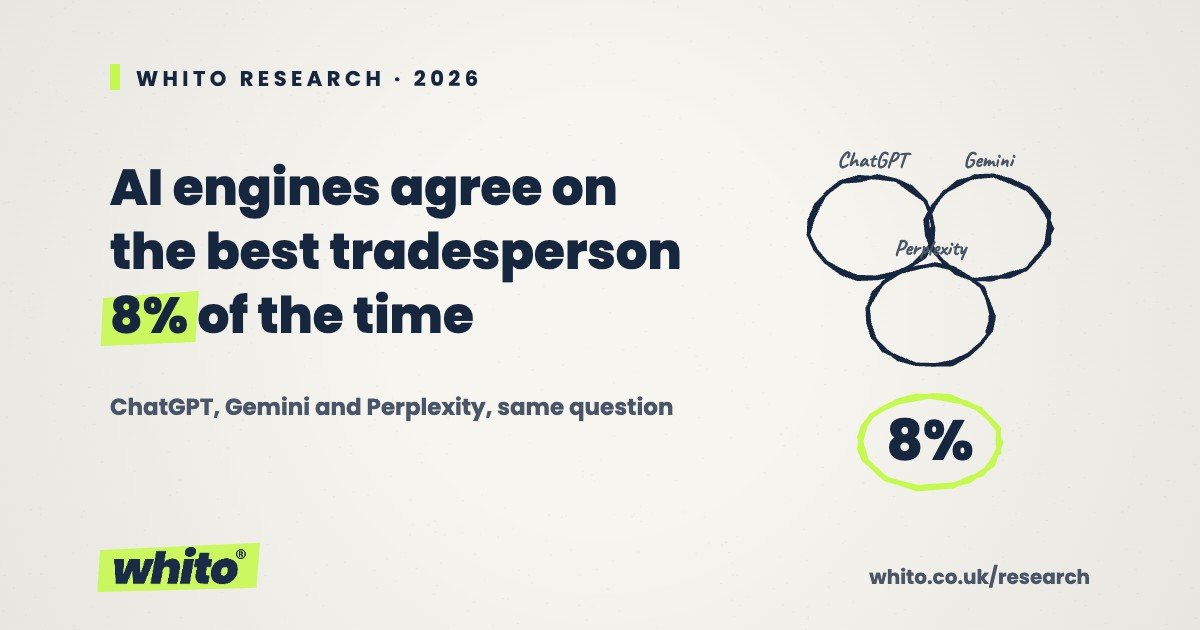
Two of three AI engines, ChatGPT, Gemini and Perplexity, agreed on the best UK tradesperson in just 1 of 12 identical questions, 8%, and 33 different businesses were named as top pick across 36 answers, in Whito's test on 30 June 2026.
Source: Whito, whito.co.uk/trades/research/ai-engines-disagree-best-tradesperson, June 2026. Free to quote with a link to this page.
Last Updated on October 7, 2026
Published by Whito Research · Last updated 9 July 2026 · Data checked July 2026
Across 36 answers the three engines named 33 different businesses, and they landed on the same top pick just once in twelve questions.
There is a comforting idea doing the rounds: that if you do the right things, the AI will start recommending your business. Owners are now asking how to “rank” in ChatGPT the way they once asked how to rank in Google.
The idea assumes there is a ranking to rank in. A settled answer that the machines agree on, which you can climb.
So we tested it. We asked the same plain question a customer would ask, across three popular AI tools, for four common trades in three English cities. One question, asked three ways, twelve times over.
The engines did not agree. Not loosely, not roughly. On eleven of the twelve questions, all three named a different business at the top. There is no shared league table behind the curtain. There are three different machines reading three different versions of the local high street.
Do AI chatbots give reliable local business recommendations? Not yet. This page is Whito’s original UK research data (2026). We asked ChatGPT, Gemini and Perplexity to name the best local tradesperson in 12 identical tests. All three agreed on the same business zero times, and any two agreed just once (8%). If you are asking whether you can trust ChatGPT to recommend a tradesperson, treat its answer as a starting point and verify the business yourself.
Key findings
- 12 identical questions (“Who is the best [trade] in [city]?”) put to 3 engines = 36 answers.
- The engines named a single shared top business in just 1 of 12 questions (8%). On the other 11, every engine picked someone different.
- All three agreed on the same top business in 0 of 12 questions.
- 33 different businesses were named as the number-one pick across the 36 answers.
- 94% of answers named a specific company; Perplexity declined to name anyone twice, pointing to directories instead.
- Tested trades: electrician, plumber, roofer, builder. Tested cities: Leeds, Manchester, Bristol.
The mistake most businesses are making
The mistake is treating AI search like Google search with a new coat of paint. In Google, there is broadly one results page. People argue about how to climb it, but everyone is looking at the same ladder.
AI tools do not work like that. Each one builds its answer in its own way, from its own mix of Google listings, review sites and trade directories, and then commits to a recommendation. Ask the same question of three tools and you get three different shortlists, with three different businesses on top.
Chasing “the AI ranking” is chasing something that does not exist. You would be optimising for a scoreboard that no two referees can agree on.
What we actually found
Take Leeds plumbers. We asked all three engines, word for word, who the best one was. Perplexity refused to name anyone and sent us off to Checkatrade and TrustATrader. ChatGPT picked Norton Plumbing. Gemini picked SKH Plumbing. Same question, same minute, same city, three different outcomes for a local business owner.
That pattern held almost everywhere. The only flicker of agreement in the whole study was Leeds electricians, where Perplexity and ChatGPT both led with SmartWired Electrical Contractor. Gemini ignored them and named Wired Electrical instead.
Here is every top pick we recorded.
| City & trade | ChatGPT | Gemini | Perplexity |
|---|---|---|---|
| Leeds | |||
| Electrician | SmartWired Electrical | Wired Electrical | SmartWired Electrical |
| Plumber | Norton Plumbing | SKH Plumbing | Declined |
| Roofer | The Family Roofing Company | DPR Roofing Leeds | Leeds Reliable Roofers |
| Builder | Priestley Construction | AKB Loft Conversions | PJ Building Services |
| Manchester | |||
| Electrician | AK Electrical Services | AMP Electrical Contractors | KHL Electrical Contractors |
| Plumber | Zodiac Plumbing & Heating | JB7 Plumbing and Heating | PlumbServNW |
| Roofer | Safeguard Roofing | Manchester Roofs Ltd | Right Choice Roofing |
| Builder | Zagros Builders Group | Schofield & Sons Ltd | Declined |
| Bristol | |||
| Electrician | Assured Electricians Bristol | MB Electrical | Brunel Electrical |
| Plumber | Emergency Plumber Bristol | P.J. Bryer Heating & Plumbing | Bristol Plumbing Service |
| Roofer | Hann Roofing Ltd | S.A.G Roofing Bristol | Bristol Roofs Ltd |
| Builder | Bristol Building Company Ltd | JAS Building Services | AMG Construction Ltd |
We checked a sample of the named businesses and they are real, trading firms with the review profiles the tools described. The disagreement is not the tools inventing companies. It is three tools genuinely choosing different real companies.
Three engines, three personalities
The way each tool answered tells you something useful about how it decides.
ChatGPT is the committer
It almost always pulled a business straight from the Google local pack, complete with a star rating and a phone number, and named a single winner even when it admitted “there isn’t one best”. If you want a tool that picks, it picks.
Gemini is the hedger
On the free Flash-Lite model it opened nearly every answer with “the best is subjective”, then surfaced a business from a Google Maps card. Once, for Bristol plumbers, it led with a firm rated 3.7 while the other engines were naming firms rated 4.9. Strong reviews were not a reliable shortcut to being named.
Perplexity is the hedger that sometimes won’t
It was the most likely to say it had “no live access” and push you towards Checkatrade, TrustATrader, Rated People or the Federation of Master Builders, then often name a firm anyway. Twice it named no one at all.
Why this matters for your revenue
If you sell to local customers, AI answers are becoming the first thing some of them see, before they ever reach Google. That makes “does the AI mention us” a real commercial question.
But the study shows there is no single front door to walk through. There are three doors, each opening onto a different shortlist, and a fourth (the directories) that several engines hide behind when they lose confidence.
The practical reading is not “give up”. It is “stop optimising for a scoreboard that does not exist, and fix the inputs all of them read from instead”. Every engine here leaned on the same raw material: Google Business Profiles, review counts and ratings, and a handful of trade directories. Those are the foundations. They are unglamorous, they are within your control, and they feed every machine at once.
There is no AI ranking to climb. There are shared inputs to get right, and three engines that each read them differently.
The sharp takeaway
Being recommended by AI is, right now, close to a coin toss that lands differently on each tool. You cannot win a ranking that does not exist. You can make yourself the obvious, well-reviewed, clearly-listed local business that every engine struggles to leave out. That is the same work that wins you customers without the AI. Which is rather the point.
How we did this
On 30 June 2026 we asked each engine the identical question, “Who is the best [trade] in [city]? Name a specific company,” for four trades (electrician, plumber, roofer, builder) across three cities (Leeds, Manchester, Bristol). That is 12 questions per engine and 36 answers in total. Engines tested were ChatGPT (free tier), Google Gemini (free, Flash-Lite) and Perplexity (free), each in a fresh session. We recorded the first business each engine named as its top pick, or marked the answer “declined” where it named none. AI answers vary by account, location, model and over time, so these results are a snapshot, not a fixed ranking, which is itself part of the finding.
Frequently asked questions
Do ChatGPT, Gemini and Perplexity recommend the same local businesses?
No. In our test of 12 identical questions, all three engines agreed on the same top business in none of them, and any two agreed in just one. On 11 of 12 questions, each engine named a different business.
How often did the AI engines agree on the best tradesperson?
Two of the three engines named the same top business in 1 of 12 questions (8%). All three never agreed. Across the 36 answers, 33 different businesses were named as the number-one pick.
Can you optimise your business to rank in AI search?
There is no single AI ranking to climb, because each engine produces a different answer. What you can do is strengthen the inputs all of them read from: your Google Business Profile, your review count and rating, and your presence on trusted trade directories.
Where do AI engines get their local recommendations?
In this study the engines drew on Google local listings and Maps cards, review sites, and trade directories such as Checkatrade, TrustATrader, Rated People and the Federation of Master Builders. Perplexity in particular often deferred to those directories rather than naming a business.
Are the businesses named by AI actually the best ones?
Not necessarily. The engines mostly reflect Google ratings and review volume, and they disagree with each other. One tool even named a firm rated 3.7 while others named firms rated 4.9 for the same question. “Named by AI” means visible to that tool, not verified as best.
Can I trust ChatGPT to recommend a tradesperson?
Use it as a starting point, not a verdict. In our 2026 UK test, ChatGPT, Gemini and Perplexity named 33 different businesses across 36 answers to the same 12 questions. Whichever name ChatGPT gives you, check the business is registered, insured and qualified before you hire.
Do AI chatbots give reliable local business recommendations?
Our UK research data says reliability is low. The three leading engines agreed on the best local tradesperson just 8% of the time, and our follow-up electrician study across 15 UK towns found AI tools recommending businesses that were dissolved or in the wrong town. Verify any AI recommendation against an official record such as Companies House.
More Whito research
Cite this research
Whito Research (2026). AI engines agree on the best UK tradesperson just 8% of the time. Whito. https://whito.co.uk/trades/research/ai-engines-disagree-best-tradesperson/
Key finding: Asked the same 12 best-tradesperson questions, ChatGPT, Gemini and Perplexity agreed on the top pick just 8 per cent of the time and named 33 different firms between them.
This is original Whito research. You are welcome to reuse these figures with a link to this page as the source.
Whito Data
The paid data underneath this study
This study stays free, with no gate and no email wall, and it always will. Whito Data is the deeper version of the same work: the method run at scale, repeated every quarter, with every business named and checked against the public register. It is priced for software vendors, lead platforms, franchisors, trade bodies and investors, not for the businesses we write about.
See Whito DataJacob’s take: Ask AI for “the best” local tradesperson and you get a guess (jacobwhitmore.com, 7 October 2026)
If your business is named here and you think we have a fact wrong, email hello@whito.co.uk and we will check it and correct it. If you want to respond, send us a statement and we will publish it alongside. Full detail: Corrections, right of reply and removals.