
Finding
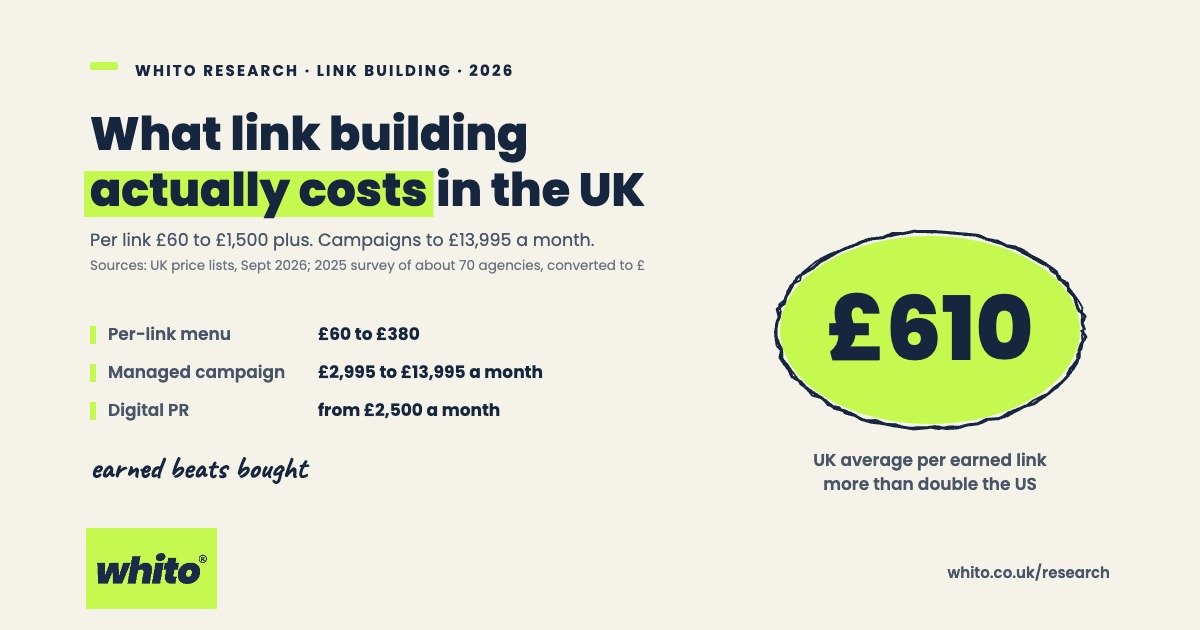
UK link building costs £60 to £380 per link from a published menu and £2,995 to £13,995 a month for managed campaigns, in Whito's September 2026 check of published UK prices, and UK survey respondents put an earned link at about £610.
Source: Whito, whito.co.uk/research/link-building-costs-uk, August 2026. Free to quote with a link to this page.
Last Updated on September 11, 2026
Per-link menus, monthly retainers, digital PR campaigns, and the risk most sellers never mention.
Updated 10 September 2026. Every UK price re-checked on the seller’s own page, survey figures converted to pounds, and one claim corrected. What changed is listed in the methodology section.
Link building is the strangest purchase in UK marketing. The prices are real and published. The surveys are recent, if some are small. And a good chunk of what is openly for sale breaks the rules of the search engine it is meant to impress.
This page sets out what link building costs in 2026, from published UK price lists and the main industry surveys. Then it explains the part most pricing guides skip: which of these purchases Google treats as spam, and what that means for your budget.
Executive summary
The short version. Links are sold three ways: per link from a menu (£60 to £380 each by authority tier), as a managed monthly campaign (£2,995 to £13,995 a month), or as digital PR (from £2,500 a month, or £4,950 a campaign). UK agencies and freelancers report a cost per earned link more than double the US figure. And the cheapest version of the product is the one most likely to be worthless or worse.
Key takeaways
A 2025 survey of around 70 digital PR agencies and freelancers, 54 per cent of them in the UK, put the UK average cost per earned link at about £610. The US figure was about £260. It is a small sample, but the gap is wide.
The spread between products is wide too. One link can cost £60 from a productised menu, roughly £230 to £700 a placement inside a published managed campaign, and roughly £400 to £1,000 a link from published digital PR prices. Those last two are Whito’s sums: each published price divided by the placement or link count the seller states. These are not the same product, and the difference is mostly about how the link came to exist, which is the thing Google’s rules care about.
The three ways links are sold
| Model | Typical price | What you are buying |
|---|---|---|
| Per-link menus | £60 to £380 per placement | A guest post or link insertion on a site chosen from an inventory, priced by authority score |
| Managed monthly campaigns | £2,995 to £13,995 a month | An agency researching, outreaching and reporting, with a placement count per month |
| Digital PR | From £2,500 a month, or £4,950 a campaign | A story or data asset pitched to journalists, earning coverage and links |
Ranges from published UK price lists and pricing pages, re-checked 10 September 2026. Sources in the methodology section.
Productised sellers price by Ahrefs Domain Rating or Moz Domain Authority. One large UK seller publishes the same ladder for guest posts and link insertions.
| Authority tier | Published menu price | Market guide range |
|---|---|---|
| DR 10 to 20 | £60 to £80 | £50 to £200 |
| DR 30 to 40 | £100 to £180 | £100 to £600 |
| DR 50 | £280 | £300 to £600 |
| DR 60 plus | £380 | £600 to £1,500 plus |
Menu prices from a UK productised seller’s live price list in pounds, re-checked 10 September 2026. Guide ranges from a London agency’s pricing guide dated April 2026, covering guest posts and link insertions; the same guide says placements on top publications can pass £1,500.
Notice the shape: on the menu, price nearly triples between DR30 and DR50, and the guide ranges sit well above the menu at the top tiers. A cheap DR60 link and an expensive one are usually different things wearing the same metric.
Monthly campaign pricing
UK agencies that publish managed campaign prices start between about £3,000 and £3,500 a month.
| Published UK tier | Price | Stated output |
|---|---|---|
| Entry managed campaign | £2,995 to £3,500 a month | At least 5 to 10 placements a month |
| Growth campaign | £4,495 to £5,500 a month | At least 10 to 16 placements a month |
| Scale campaign | £7,495 to £8,500 a month | At least 20 to 30 placements a month |
| Top published tier | £13,995 a month | At least 60 placements a month |
Published tiers from two UK sellers, re-checked 10 September 2026. Placement counts are the stated minimums, so the cost per placement works out at about £230 to £700 at most.
A London agency’s pricing guide puts link building for small businesses at £500 to £1,500 or more a month, and says larger high-authority campaigns can pass £4,000 to £8,000 a month. A link building company’s survey of 518 SEO professionals put the average minimum monthly budget to compete in highly competitive niches at about £6,290.
Digital PR costs
Digital PR earns links with stories rather than buying placements, and it is priced accordingly. Published UK figures: packages from £2,500 a month for a batch of 5 editorial placements, £4,950 per campaign from an agency guaranteeing an average of 10 links at DR50 plus, and campaigns from £3,500 at one large productised seller. At the top of the market, published project examples run from £18,500 for 28 links to £63,500 for 81 links in competitive sectors.
The 2025 survey put the average digital PR retainer at about £4,080 a month, with 52.5 per cent of contracts under about £3,740. A 2023 UK agency study of 500 campaigns found the average campaign earned links from 42 unique domains, and 5 per cent earned none at all. Digital PR is the defensible end of link building, and also the least predictable.
What the surveys say a link costs
Industry studies publish in US dollars, so the pound figures in this section are conversions, explained in the methodology section. For the wider dataset, see our UK link building statistics.
The 2025 digital PR survey is the one with a UK split. UK respondents put their average cost per earned link at about £610, against about £260 in the US and about £345 for everyone else. That makes the UK the dearest of the three groups the survey reports. It does not show the UK is the dearest in the world: around 70 people answered, and every country outside the UK and US was counted as one group.
Other studies look at different parts of the market. An older Ahrefs outreach experiment found only 12.6 per cent of the 450 sites it approached would sell a link, and those that would charged about £270 on average to insert one. A link building company’s survey of 518 SEO professionals, published March 2026, put the acceptable price for one high quality link at about £380. A marketplace dataset of 22,703 placements, published July 2026, averaged about £120, with a median of about £85.
Those numbers are not contradictory. They describe different markets: cheap marketplace placements at the bottom, negotiated editorial links at the top. The cheaper the link, the more likely it exists purely to be sold, which brings us to the part that matters.
The risk nobody prices in
Google’s spam policy is explicit. Its published list of link spam includes “buying or selling links for ranking purposes”, and goods or services count as payment as well as money. Paid links are only within the rules when marked with a sponsored or nofollow attribute, and Google says links marked that way “will generally not be followed”. Sites that break its policies “may rank lower in results or not appear in results at all”, and can receive a manual action.
Follow that through. A paid link that keeps to Google’s rules is declared, and Google generally does not follow declared links. So a link bought to lift rankings only does its job by breaking the rules. When Ahrefs checked the top 110,000 sites in 2020, only 0.01 per cent of their referring domains used the sponsored label.
There is a UK consumer law angle too. The CAP Code requires marketing communications to be obviously identifiable as such, and CMA guidance, updated in September 2025 with references to the DMCC Act, requires disclosure wherever content is paid for or incentivised. Undisclosed paid editorial is not just a Google problem.
None of this makes link building pointless. Google would not police paid links if links did not matter to rankings. It means the safe end of the market is the end where links are earned: digital PR, useful research and data, local press coverage, supplier and industry relationships. That is also the expensive end.
What moves the price
Authority tier. The main published variable. On one UK menu, a DR60 placement costs nearly four times a DR30 one: £380 against £100.
Your niche. In the July 2026 marketplace dataset, gambling placements averaged about £190 and finance about £165, roughly 55 and 35 per cent above the overall average. Competitive niches can also raise outreach costs.
What is included. Productised sellers include the article and basic guarantees, and one large UK seller publishes a lifetime link guarantee. Managed campaigns add research, outreach and reporting, which is where the money goes. Ask what happens if a link goes down.
Contracts. Published terms run from month to month up to a recommended minimum of six months. Month-to-month terms are published for both managed campaigns and digital PR, so treat a long lock-in as a price in itself.
Where your budget should go
Whito sorts marketing advice into three stages: Start, Build and Scale. Buying links belongs at the last one.
Start: under £500 a month. Do not buy links. At this budget the option on sale is per-link placements from a menu, the purchase Google’s policy describes. Spend it on the links no one can sell you: your Google Business Profile, consistent directory citations, your trade body, your chamber of commerce, local press when you have actual news, and suppliers and partners who already know you.
Build: £500 to £2,500 a month. Still mostly not links. Fix the site and the content that would make anyone want to link to you first. If your pages have nothing worth citing, bought links are scaffolding around an empty building. See our UK SEO costs study for what full SEO retainers buy at this level.
Scale: £2,500 plus a month. This is where published UK digital PR packages and managed campaigns start. If you buy at this level, buy earning, not placement: ask any agency to show you where their links came from, whether payment was involved, and how they would survive Google reading the emails.
Methodology and sources
First compiled August 2026. Every UK price was re-checked on 10 September 2026 on the seller’s own pricing page: a productised link seller in Staffordshire, two agencies publishing managed campaign tiers, and three digital PR specialists. Industry datasets: a 2025 digital PR cost survey of around 70 agencies and freelancers (54 per cent UK, 23 per cent US), a survey of 518 SEO professionals published March 2026 by a link building company, an older Ahrefs outreach experiment across 450 sites, a marketplace dataset of 22,703 placements published July 2026, a 2023 UK agency study of 500 digital PR campaigns, and a 2020 Ahrefs study of link attributes across the top 110,000 sites.
Figures those sources publish in US dollars are converted to pounds at HMRC’s monthly exchange rate for August 2026, 1.3367 US dollars to the pound, and rounded to the nearest £5 (nearest £10 above £1,000). Treat them as approximate. It is the same rate used on our UK link building statistics page, so the two pages agree. The cost per placement inside managed campaigns and digital PR packages is Whito’s arithmetic: the published price divided by the stated placement or link count. Google policy wording was checked on Google Search Central, and UK disclosure rules on ASA and CMA pages. Where sources conflict we show the range. Prices change, and this is general information, not advice for your situation.
What changed on 10 September 2026. The per-link menu now reads £60 to £380 in pounds; in August this page reported £72 to £456, the same digits the seller shows on its dollar price list. Published managed campaign tiers now run £2,995 to £13,995 a month (August: £2,500 to £14,000), and the lowest published digital PR package is now £2,500 a month (August: £2,750). Survey figures are now shown in pounds rather than dollars. One figure whose original survey is no longer online was removed. And we corrected the claim that the UK has the highest link prices in the world: the survey behind it compares the UK, the US and everyone else combined, so it supports the UK being the dearest of those three groups and nothing wider.
What to do next
Before spending anything on links, find out whether your site gives anyone a reason to link to it, and whether Google and AI engines can even read what you have. Both are cheaper to fix than a month of link building.
Is your business easy to find and easy to trust?
Run the free Whito Visibility Check. It shows you what customers and AI engines actually see. Free. Takes 3 minutes. No sales calls.
Common questions
How much does link building cost in the UK?
Published UK prices checked in September 2026: £60 to £380 per link on a productised menu depending on authority tier, £2,995 to £13,995 a month for managed campaigns, and digital PR from £2,500 a month or £4,950 a campaign. UK respondents to a 2025 industry survey put the average cost of an earned link at about £610, against about £260 in the US.
How much does a single backlink cost?
Anywhere from about £50 to over £1,500. A productised UK menu runs £60 to £380 by domain rating, and a London agency’s pricing guide says placements on top publications can pass £1,500. Industry studies put a negotiated link insertion at about £270, the price SEO professionals consider acceptable for one high quality link at about £380, and the average placement on one large marketplace at about £120.
Is buying backlinks against Google’s rules?
Buying or selling links for ranking purposes is on Google’s published list of link spam. Paid links are only within the rules when marked sponsored or nofollow, and Google says links marked that way will generally not be followed. Sites that break its policies can rank lower, drop out of results, or receive a manual action.
How much does digital PR cost in the UK?
Published UK prices start at £2,500 a month for a batch of 5 editorial placements, or £4,950 a campaign with an average of 10 links guaranteed. Published project examples run from £18,500 for 28 links to £63,500 for 81 links. A 2025 industry survey put the average digital PR retainer at about £4,080 a month.
Does my business need to buy links?
Usually not. Published UK managed campaigns and digital PR packages start at around £2,500 to £3,000 a month, and below that a link budget mostly buys per-link placements of the kind Google’s policy describes. Local businesses get more from their Google Business Profile, directory citations, trade bodies, local press and a site worth linking to. Paid campaigns belong at the Scale stage.
Related research: Digital PR costs UK · UK link building statistics · UK SEO costs · Are UK businesses overpaying for SEO? · PR and press release costs UK · UK marketing prices compared · UK Marketing Cost Index
The structural checks behind this research run on any website in about twenty seconds. Enter yours and read the full result on the page. Free, and we do not ask for your email.
Run the free Visibility CheckIf your business is named here and you think we have a fact wrong, email hello@whito.co.uk and we will check it and correct it. If you want to respond, send us a statement and we will publish it alongside. Full detail: Corrections, right of reply and removals.