Finding
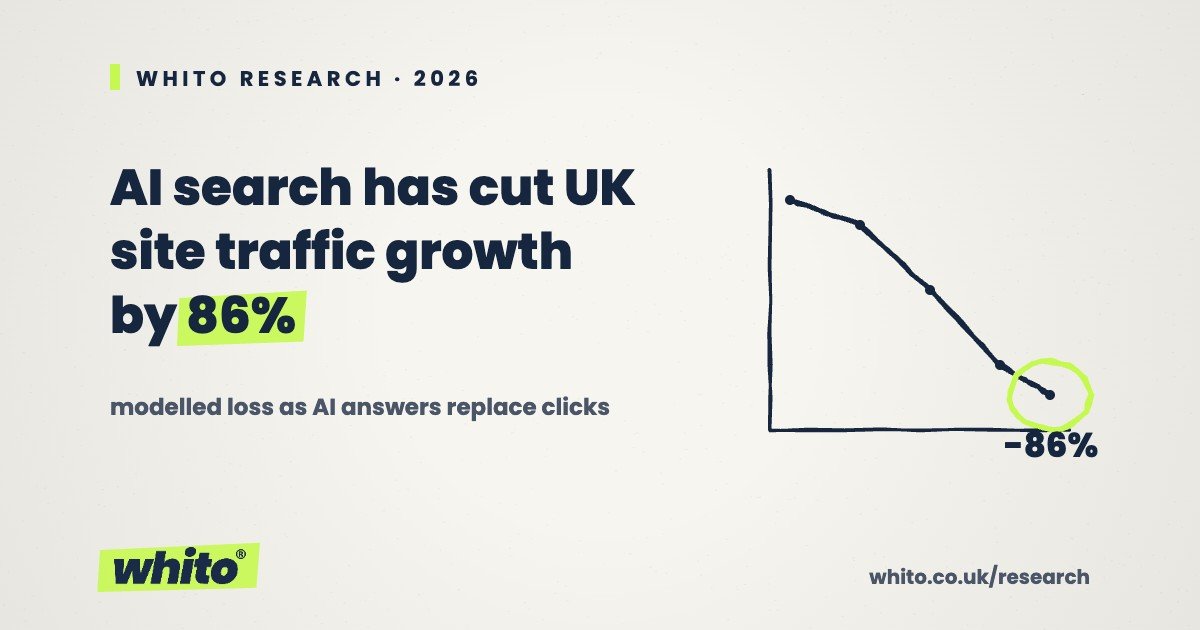
UK organic website traffic growth collapsed 86% in the year after AI search launched, falling from 26.3% average annual growth to 3.7% across 800 companies in 16 sectors, according to Tank data published in October 2025 and compiled by Whito.
Source: Whito, whito.co.uk/research/ai-search-uk-website-traffic-collapse, October 2025. Free to quote with a link to this page.
Last Updated on September 17, 2026
AI search has cut UK website traffic growth by 86 percent and most business owners cannot even see it happening
The uncomfortable argument
The SEO advice most UK businesses are still paying for is advice for a search engine that no longer exists.
For twenty years the deal was simple. You published a page, Google ranked it, people clicked, and you got a visitor. Rank higher, get more clicks. That was the whole game, and a generation of agencies, courses and freelancers were built on it.
That deal has quietly broken. Google now answers the question itself, at the top of the page, using your content, without sending anyone to your site. People read the answer and move on. The link you worked to rank is still there. Nobody clicks it.
Here is the part nobody is saying out loud to businesses. This is not a dip you wait out. It is a structural change in how being found online works, and the numbers are already brutal. Worse, the tools most owners use to measure their marketing cannot see most of what is now happening. You are being told traffic is “a bit down” when the foundation has moved.
This report sets out what the data actually shows, why your analytics are lying to you by omission, and what a small business should do about it. None of it requires a bigger budget. It requires fixing structure before chasing scale.
Key facts
Key takeaways
- UK organic traffic growth collapsed 86% in the year after AI search launched, falling from 26.3% average annual growth to 3.7%, across 800 companies in 16 sectors (Tank, October 2025).
- When Google shows an AI summary, people click through to a website in just 8% of searches, against 15% when there is no summary. That is a 47% drop in clicks (Pew Research Center, July 2025).
- Zero-click searches have risen from 56% to 69% of all Google searches since AI Overviews launched, and in Google’s AI Mode around 93% of sessions end with no click to any site (Similarweb, Semrush).
- Small publishers and small sites have been hit hardest, with search referral traffic down around 60% over two years for sites in the 1,000 to 10,000 daily views range (Chartbeat via Axios, March 2026).
- Standard analytics like GA4 capture only an estimated 30 to 40% of AI-driven visits, so the majority of AI-era discovery is invisible to most small businesses.
- The fix is not more blog posts. It is becoming the answer the AI gives, and measuring branded and direct traffic instead of raw rankings.
Contents
The UK numbers: an 86% collapse
The clearest UK picture comes from a study by the agency Tank, published in October 2025. It tracked organic traffic for 800 companies across 16 sectors, using Ahrefs data spanning three annual periods from August 2022 to August 2025, before and after Google launched AI Overviews in August 2024 and AI Mode in July 2025.
Average monthly organic traffic growth across all sectors fell from 26.3% the year before AI search to 3.7% the year after. That is a decline of 22.6 percentage points, or an 86% collapse in the rate of growth. Sites were not just growing more slowly. The engine that quietly added visitors every year had largely stopped.
Why nobody is clicking any more
The mechanism behind the UK collapse is visible in the click data. The Pew Research Center analysed the real browsing behaviour of 900 US adults in March 2025. Close to 6 in 10 of their searches returned an AI summary at the top of the page.
The effect on clicks was stark. When an AI summary appeared, users clicked through to a traditional website result in only 8% of searches. Without a summary, the figure was 15%. That is nearly half the clicks, gone, simply because Google answered the question itself. Clicks on the links inside the AI summary were rarer still, at 1% of visits. People were also more likely to give up and end their session entirely after seeing an AI answer.
Step back and the trend is industry-wide. Similarweb data shows zero-click searches, where the user gets what they need without leaving Google, rose from 56% to 69% after AI Overviews launched. In Google’s newer AI Mode, analysis from Semrush puts the share of sessions ending with no click at around 93%. The website is becoming the thing the AI reads, not the thing the customer visits.
| What changed | Before AI search | With AI search |
|---|---|---|
| Click to a website (per search) | 15% | 8% |
| Zero-click searches (all Google) | 56% | 69% |
| Sessions with no click (AI Mode) | n/a | around 93% |
| Session abandoned after the page | 16% | 26% |
Click and abandonment figures from Pew Research Center (US browsing data, 2025). Zero-click figures from Similarweb and Semrush. AI Mode figure is an industry estimate and will move as the feature rolls out.
Who is getting hit hardest
The damage is not spread evenly. The pattern is clear and it is bad news for exactly the businesses Whito works with: anyone whose customers start with a question.
In the Tank study, hospitality was the worst affected, with organic traffic actually shrinking by 6.7% in the year after AI search. Content-heavy and advice-led sectors, the how-to guides, the explainers, the “what does this cost” pages, saw some of the steepest drops, because those are precisely the questions an AI answer handles in full. IT and technology firms held up best, with growth slowing only slightly, because their buyers still click through to compare technical detail.
Separate analysis from Chartbeat, reported by Axios in March 2026, found that small publishers were hit hardest of all. Sites in the 1,000 to 10,000 daily page view range, which describes a great many small business websites, saw search referral traffic fall by around 60% over two years. Big brands with direct traffic and strong names absorbed the hit. Small sites that depended on Google to be found took the full force of it.
The blind spot: your analytics are lying to you
Here is the part that should worry owners most, and the reason this change has gone under-reported. The tools businesses use to judge their marketing cannot see most of what is now happening.
When ChatGPT recommends your business, when Gemini summarises your service, or when Perplexity cites your page, there is often no clickable link and no referral. Someone reads the answer, then types your name into Google or your address straight into the browser. In your analytics that shows up, if it shows up at all, as “direct” or “branded” traffic with no obvious cause. Industry estimates suggest standard GA4 setups capture only 30 to 40% of genuine AI-driven visits. Google only added a dedicated way to spot AI assistant traffic in May 2026, and most small business accounts are not configured to use it.
So the typical small business is flying blind in both directions. The old traffic is falling and they can see that. The new AI-era discovery is happening and they mostly cannot. An owner checks their dashboard, sees traffic “a little soft”, and concludes they need a few more blog posts. The real story, that the channel has fundamentally changed, is invisible on the screen they are looking at. The principle still holds: if you cannot measure it, do not fund it, but first you have to measure the right thing.
The reframe: stop trying to rank, start being the answer
This is where most reactions go wrong. The instinct is to fight harder in the old game: publish more, chase more keywords, buy more SEO. That is spending money to win a race that has moved to a different track.
The principle is the one Whito comes back to on everything. Structure before scale. Before you spend on tactics, fix what the business looks like to the system that now does the answering.
In an AI answer, there is usually one recommendation, not a page of ten blue links. The question is no longer “where do I rank”. It is “am I the business the AI names”. That is won by being clear, consistent and genuinely useful across the web: a sharp description of what you do and who for, real reviews, accurate listings, content that answers questions properly rather than padding for word count. The businesses AI recommends are the ones whose positioning is unambiguous. That is a structure problem, and structure is cheaper to fix than traffic is to buy. Our earlier work on how Google AI Overviews are changing UK search covers the mechanics, and the Start stage is where this work begins.
There is one piece of good news in the data worth holding onto. Visitors who do arrive after an AI answer convert at several times the rate of ordinary search visitors, because the AI has already done the explaining and the trust-building. Fewer visitors, but warmer ones. For a business, a handful of ready-to-buy enquiries beats a thousand browsers who bounce. The job is to make sure you are the name the AI hands them.
What a business should do now
- Stop judging yourself on rankings and raw traffic alone. Watch branded searches, direct traffic and actual enquiries. Those are where AI-era discovery now shows up.
- Make your positioning unmistakable. One clear line on what you do, who for, and where. AI recommends businesses it can describe confidently. Vagueness gets skipped.
- Get your basics consistent everywhere. Name, services, location and reviews should match across your site, Google Business Profile and the main directories. Mixed signals get filtered out.
- Answer real questions properly. Pages that genuinely answer what customers ask are what AI pulls from. Thin, padded content is now worthless on both tracks.
- Measure what matters: profit, not vanity. If enquiries and sales hold up while raw traffic falls, you are winning the new game. Do not panic over a metric that has stopped meaning what it used to.
- Fix structure before you spend. Do not buy more SEO or more posts until the foundation above is solid. Scaling a weak structure just wastes money faster.
Cite this research
Whito Research (2026). AI Search Has Cut UK Website Traffic Growth by 86%, and Most Owners Cannot See It Happening. Whito. https://whito.co.uk/research/ai-search-uk-website-traffic-collapse/
Key finding: Modelled on current click-through data, UK websites face losing up to 86 per cent of traditional search traffic as AI answers replace clicks.
This is original Whito research. You are welcome to reuse these figures with a link to this page as the source.
Methodology and sources
Compiled by Whito in June 2026 from the most recent available studies on AI search and click behaviour. UK traffic figures are from Tank’s “Google AI Search Shift Report” (October 2025), covering 800 companies across 16 sectors using Ahrefs data from August 2022 to August 2025. Click and session figures are from the Pew Research Center analysis of 900 US adults’ browsing data (March 2025, published July 2025). Zero-click figures are from Similarweb and Semrush. Small-publisher decline is from Chartbeat data reported by Axios (March 2026). The analytics blind spot reflects current GA4 measurement guidance and Google’s May 2026 AI assistant traffic update. Figures combine UK and US data; US studies are the most robust available on click behaviour and are widely treated as a leading indicator for the UK. Treat the combined estimates as directional benchmarks, not precise measurements, and check the dated primary sources for detail.
Common questions
How much has AI search cut UK website traffic?
UK organic traffic growth collapsed 86% in the year after AI search launched, from 26.3% to 3.7% average annual growth, across 800 companies in 16 sectors (Tank, 2025).
How much do AI answers reduce clicks?
When Google shows an AI summary, people click through in just 8% of searches versus 15% without, a 47% drop (Pew, 2025). In Google’s AI Mode around 93% of sessions end with no click.
Why can I not see AI’s impact in my analytics?
Tools like GA4 capture only an estimated 30 to 40% of AI-driven visits, so most AI-era discovery is invisible. Measure branded and direct traffic instead of raw rankings.
The structural checks behind this research run on any website in about twenty seconds. Enter yours and read the full result on the page. Free, and we do not ask for your email.
Run the free Visibility CheckIf your business is named here and you think we have a fact wrong, email hello@whito.co.uk and we will check it and correct it. If you want to respond, send us a statement and we will publish it alongside. Full detail: Corrections, right of reply and removals.