Data last verified: 2 November 2026. Figures re-checked against their primary sources under the Whito rolling re-verification programme.
Finding
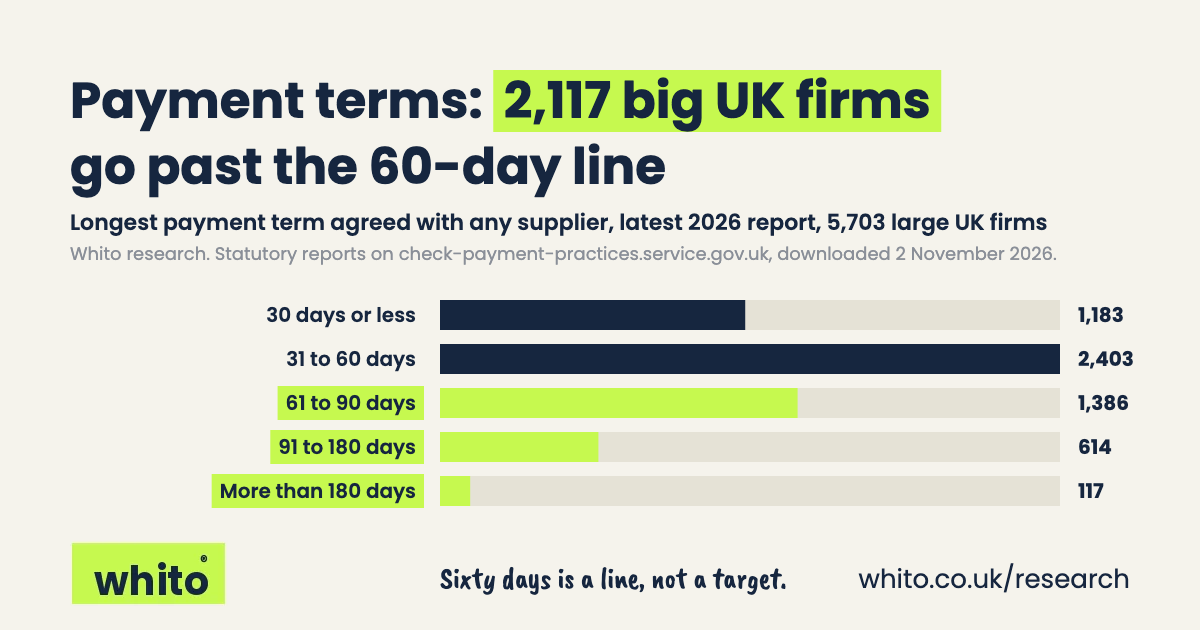
On 2 November 2026, 2,117 of 5,703 large UK firms (37%) with a 2026 report on the government’s payment practices register said they had agreed at least one supplier contract with payment terms longer than 60 days, the cap proposed in the Commercial Payments Bill.
Source: Whito, whito.co.uk/research/60-day-line-payment-terms, 2026-11-02. Free to quote with a link to this page.
Last Updated on November 2, 2026
Read: 2 November 2026. Every payment report on the government’s register, 116,697 of them, and the latest one for each of 6,110 large UK companies and LLPs whose reporting period ended in 2026. Every figure on this page comes from the firms’ own statutory reports. We name no firm on this page. You can look up any company on the free government register, and the full company-level file is available on request. If you think a figure here is wrong, tell us and we will check it against the register and correct the page, free of charge.
A new law before Parliament would cap how long a business can make its suppliers wait. The Commercial Payments Bill, introduced in May 2026, sets a maximum payment term of 60 days, with strictly limited exemptions. It has no start date yet.
So we asked a simple question: how many large UK firms already go past that line? Every large company has to tell the government, twice a year, the longest payment term it agreed in any supplier contract. On 2 November 2026, 2,117 of 5,703 large UK firms (37%) said they had agreed at least one supplier contract with payment terms longer than 60 days. In manufacturing it was 678 of 932, nearly three in four.
The one-minute brief
- 2,117 of 5,703 large UK firms (37%) report a maximum contractual payment term of more than 60 days. 731 go past 90 days. 580 reach 120 days or more.
- A further 1,957 sit exactly on the line, at 60 days. Only 1,183 keep every contract at 30 days or less.
- Manufacturing is most exposed: 678 of 932 firms (73%) go past 60 days. Wholesale and retail is next: 476 of 774 (62%).
- Firms past the line also pay more slowly. Their median firm pays 39% of invoices within 30 days and averages 41 days. For firms at 60 days or less it is 76% and 27 days.
- Payment codes do not rule it out: 59 of the 360 firms that name a payment code in their report still report a maximum term over 60 days.
Method: latest report per company number on the government’s payment practices register, period ending in 2026, downloaded 2 November 2026; industry from Companies House. Free to quote with a link. The working data behind our studies is sold as files →
What we did
Large UK companies and LLPs must publish a payment practices report every six months on check-payment-practices.service.gov.uk. Each report gives the average time taken to pay invoices, the share paid within 30, 31 to 60 and over 60 days, the share paid later than agreed terms, the firm’s standard payment terms, and the maximum contractual payment period: the longest payment term the firm agreed with any supplier in that period.
On 2 November 2026 we downloaded the register’s full export: 116,697 reports from 10,302 company numbers. For each company we kept its latest report and then only those whose reporting period ended between 1 January and 2 November 2026. That gave 6,145 companies. We set aside 35 reports whose stated period ends after the date they were filed, which cannot be right, leaving 6,110.
Of those, 5,703 give a usable maximum term in days. The other 407 left it blank (402) or entered zero (5). Those 5,703 firms are the base for every share on this page.
We added each firm’s industry from its first SIC code in the Companies House company data file dated 1 November 2026, matched on company number. SIC codes are the government’s industry labels. 215 of the 5,703, mostly LLPs, have no SIC code and appear as “not known”.
To check our copy of the data, we drew 30 reports at random and compared our figures with the report pages on the register. The maximum term, average days to pay and share paid within 30 days matched in all 30.
The 60-day line: how far payment terms run
The most common answer is exactly 60 days. The next most common are 30 days and 90 days. Here is how the 5,703 firms spread out.
| Longest payment term agreed | Firms | Share |
|---|---|---|
| 30 days or less | 1,183 | 21% |
| 31 to 45 days | 402 | 7% |
| 46 to 60 days | 2,001 | 35% |
| 61 to 90 days | 1,386 | 24% |
| 91 to 120 days | 423 | 7% |
| 121 to 180 days | 191 | 3% |
| More than 180 days | 117 | 2% |
The bold rows are the 2,117 firms past the line. 71 report a maximum of a year or more. Some of those add a note in their report saying the longest terms cover a small number of special arrangements, such as annual billing or stock held on credit. The Bill’s exemptions may cover some of these cases. We cannot tell which from the register alone.
Which industries are most exposed
Industries with at least 30 reporting firms, ranked by the share whose longest agreed term is more than 60 days.
| Industry (SIC section) | Firms | Over 60 days | Share | Median days to pay |
|---|---|---|---|---|
| Manufacturing | 932 | 678 | 73% | 45 |
| Wholesale, retail and motor trade | 774 | 476 | 62% | 37 |
| Agriculture, forestry and fishing | 36 | 19 | 53% | 30 |
| Water, sewerage and waste | 62 | 30 | 48% | 36 |
| Other services | 106 | 37 | 35% | 31 |
| Transport and storage | 232 | 74 | 32% | 35 |
| Accommodation and food | 134 | 42 | 31% | 36 |
| Professional, scientific and technical | 435 | 135 | 31% | 31 |
| Information and communication | 444 | 135 | 30% | 28 |
| Construction | 377 | 107 | 28% | 33 |
| Mining and quarrying | 91 | 23 | 25% | 32 |
| Administrative and support services | 550 | 132 | 24% | 27 |
| Electricity and gas supply | 147 | 33 | 22% | 25 |
| Real estate | 64 | 10 | 16% | 27 |
| Arts and recreation | 64 | 10 | 16% | 28 |
| Health and social work | 132 | 18 | 14% | 27 |
| Finance and insurance | 607 | 78 | 13% | 22 |
| Education | 288 | 19 | 7% | 25 |
Manufacturers and retailers sit in the middle of long supply chains. They are often paid slowly by their own customers and pass that wait down the line. Finance and education sit at the other end: 13% and 7% past the line.
Long terms, slower payment
A long maximum term is the longest contract a firm agreed. It does not mean every supplier waits that long. But the firms past the line also pay more slowly overall, on their own figures.
| Median firm | Longest term over 60 days | 60 days or less |
|---|---|---|
| Average days to pay an invoice | 41 | 27 |
| Invoices paid within 30 days | 39% | 76% |
| Payments made later than agreed terms | 17% | 14% |
433 of the 5,703 firms report an average time to pay of more than 60 days. 340 of them also report a maximum term past the line.
Payment codes and the line
Each report asks whether the firm takes part in a payment code, such as the Fair Payment Code. 360 of the 5,703 firms name one. 59 of those 360 still report a maximum term over 60 days. The maximum term can come from a single special contract, so this does not show any firm breaking its code. It does show that membership and long terms can sit side by side.
What this means if you supply large firms
- Look up your biggest customers. Search each one on the government register. Check its maximum term and its average days to pay. It takes two minutes per customer.
- Price for the wait. If a customer’s terms run past 60 days, that is cash you fund. Build it into the price or the payment terms you accept.
- Do not count on the Bill yet. It is not law, it has no start date, and it has exemptions. Today your contract decides when you are paid.
- Know your rights now. Late payment interest already exists under the 1998 Act. See our guide to late payment in the UK.
What this means if you are a large buyer
- Count your contracts over 60 days. If your own report says your maximum term is over 60, the Bill as introduced could mean rewriting those contracts or relying on an exemption, depending on its final wording and start date.
- Expect questions. Your figures are already public, and suppliers can read them. The Bill would also give the Small Business Commissioner powers to investigate persistently poor payers.
Limits
- Every figure is the firm’s own report. We have not audited any of them.
- The maximum term is the longest term agreed with any supplier. It can apply to one contract. It is not the term most suppliers get.
- Groups report entity by entity, so one group can appear several times.
- Reporting periods differ. Most ended in June 2026 (3,636 firms, nearly all on 30 June) or in September 2026 (1,193 firms).
- The Bill’s final wording, thresholds and exemptions could change. Nothing here says any firm is breaking a law.
- Industry comes from each company’s first SIC code, which is self-declared.
Common questions
How many large UK firms use payment terms longer than 60 days?
On 2 November 2026, 2,117 of 5,703 large UK companies and LLPs (37%) with a 2026 report on the government’s payment practices register said they had agreed at least one supplier contract with payment terms longer than 60 days. 731 reported more than 90 days.
What does the Commercial Payments Bill say about payment terms?
The Bill, introduced to Parliament in May 2026, would set a maximum payment term of 60 days between businesses, with strictly limited exemptions. It would also make interest at 8% above the Bank of England base rate mandatory on late payments. It is not yet law and has no start date.
Which industries have the longest payment terms?
Manufacturing: 678 of 932 large manufacturers (73%) reported a maximum contractual payment term over 60 days in their latest 2026 report. Wholesale and retail followed with 476 of 774 (62%). Education (7%) and finance and insurance (13%) had the lowest shares.
How do I check a company’s payment terms?
Search the company on check-payment-practices.service.gov.uk, the free government register. Its latest report shows its maximum contractual payment period, standard payment terms, average days to pay and the share of invoices paid within 30, 60 and more days.
For finance and credit teams
We build company-level files to order: every firm in your customer list or sector with its maximum term, standard terms, average days to pay and last four reports, checked against the register. £1,280 per file, bought outright, scope agreed in writing first. No VAT is added.
Buying a file does not change anything on this page. Nobody pays to appear, or to be left out. Ask for a file →
Download the data
Industry-level counts and medians: whito-60-day-line-sectors-2026-11-02.csv. Free to reuse with a link to this page. If you spot an error, tell us through our corrections page.
Cite this research
Whito Research (2026). The 60-Day Line: Large UK Firms’ Payment Terms Against the Commercial Payments Bill. Whito. https://whito.co.uk/research/60-day-line-payment-terms/
Key finding: On 2 November 2026, 2,117 of 5,703 large UK firms (37%) with a 2026 report on the government’s payment practices register said they had agreed at least one supplier contract with payment terms longer than 60 days, the cap proposed in the Commercial Payments Bill.
The structural checks behind this research run on any website in about twenty seconds. Enter yours and read the full result on the page. Free, and we do not ask for your email.
Run the free Visibility CheckIf your business is named here and you think we have a fact wrong, email hello@whito.co.uk and we will check it and correct it. If you want to respond, send us a statement and we will publish it alongside. Full detail: Corrections, right of reply and removals.