Last Updated on October 15, 2026
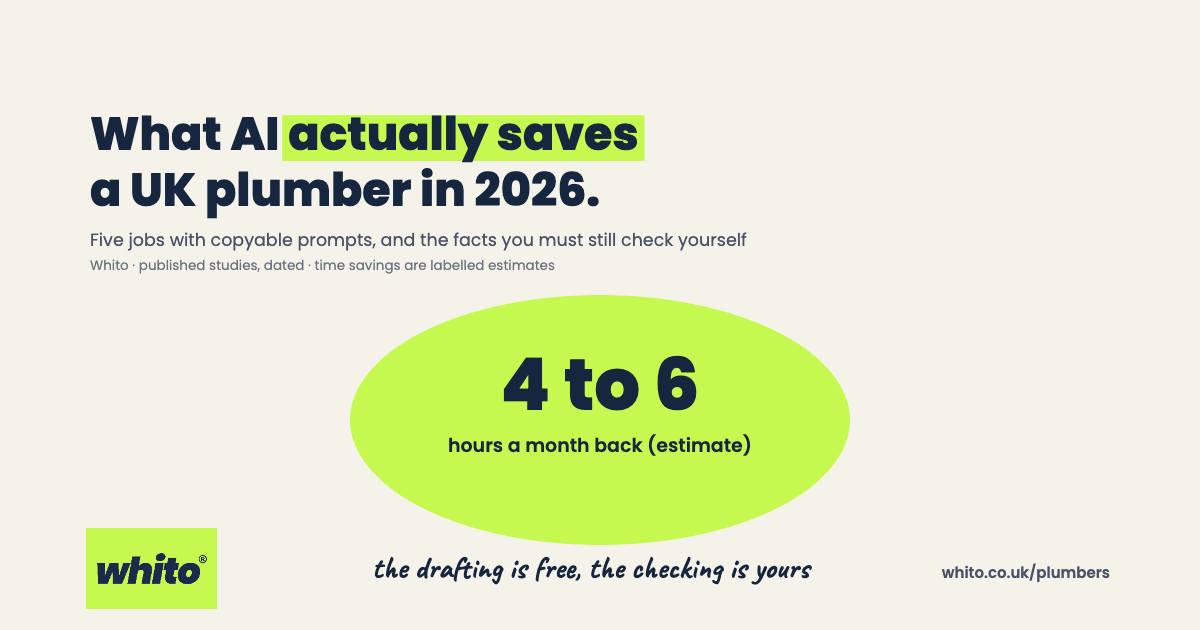
The short answer: AI can take a working UK plumber’s admin and marketing writing from hours to minutes: service pages, quote write-ups, review replies and customer messages are all first-drafted in under five minutes each. We estimate four to six hours a month back for a sole trader who currently does this writing, or avoided spend of £200 to £500 a month against Whito’s published planning budget if it was being paid for. The caveat that matters: AI drafts words well and invents facts confidently, so your prices, your Gas Safe number, your company details and your claims get checked by you, every time.
Sources: every figure below comes from a published Whito study, with its date beside it. Time savings are Whito estimates, labelled as such. Last checked 15 October 2026.
What the measured numbers say
Three Whito findings explain why AI matters to a plumber, and none of them are about writing speed.
First, the engines are already recommending plumbers, inconsistently. ChatGPT and Gemini named 75 different plumbers across 12 UK cities from one identical prompt, and not one of their 24 answers linked the Gas Safe Register (UK Plumber Statistics, 2026). Asked for the best plumber in three towns, three engines never named the same firm.
Second, what they cite is yours to control. Across 159 AI answers, 90% cited the business’s own website, 81% cited Google reviews or Business Profiles, and 98% rested on one or both (what AI actually cites, August 2026). For trades specifically, Checkatrade appeared in 50 of 60 answers. The engine is mostly summarising your own website and your Google profile. Better pages in, better recommendations out.
Third, the bar is low. 117 of 179 emergency plumber websites checked across eight UK towns published no call-out price at all, and only 24 published a figure in pounds, running £50 to £190 (emergency call-out price study, 2 October 2026). And of 23 plumber sites presenting as a limited company in a separate October check, 4 showed no company number (company numbers study, 14 October 2026). A plumber who publishes a clear from-price, a visible Gas Safe number and a correct company number is ahead of most of the trade before AI writes a word.
For scale: the published median for a small business website build is £520 one-off (Whito dataset, June 2026), the DIY route runs roughly £130 to £250 a year all in (plumber website guide), and Whito’s planning budget for a sole trader plumber’s marketing is £200 to £500 a month (May 2026, on the plumbers hub).
Five jobs to hand to AI this week
Each job below has a prompt you can copy, what to check before anything goes live, and an estimated time saving. The estimates are ours, from drafting these tasks with AI; they are not a timed study.
1. Service pages that state the job and the price
One page per service you actually sell: boiler repair, bathroom installation, emergency call-out, landlord certificates. Most plumber websites have one vague “services” page; the engines cite specific pages.
Prompt: “Write a 300-word web page for a plumber in [town] about [service]. Plain British English, short sentences, no marketing cliches. Include what the job involves, how long it typically takes, and leave a clearly marked gap where I will add my own from-price. Do not invent any prices, qualifications or company details.”
Verify before publishing: the from-price is yours, the areas covered are real, and nothing on the page claims a qualification you do not hold. Estimated saving: an hour or more per page, five minutes of checking.
2. Quote write-ups that win the job
You price the job; AI turns your notes into a clear written quote the customer can compare. The call-out study found the commonest published claim is “no call-out charge” with no rate alongside it, which is exactly the ambiguity a written quote beats.
Prompt: “Turn these notes into a short written quote for a customer: [your notes, with your prices]. Itemise labour, parts and VAT treatment separately. State what is included and what is not. Friendly, plain, no padding.”
Verify: every number is the one you set, VAT is stated the way you actually charge it, and exclusions are complete. Estimated saving: 15 to 20 minutes per quote.
3. Review replies, especially the hard ones
Your Google profile fed 81% of AI answers in the citation study, and reply quality is part of what a profile says about you. AI drafts a calm reply to a bad review faster than you can type an angry one.
Prompt: “Draft a reply to this Google review of my plumbing business: [paste review]. Thank them, address the specific point, no excuses, no legal admissions, offer to put it right if that is genuine. Three sentences maximum.”
Verify: the facts of the job match your records, and you are not promising a remedy you will not deliver. Estimated saving: 10 minutes per reply, plus replies that actually get written.
4. FAQs and the schema behind them
The questions customers actually ask (do you charge a call-out fee, are you Gas Safe registered, how fast can you come out) belong on your site as an FAQ, with FAQPage structured data so machines can read it. AI writes both.
Prompt: “Write six FAQs for a plumber’s website covering call-out charges, Gas Safe registration, response times, payment and guarantees, using these facts: [your facts]. Then output valid FAQPage JSON-LD for the same questions. Do not invent any detail I have not given you.”
Verify: paste the JSON-LD into a schema validator, and read every answer against your real terms. If you are Gas Safe registered, your registration number appears as plain text on the page, not only in the markup. Estimated saving: two hours the first time.
5. Customer messages on repeat
Appointment confirmations, running-late messages, aftercare notes, payment reminders. Write each one once with AI, save them, reuse them for years.
Prompt: “Write five short text message templates for a plumbing business: booking confirmation, running late, job done with aftercare note, invoice sent, polite payment reminder. Under 50 words each, plain and friendly, with [bracketed] gaps for name, time and amount.”
Verify: the payment reminder states amounts and dates as gaps for you to fill, never as examples that could go out unedited. Estimated saving: an hour once, then minutes every week.
| Task | Without AI (typical) | With AI (draft plus your checks) |
|---|---|---|
| Service page | 1 to 2 hours, or not done | 10 to 15 minutes |
| Written quote from notes | 20 to 30 minutes | 5 to 10 minutes |
| Review reply | 10 to 15 minutes, often skipped | 2 to 5 minutes |
| FAQ page with schema | 2 to 3 hours, usually never | 30 minutes |
| Message templates (set of five) | An hour, usually never | 10 minutes |
Times are Whito estimates from doing these tasks with AI, not a timed study. The pattern holds even if your times differ: AI moves the hours from writing to checking, and checking is faster.
What AI must never invent
Every item here has appeared wrong in AI output Whito has tested. Check them by hand, every time.
Prices. AI engines ran a median 14% high on UK marketing services in Whito’s October 2026 accuracy check, and they are no better on trade prices. Every figure a customer sees is one you set.
Your Gas Safe registration. If you do gas work, your registration number appears exactly as it does on the Gas Safe Register, in plain text. Never let AI write “Gas Safe registered” into a page as filler: in Whito’s register study, AI engines recommending plumbers never linked the register once, so your own page is where the customer checks.
Your company details. If you trade as a limited company, the registered name and company number match your Companies House record exactly. AI will cheerfully invent an eight-digit number that looks right.
Legal and guarantee claims. “Fully insured”, “all work guaranteed for 10 years”, “approved by” anything: only if true, in your own words, with the paperwork behind it.
Free fixes first
Before any paid tool or any new spend, make your site say what the engines need to find. This is the same structural logic as Whito’s free Visibility Check, which will score you on it:
1. Gas Safe registration number in plain text on the site (if you do gas work), matching the register.
2. Company number and registered name visible and matching Companies House (if you are a limited company). 4 of 23 plumber sites presenting as Ltd failed this in October 2026.
3. A from-price for your common jobs, dated. 117 of 179 emergency sites publish nothing; publishing anything honest puts you in the cited minority.
4. Structured data: LocalBusiness schema with your real name, area and contact, plus FAQPage if you added FAQs.
5. Google Business Profile complete and current: categories, areas, hours, photos of real work, and reviews replied to. It fed 81% of AI answers.
All five are free. Run the Visibility Check after, and keep the result as your dated baseline.
Next steps: Start, Build, Scale
Start: do the free-fix list above, then use AI for the five jobs in this guide, in order. A sole trader needs nothing else this month and spends £0.
Build: once the pages exist and the profile is complete, put the £200 to £500 a month planning budget (May 2026 figure) behind what is working: a proper site if you are still on a Facebook page (published median build £520, DIY roughly £130 to £250 a year), and Google Ads only once your pages state prices, because a click that lands on a page with no price is money out.
Scale: for firms past one van. Repeat the service-page job per town you cover, keep prices and the register details current on a schedule, and re-run the Visibility Check quarterly, because the engines re-read your site and so should you.
One limitation, stated plainly: the time savings in this guide are estimates from Whito doing these tasks with AI, not measurements of working plumbers. The study figures around them (what engines cite, what emergency sites publish, who shows a company number) are measured and dated. If your own times differ, the order of the advice does not change.
Questions plumbers ask
Can AI write my website for me?
It can draft every page in an afternoon. You still supply and check the facts: prices, Gas Safe number, company details, areas covered. The published median for having a small business site built is £520 one-off (June 2026); the DIY route with AI drafting runs roughly £130 to £250 a year.
Will AI engines recommend my plumbing business?
They already recommend someone: 75 different plumbers across 12 cities in one Whito test. 98% of AI answers rested on the business’s own website, its Google presence, or both, so those two are where the work goes.
Should I publish my call-out price?
117 of 179 emergency plumber sites publish no price at all (October 2026). An honest, dated from-price puts you in the minority that a customer, and an engine, can actually cite. Publish the price you charge, not a loss-leader you argue about later.
Figures on this page: Whito published studies, dated beside each figure. Estimates are labelled as estimates. Free to read. Nobody pays to appear.