Finding
Microsoft Copilot and its partners cited whito.co.uk 17,400 times across 127 pages in the three months to 28 August 2026, while Bing sent 167 clicks in the same window, a ratio of 104 citations to one click, per Bing Webmaster Tools.
Source: Whito, whito.co.uk/research/do-ai-citations-drive-traffic, August 2026. Free to quote with a link to this page.
Last Updated on September 5, 2026
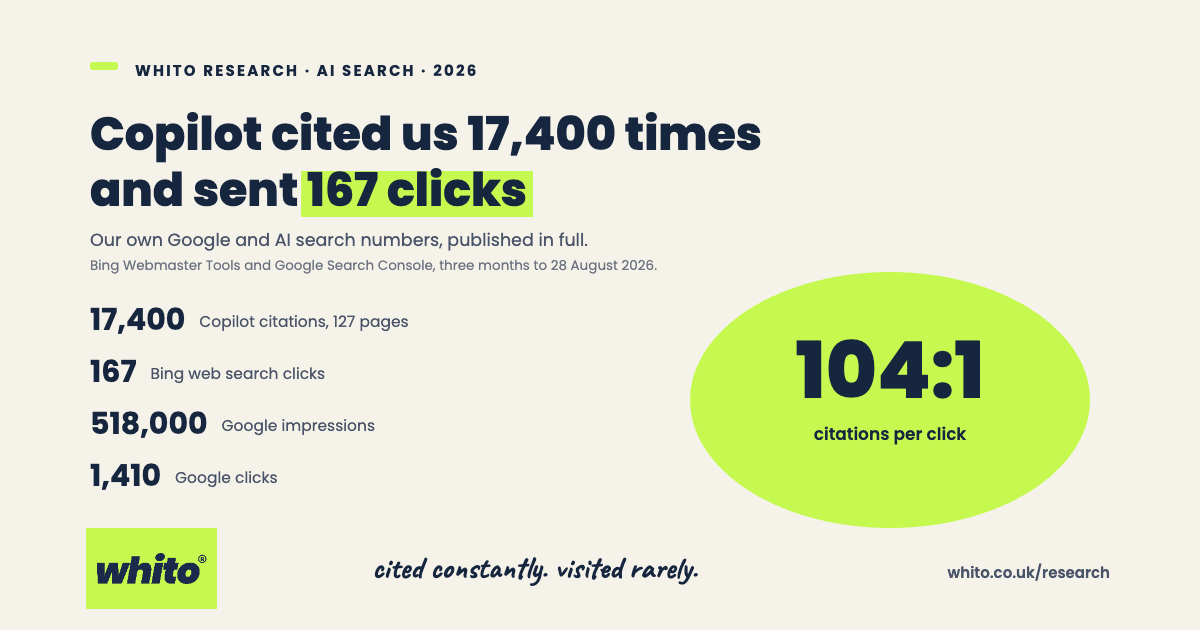
Whito’s own search and AI numbers, published in full. Google Search Console and Bing Webmaster Tools, both pulled 29 August 2026. Nothing here is modelled or estimated.
Everyone selling AI visibility right now is selling the same promise. Get cited by ChatGPT, Copilot and Google’s AI answers, and the traffic follows.
We have been building for exactly that since June. Structured answers, sourced figures, tables the machines can read, 731 published posts behind it. It worked. Over the three months to 28 August 2026, Microsoft Copilot and its partners cited this site 17,400 times across 127 pages.
Bing sent 167 clicks in the same three months.
Bing Webmaster Tools, 29 May to 28 August 2026, read 29 August 2026. Both figures cover the same window, so the ratio is a like-for-like comparison.
The mistake almost everyone is making
Treating a citation as a visit.
They are not the same event and they do not even happen in the same place. A citation is the machine reading your page and using it to answer somebody else’s question. A click is a person choosing to come and read it themselves. The first can happen two hundred times a day without the second happening at all.
We know that because it happened to us.
What the Copilot side actually looks like
Roughly 190 citations a day, across 317 distinct questions. The last time we read this report, on 23 July 2026, it showed 7,100 citations across 73 pages. Citations have since roughly doubled and the number of pages being drawn on has gone up by 54.
On some questions this site is the source Copilot leans on more than any other.
| Question put to Copilot | Citations | Our share |
|---|---|---|
| SaaS pricing tiers comparison GBP per month | 140 | 52.6% |
| most effective offline online advertising channels new high street cafe | 82 | 47.7% |
| small restaurant monthly marketing budget | 81 | 46.6% |
| Mailchimp UK company evaluation | 208 | 44.4% |
| marketing performance audit cost UK | 132 | 38.6% |
| online advertising costs for small businesses | 321 | 21.1% |
Bing Webmaster Tools, AI Performance report (beta), three months to 28 August 2026. Citation share is Bing’s own measure of our visibility against other sources on the same question.
The pages doing the work are almost all the same two shapes. Cost research with real figures, and tool reviews with real prices.
| Page | Copilot citations |
|---|---|
| Best payment processors for UK businesses | 1,500 |
| Shopify review | 1,100 |
| UK agency retainers | 720 |
| Website design costs UK | 714 |
| HubSpot review | 526 |
| Mailchimp review | 506 |
| Childcare nurseries leaderboard | 479 |
| UK PPC costs | 443 |
| UK business statistics | 415 |
| UK business software price index | 402 |
Not one opinion post in the top ten. Not one thought piece. The machine wants a number with a source on it, which is the single most useful thing we have learned in six months.
The Google side is the same story at scale
Google Search Console, three months to 27 August 2026:
518,000 impressions. 1,410 clicks.
A click-through rate of 0.3%, at an average position of 30.7.
Google Search Console, domain property, pulled 29 August 2026.
Half a million times this site was put in front of somebody. Fourteen hundred times somebody came.
Three months earlier the same report read 418,000 impressions and 1,170 clicks. Impressions grew by roughly a quarter. The click-through rate did not move at all. It has sat at 0.3% through every change we have made.
Bing behaves better on this measure, for what it is worth: 167 clicks from 10,400 impressions is a click-through rate of 1.6%. It is a much smaller pool, and the citations still outnumber the clicks a hundred to one.
We rebuilt 84 posts for AI search. Here is what it did.
On 22 June we upgraded 84 posts: structured answers near the top, sourced figures, schema, tables. We measured it on 20 July against the 27 days before.
| Measure | Before | After | Change |
|---|---|---|---|
| Site impressions | 85,800 | 142,000 | Up 65% |
| Site click-through rate | 0.30% | 0.28% | Down |
| Site average position | 37.4 | 28.9 | Up 8.5 places |
| Research section impressions | 24,300 | 51,500 | Up 112% |
| Research section click-through rate | 0.44% | 0.38% | Down |
Google Search Console, 27-day windows, 22 June to 18 July 2026 against 26 May to 21 June 2026.
Impressions up 65%. Position up more than eight places. Click-through rate down.
Eight of the upgraded pages returned 17 impressions and zero clicks between them across the whole 27 days.
Three other things shipped in that same window: a directory push, two new flagship pages, and a pass rewriting page titles. We cannot separate the rebuild from those. The direction is clear, the attribution is not, and anyone telling you they can cleanly attribute an AI-search uplift on a live site is guessing.
Three readings, and we cannot yet rule any of them out
The answer is the destination. The machine reads the page, gives the person the number, and the person has what they came for. No click needed. This is the reading we think is most likely, because the pages being cited are precisely the ones whose value is a single figure.
We rank in the wrong place. An average position of 30.7 is page three. Impressions at position 30 barely convert to clicks for anybody. Some of this is simply not ranking well enough yet.
The titles are not earning the click. We have rewritten titles twice and the rate has not moved off 0.3%, which makes this the weakest of the three, but it is not disproved.
Note what we are not claiming. One website is not a study. We are publishing our own numbers because almost nobody does, not because one site settles anything.
What to do if somebody is selling you AI visibility
Ask them which number goes up.
If the answer is citations, mentions, share of voice or AI visibility score, they are selling you the 17,400 and not the 167. Those are real, measurable numbers. None of them is revenue. We have a great deal of the first and almost none of the second, and we built the thing ourselves for free.
Before you spend anything on being cited, three questions in order:
Can somebody who lands on you actually buy? Getting cited more when nothing converts multiplies zero. That is a Start problem, and it comes first.
Do you know what a customer is worth? Without that you cannot price any channel, let alone a new one nobody has benchmarks for.
Is anybody asking a machine about your trade at all? Look at the questions above. They are cost questions asked by people researching a purchase, not people ready to buy one. For a local plumber the honest answer today is mostly no, and word of mouth still decides it. Build for the search that already exists before the one that might.
Being cited is worth having. It counts as brand and as reach, and on the evidence above it lands on pages that carry real figures with named sources. That is a decent argument for publishing your figures and naming your sources. Just do not let anybody price it as traffic.
Method
Copilot citations and Bing clicks both come from Bing Webmaster Tools for the verified whito.co.uk property, read on 29 August 2026. Citations are from the AI Performance report (beta), which Microsoft labels a sample of overall activity and which covers Copilot and its partners rather than every AI assistant. Clicks and impressions are from the Search Performance report. Both cover 29 May to 28 August 2026, so the ratio compares the same window on both sides. The earlier comparison figures, 7,100 citations across 73 pages, are from the same report read on 23 July 2026 covering 23 April to 21 July 2026.
Google figures come from the Search Console domain property, pulled 29 August 2026 for the three months to 27 August, and on 20 July for the 27-day comparison windows. Search Console data lags roughly two days. Comparison windows are equal length.
Post count taken from the site’s own content API on 29 August 2026. A wider set of our operating figures, updated as they change, sits on Whito in Numbers.
No figure on this page is modelled, projected or rounded up beyond the rounding Bing itself applies to its larger totals.
The takeaway
Citations roughly doubled in five weeks. Impressions went up 65% after the rebuild. Position improved by eight places. The click-through rate has not moved off 0.3% in three months and the revenue attached to all of it is nothing.
We are not going to stop building for AI search on the back of this. But nobody should be selling it to you as traffic, and that includes us.
Related reading: the UK AI Recommendation Integrity Report, on what those machines actually recommend, and our directory listings study, where 29 of 100 listings failed a Companies House check. You can also run the free visibility check on your own site; ours scores 48 out of 100.
Structure before scale. Get the thing people land on working first, then worry about how many machines are talking about it.
Corrections and challenges to any figure here go to hello@whito.co.uk. If a number on this page is wrong we will correct it on the page and date the correction.
The structural checks behind this research run on any website in about twenty seconds. Enter yours and read the full result on the page. Free, and we do not ask for your email.
Run the free Visibility CheckIf your business is named here and you think we have a fact wrong, email hello@whito.co.uk and we will check it and correct it. If you want to respond, send us a statement and we will publish it alongside. Full detail: Corrections, right of reply and removals.