
Last Updated on August 11, 2026
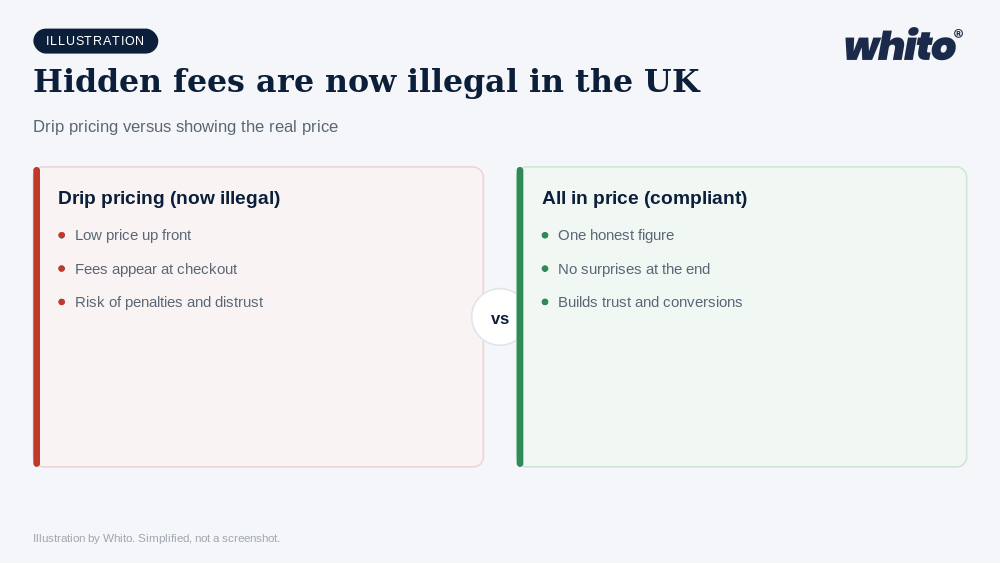
If your advertised price is not the price people actually pay, the rules just caught up with you. Under the Digital Markets, Competition and Consumers Act, drip pricing, the trick of adding unavoidable fees later in checkout, is now banned. And the regulator has started handing out penalties.
This is not a warning for some distant future. The first enforcement has already landed.
What the law now says
Two changes matter most for everyday UK businesses.
Drip pricing is out. If a fee is unavoidable, it has to be in the headline price, not sprung on the customer at the end. Booking fees, service charges, compulsory extras, all of it must be shown up front.
Fake reviews are illegal. Writing, commissioning or hosting fake or misleading reviews is now against the law, not just against a platform’s policy.
The Competition and Markets Authority can now act directly, without going to court first, and fine businesses up to 10 percent of worldwide turnover. In April 2026 it issued its first infringement notice for a substantive breach. The teeth are real.
Why this catches ordinary businesses
You do not have to be a dodgy operator to fall foul of this. Plenty of honest businesses advertise a tempting headline figure and add the unavoidable bits later, because that is how their booking system or their industry has always done it.
Intent does not matter here. If the real, unavoidable price is hidden until checkout, that is drip pricing, however innocent the reason.
| Practice | Status now | The fix |
|---|---|---|
| Headline price, fees added at checkout | Banned | Show the full unavoidable price up front |
| Compulsory booking or service fee hidden | Banned | Build it into the displayed price |
| Buying or posting fake reviews | Illegal | Earn genuine reviews, nothing else |
What to do about it
The good news is that the compliant way is also the way that builds trust and sells better.
Audit your own pricing. Go through your site and ads as a customer. Is the first number you show the number they pay? If not, fix it before someone else points it out.
Make honest pricing a selling point. Hidden fees breed distrust and refunds. A clear, all-in price wins the sale and the repeat custom. If you are not sure what to charge in the first place, our study of what UK marketing actually costs is a useful reference.
Keep reviews genuine. The same honesty rule runs through Google’s tightened policies too. We broke those down in Google’s new review rules.
The takeaway
The law has simply made honesty compulsory. Show the real price, earn real reviews, and none of this touches you. Keep the fees hidden, and you are now risking a fine on top of the trust you were already losing.