Last Updated on November 13, 2026
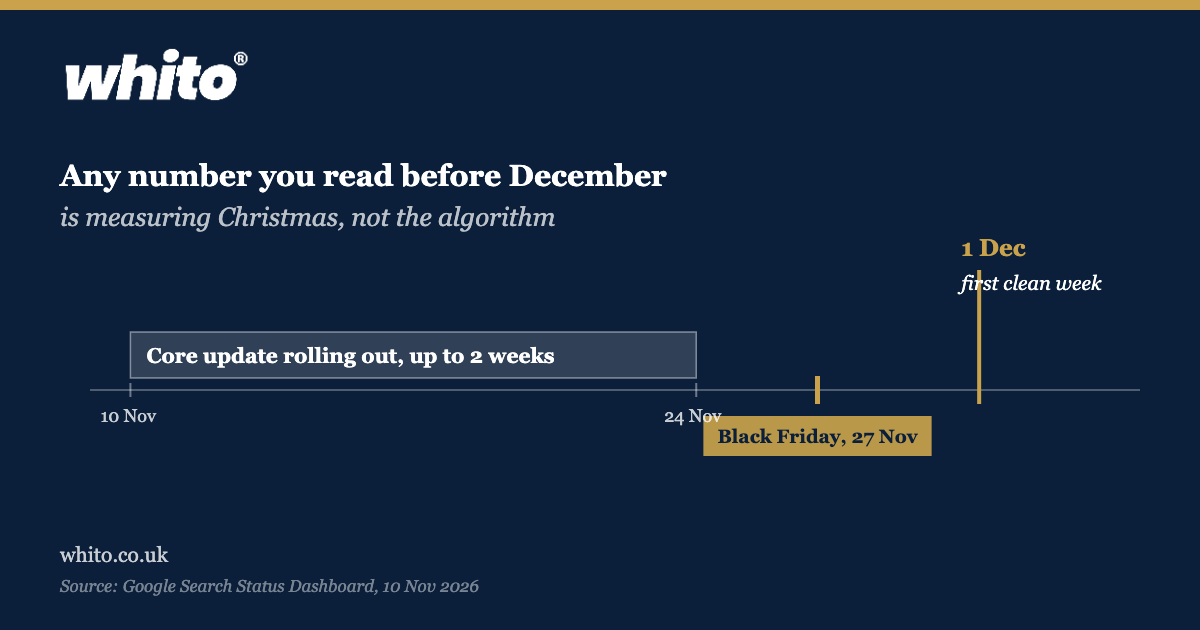
Google logged the November 2026 core update on its Search Status Dashboard on 10 November. Its own note reads: “Released the November 2026 core update, which applies globally and to all languages.” And then the line that matters: “The rollout may take up to 2 weeks to complete.”
Two weeks from 10 November lands around 24 November. Black Friday is 27 November.
Most UK businesses will handle this in one of two ways. They will ignore it, which is usually the right answer. Or they will watch their traffic wobble, decide they have been hit, and start rewriting pages in the middle of the busiest trading fortnight of their year.
The second group is the one that loses money, and not because of the update.
The mistake is not the ranking drop. It is the date you read it on.
Google’s published guidance on core updates is specific. “We recommend waiting at least a full week after a core update completes before analyzing your site in Search Console.” It also tells you what to compare against: “try comparing this week with a week before the core update started rolling out.”
Now work the dates through properly.
| Date | What it is | What you can honestly conclude |
|---|---|---|
| 10 November | Rollout starts, per Google’s dashboard | Nothing. This is your baseline week’s cut-off, not a result. |
| 24 November | Earliest finish if it uses the full two weeks | Still nothing. Google says wait a full week after it completes. |
| 27 November | Black Friday | Your traffic is abnormal on purpose. Nothing about the algorithm. |
| About 1 December | First clean full week of post-rollout data | Now you can compare, against the week before 10 November. |
Every comparison available to you before December sets a Black Friday or pre-Black Friday week against an ordinary November one. Whatever figure that produces, it is not a measurement of the core update. It is a measurement of Christmas.
This is the question worth asking of any number anybody shows you this month: what is it actually comparing? A 30 per cent swing between two weeks that are not alike tells you nothing, however confidently it is presented. If your reporting cannot answer that question, the report is the problem, not the algorithm. Our guide to what a monthly SEO report should show sets out the comparisons that do hold up.
Why the panic edits cost more than the update
Google is also clear on how long recovery takes. It “could take several months for our systems to learn and confirm” that a site is consistently producing helpful content, and “there’s no guarantee that changes you make to your website will result in noticeable impact in search results.”
Read that honestly and it cuts both ways. If you genuinely have been affected, nothing you publish on 20 November fixes it by 27 November. And if you have not been affected, which Google says is the common case, you have spent your best trading fortnight rewriting pages that were earning.
Google’s own wording: “In general, most sites don’t need to worry about core updates and may not even realize one has happened.”
Expect at least one call or email this fortnight offering urgent recovery work because of the update. Ask what evidence of impact they have, which weeks they compared, and whether the rollout had even finished when they ran the numbers. If the answers are vague, that is your answer. We set out the checks in how to tell if your SEO agency is working.
Three dates to write down today
10 November: the end of your baseline week. 24 November: the earliest the rollout can finish. 1 December: the first day you are entitled to an opinion.
What to do between now and December
Three jobs, and none of them involve touching your content.
1. Record your baseline now, before you forget. Export Search Console clicks and impressions for the week ending 9 November, broken down by page. Then export the same calendar week from last year. You need two baselines, one for the update and one for the season, because without the second you cannot tell them apart.
2. Split brand from non-brand. If searches for your company name hold steady while generic searches move, that is a ranking story worth investigating in December. If both move together, the cause is almost always demand, a promotion, the weather, or the calendar. Most small firms never separate the two, which is why they misread every update.
3. Keep trading. Answer the phone, reply to enquiries, fulfil orders, keep your opening hours and stock accurate. In the next fortnight those are worth more than any on-page change you could make, and they are the foundations a core update cannot take away from you.
If you want the wider context on how Google’s search changes are landing in the UK, we keep a running timeline of Google AI search changes and when they take effect. One more December date is worth pencilling in alongside 1 December: Google is due to publish AI search numbers on 3 December, which will matter rather more to most UK firms than this fortnight’s ranking wobble.
The takeaway
A core update is not an emergency. A bad measurement window is, because it makes you act on a number that was never telling you what you thought.
Do nothing clever for three weeks. Save your baseline, keep selling through your best fortnight of the year, and form your view on 1 December when the data can finally answer the question. The firms that lose out to this update will mostly not be the ones Google demoted. They will be the ones who redesigned their website during Black Friday on the strength of a comparison that never made sense.