
Last Updated on September 8, 2026

Google launched its May 2026 core update on 21 May. It is the second major algorithm change this year, following one in March. The rollout will take up to two weeks.
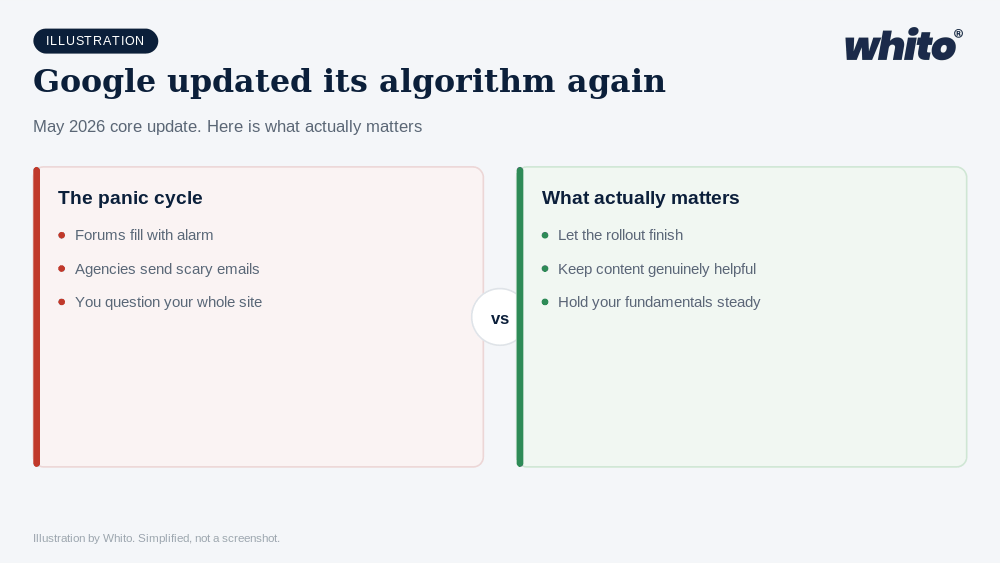
Every time this happens, the same cycle kicks off. SEO forums fill with panic. Agencies send alarming emails. Business owners start questioning everything about their website.
Most of that noise is wasted energy. Here is what is actually going on, why it matters, and what you should do about it.
What a core update actually is
A core update is Google recalibrating how it ranks pages. It is not a penalty. It is not aimed at one industry. It is Google adjusting which content it considers most useful for each search.
Think of it like this: the questions people type into Google have not changed. But Google is changing which answers it puts first.
That means some pages go up. Some go down. And most of the movement has nothing to do with anything you did wrong.
Why small businesses panic (and Shouldn’t)
The mistake most business owners make is reacting during the rollout. Rankings bounce around while the update is still rolling out. One day your page drops. The next day it recovers. Then it drops again.
That is not a signal. That is noise.
If you start rewriting pages, deleting blog posts, or stuffing keywords based on a few days of data, you are making changes to fix a problem that might not exist. Worse, you could break something that was working fine.
The principle here is simple: do not treat turbulence as a crash.
What to watch (and what to ignore)
During the rollout, keep an eye on three things in Google Search Console:
Clicks to your service pages. These are the pages that bring in enquiries, calls, and bookings. If those are steady, you are fine.
Impressions on your key search terms. This tells you whether Google is still showing your pages for the searches that matter.
Conversions, not just traffic. A dip in blog traffic is rarely a business problem. A dip in contact form submissions is.
Ignore daily ranking positions. Ignore generic traffic numbers. Ignore anyone telling you to “act now” before the rollout is even finished.
What Google actually wants
Google described this update as designed to “better surface relevant, satisfying content from all types of sites.” That phrase has not changed much in years, because the goal has not changed.
Google wants pages that:
- Answer real questions your customers ask
- Explain your services in plain language
- Show your experience and point of view
- Help someone make a confident decision
- Are written for people, not search engines
If your website already does this, a core update is not a threat. It is an advantage.
The businesses that get hurt by core updates are the ones running on thin content, copied descriptions, and pages that could belong to any company in their industry. If your service page reads like a template, Google has no reason to rank it above anyone else’s template.
What to do after the rollout finishes
Once the update settles (expected around 4 June), give it at least a full week of stable data. Then review.
Start with the pages that matter most. For most businesses, that means your service pages, your location pages, and your top-performing blog posts.
Ask yourself:
Is this page specific to my business, or could any competitor use the same words? Is the information current, or am I showing last year’s pricing and old process steps? Is the next step obvious, or does a visitor have to hunt for how to get in touch?
Most businesses do not need a full SEO overhaul after a core update. They need clearer descriptions, better calls to action, and content that sounds like it came from someone who actually does the work.
The Whito take
Core updates reward structure. They reward clarity. They reward businesses that have done the boring work of making their website genuinely useful.
If your site is built on solid foundations, clear messaging, helpful content, and an obvious path from visitor to customer, you do not need to panic every time Google changes its algorithm.
If your site is held together with thin content and vague service descriptions, this is the nudge to fix that. Not with tricks. With substance.
Structure before scale. Always.