

Last Updated on July 8, 2026
Most pricing guides online are written to make you book the company that wrote them. This one is not. Whito does not do electrical work, so we have no reason to talk the numbers up or down. Here is what UK electricians actually charge in 2026, what moves the price, and how to tell a fair quote from a bad one.
The mistake most people make when they get a quote
They ask one question: “how much per hour?”
It feels sensible. It is the wrong question. Two electricians can charge the same hourly rate and hand you quotes that are hundreds of pounds apart, because the hours, the parts, the certification and the call out terms all sit underneath that headline number.
The right question is “what is the total for this job, including parts, testing and certificate, and what would change it?” Price the job, not the hour.
What electricians charge in 2026
These are typical UK ranges. Treat them as a sense check, not a fixed menu. Your town, the age of your property and how urgent the work is will all move the figure.
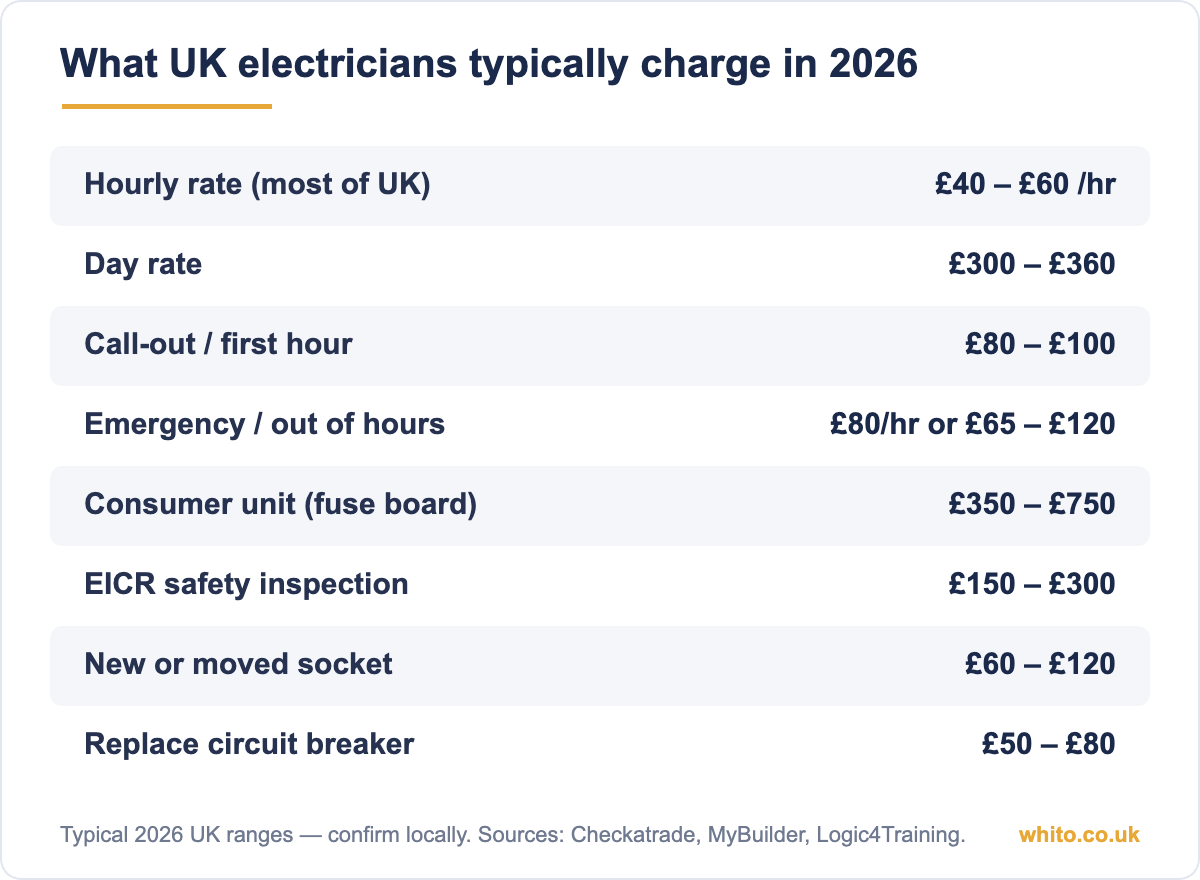
Hourly rate. Around £40 to £60 an hour across most of the UK. London and the South East sit at the top of that, often about a third higher than the national average.
Day rate. Roughly £300 to £360 for a full day, with an average near £330. Booking a day is usually better value than paying by the hour for anything that takes more than a couple of hours.
Call out fee. Many electricians charge a first hour or a minimum call out of about £80 to £100. This covers turning up and diagnosing the problem, and it is normal, not a rip off.
Emergency and out of hours. Expect £80 an hour or more, or a flat emergency fee often between £65 and £120. Evenings and weekends cost more because the electrician is giving up their own time.
What common jobs actually cost
Prices here include labour and standard parts for a typical domestic job. Complex properties cost more.
Consumer unit, the fuse board. Around £350 for a small terraced property up to £750 or so for a large detached home, with most jobs landing near £480 to £550. This is one of the most common upgrades and one of the most commonly overpriced, so get two quotes.
EICR, the electrical safety inspection. Around £150 to £300 for a typical home. Landlords need one every five years, so if a price looks very low, check whether the certificate and any minor remedial work are included.
Replacing a tripping circuit breaker. Around £50 to £80 for the part and fitting, assuming the electrician is already diagnosing the board.
New socket or moving one. Roughly £60 to £120 depending on whether the wall needs chasing out and making good.
Moving the consumer unit. Around £400, and closer to £2,000 or more if the incoming mains cable has to move with it. That jump surprises people, so ask early.
If your job is not here, the pattern still holds. Ask for the total, ask what is included, and ask what would push it up.
How to read a quote like you know what you are doing
A fair quote is boring in a good way. It tells you the total, lists the main parts, confirms testing and a certificate where the work needs one, and states the call out terms in writing.
Be careful with three things.
A price that is far below the others usually means something has been left out, often the certificate or the making good. Cheap now, expensive later.
A refusal to put the quote in writing is a quiet warning. Good electricians write things down because it protects them too.
No mention of certification on notifiable work, such as a new consumer unit or a rewire, is a real problem. That work has to be certified, and the certificate is what protects your insurance and your house sale.
Why the same job costs more in one town than another
It is not random. Higher demand areas, mainly London and the South East, carry higher labour rates because the cost of running the business is higher. Rural areas can cost more for a different reason, travel time to reach you.
None of this means you should hunt for the cheapest sparky in the county. The cheapest quote is not the goal. The fair quote from someone you can verify is the goal, and those are two different things.
The sharp takeaway
Do not shop for an hourly rate. Shop for a clear total, the right certificate, and someone whose business you can actually check.
An hourly rate tells you almost nothing. A written quote that prices the whole job, names the parts and confirms the certificate tells you almost everything.
Whito lists and verifies UK electricians against Companies House, so you can check a business before you let them near your fuse board. Find a verified electrician near you, or if you run an electrical business, claim your listing free.
Rates in this guide are typical 2026 UK ranges gathered from public cost data and should be confirmed locally. Sources: Checkatrade, MyBuilder, Logic4Training.
Related on Whito