
Last Updated on September 28, 2026
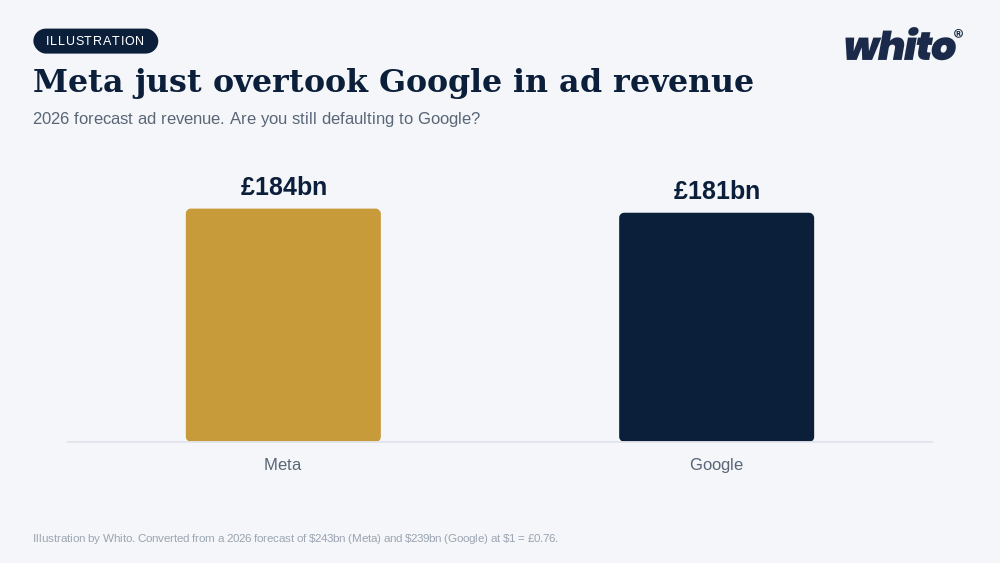
For the first time in the history of digital advertising, Meta is set to generate more ad revenue than Google in 2026. £179 billion ($243 billion) versus £176 billion ($239 billion), converted at HMRC’s September 2026 rate of £1 = $1.3554.
That is not a rounding error. That is a fundamental shift in where businesses are choosing to spend their money.
And yet, walk into any UK business and ask where they advertise online, and the answer is almost always the same: Google Ads.
What actually happened
According to EMARKETER data, Meta’s ad revenue is growing at 24.1% this year. Google is growing at 11.9%. For the first time, Meta will hold a larger share of global digital ad spend, 26.8% compared to Google’s 26.4%.
This is not about Facebook being trendy. It is about a structural change in how online advertising works.
Meta’s growth has been driven by Advantage+, its AI-powered ad system that automates campaign setup, audience targeting, and creative optimisation. Brands using Advantage+ are seeing 41% higher return on ad spend and 17% lower customer acquisition costs compared to manual campaigns.
Why this matters for UK small businesses
Most UK small businesses still treat Google Ads as the default. You set up a few keywords, write some ad copy, set a daily budget, and hope for the best.
That approach is not necessarily wrong. But it ignores what has changed.
On Meta’s platforms (Facebook and Instagram), 70 to 80% of ad performance is now driven by creative quality, not by budget or targeting. The algorithm does the heavy lifting on who sees your ad. Your job is to make something worth looking at.
For small businesses, this is actually good news. You do not need a massive budget to compete. You need good creative. A well-shot video on your phone, a clear before-and-after photo, a genuine customer testimonial. These outperform polished corporate ads on Meta every single time.
There is no minimum spend. You can start with a few pounds a day and see real results.
The mistake most businesses make
The biggest mistake is not choosing the wrong platform. It is never testing the alternative.
If you have been running Google Ads for years and never tried Meta, you are making a decision based on habit, not data. The reverse is also true, but given that most UK businesses default to Google, the missed opportunity is usually on the Meta side.
Google Ads works best when people are already searching for what you sell. If someone types “plumber near me” or “best accountant in Manchester”, Google is the right place to be.
Meta works best when people do not know they need you yet. It is discovery advertising. Someone scrolling Instagram sees your ad, thinks “I need that”, and clicks. The intent is created by the ad, not by the search.
Both have a place. But if you are only using one, you are leaving money on the table.
What to do about it
If you have never run Meta ads: Start small. Set a budget of three to five pounds a day. Use a simple image or short video (under 15 seconds). Point it at your best-selling product or service. Let it run for two weeks before you judge results.
If you are already running Google Ads: Do not stop. But take 10-20% of your monthly budget and test Meta alongside it. Compare the cost per lead or cost per sale. You might be surprised.
Focus on creative, not targeting. Meta’s AI handles targeting better than you can manually. Your competitive advantage is in the creative. Use real photos, real customers, real results. Avoid stock images and corporate language.
Track properly. Make sure you have the Meta Pixel installed on your website. Without it, you are flying blind. If you are not sure how, your website developer should be able to add it in minutes.
The bottom line
The advertising world just had its biggest power shift in a decade, and most UK business owners have not noticed.
Google is not going anywhere. But the assumption that Google Ads is automatically the best place for your money is no longer safe.
Test both. Measure both. Let the data tell you where your customers actually respond.
The businesses that will win are the ones willing to challenge their defaults. And right now, the data says Meta deserves a serious look.